
Last Stand of the White Men in Suits

HOUSE REPUBLICAN LEADERS. AP photo, 02-09-11

Not to belabor the obvious, but does the above photo look like the last stand of Republican white men in suits?
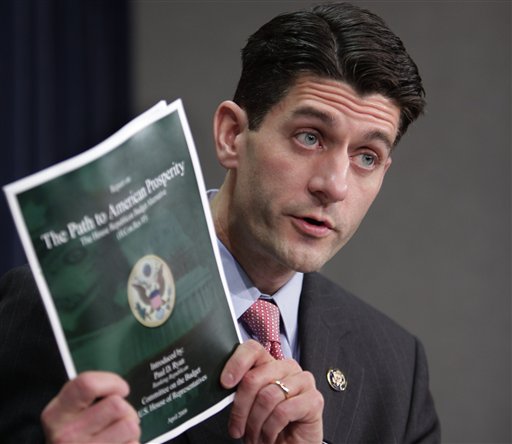
REP. PAUL RYAN. AP photo by J. Scott Applewhite

This morning, Rep. Paul Ryan, chairman of the House Budget Committee, presented the Republican budget for 2012. Joining him were a TV screen full of his Republican colleagues on the House Budget Committee. Everyone present, from what I could see on TV, was a white man. With a few exceptions, they are from the Red States, the heartland of America.

Not to put too fine a point on it, but the Republican budget would cut government spending by $6.2 trillion over a decade, and sharply cut taxes for the wealthy. The top income tax rate would be reduced from 35 percent to 25 percent. Is the U.S. really broke, or is the U.S. wealthy? You decide.

Here is a list of Republican members of the House Budget Committee. White men in suits from the heartland. Only one female name is on the list.

Many believe the Republican budget is so draconian that it's dead on arrival. I hope so, but the hard line on Medicare, especially, is ominous.

NOT TO IGNORE THE REPUBLICANS IN THE SENATE. Roger L. Wollenberg photo, 03-31-11

Umm, the photos above, of Republican leaders in the House and Senate, and the list of Republicans on the House Budget Committee . . . Is this what democracy looks like in America, in 2011? (Disclaimer: Many of my friends and relatives are white men. Come to think of it, I am a white man. Hey, I even own two winter suits AND two summer suits, so I am prepared to attend weddings, funerals, and job interviews in all seasons.)

The name of the Republican budget is “Path to Prosperity.” Rep. Ryan says these words, “Path to Prosperity,” with a straight face, without a hint of irony.

Here’s an early analysis of the Republican budget numbers, from the Huffington Post.

Here’s another analysis by Ezra Klein in the Washington Post.

The “Path to Prosperity” runs right over Medicare and Medicaid. At this moment, it appears to me that the Path to Prosperity would effectively destroy Medicare and Medicaid. Maybe that is a  good thing. Sometimes, I think, the only way to reform a program or a bureaucracy is to destroy it and start over. But I don’t think that’s what Republicans have in mind. I think Republicans intend to privatize health care for the elderly and the poor. In the name of paying off the debt. (For an earlier post on Republican strategy regarding Social Security, see “Divide and Conquer.”)

Also on the Republican chopping block: education, from Head Start to Pell Grants.

I think Republicans are focused entirely on two things: paying off the public debt, and reducing taxes. Two contradictory goals, but possibly both can be accomplished at the same time, by grinding the middle class and the poor — and the elderly — into the dirt. (Go ahead, accuse me of class warfare. Doesn’t this look like a scorched-earth policy to benefit wealthy America and corporate America?)

Rep. Paul Ryan says the Republican budget will “create jobs.”

SHOW ME THE JOBS. How exactly do you create jobs by slashing spending to the bone, on everything except the Department of Defense?

How do you create jobs when Toyota is shutting down 13 factories in the U.S., and food and gasoline inflation is vacuuming up every spare dollar of discretionary spending? AND the U.S. is fighting three wars in the Middle East.

Oh, yeah. And to show their power, or something, Republicans intend to shut down the U.S. government at the end of the week. Will that create jobs?

— John Hayden

You Decide: How Much Is A Worker Worth? What Is Fair Pay?

Last night, I attended a meeting about social justice issues. Naturally, the controversy about public worker salaries and unions in Wisconsin came up.

One person commented, “The workers in Wisconsin are not poorly paid.” As if that were a known fact.

We all have preconceived notions about how much certain workers are paid. (When we say “public workers,” we’re often thinking of  teachers, firefighters, and police officers. It is important to point out that by the very nature of state and local government, large numbers of the workers are in traditionally low-paying  jobs requiring low levels of skill or education.)  What do you think is fair pay? Please vote.

Which workers are we talking about? Teachers? Police officers? School maintenance workers? School cafeteria workers? Bus drivers? Road repair crews? Attorneys, engineers, accountants? Public health nurses? Truck drivers? Clerks who process paperwork or answer the phone?

Does a police officer deserve to be paid an adequate living wage? Does a trash collector? Should fair pay be enough for the worker to support himself or herself only? Or should the pay be high enough to also support a child? Two children?

Was answering these questions difficult, impossible, easy? Who should set pay rates? The governor, the private market, the unions, collective bargaining, lottery? Put them all  on the ballot for the voters to decide in a referendum?

How much should bloggers be paid? What? Never mind!

John Hayden

‘Democratic Revolution’ in Ireland

Irish General Election - Enda Kenny's Victory ...

Enda Kenny claims victory for Fine Gael at Burlington Hotel. By infomatique via Flickr

Countries with elected parliaments operate under a strict-constructionist interpretation of the “consent of the governed” clause.

Irish voters lashed out in economic pain this week, withdrawing their consent in no uncertain terms, and dismissing Ireland’s longtime ruling party, Fianna Fail. It may be a historic change election.

Enda Kenny, leader of the victorious Fine Gael party, called it a “democratic revolution.” See the Christian Science Monitor story.

Irish voters are incensed over the banking meltdown and the collapse of housing values — which left their country nearly bankrupt — and angry about bailouts by the European Union and International Monetary Fund.

Fine Gael is projected to win 75 seats in the Irish parliament, 8 seats short of a majority, according to the Christian Science Monitor. Relying on the revised consent of the governed, Mr. Kenny is expected to forge a coalition government with the Labour Party, projected to win 37 seats.

75 seats + 37 seats = consent of the governed

The consent of the governed is just so tenuously conferred, and is valid so long as the new coalition can dodge a vote of no-confidence.

For the long-powerful Fianna Fail party, consent was replaced by contempt. Fianna Fail was reduced from 77 seats to a woeful minority of 20. And the Green Party was wiped out, losing all 6 of its seats.

Exactly what the new ruling coalition will do differently is far from clear, but the voters are not pleased that their recent proud prosperity has been reduced to indebted austerity.  They believe that ordinary Irish citizens are not responsible for the economic collapse, but are  bearing the resulting hardship.

Mr. Kenny has indicated that he will attempt to renegotiate interest payments on the unpopular bailout.

Spectacular street protests against dictators in Egypt, Bahrain, and Libya have attracted far more news coverage in the U.S.  However, this Irish election is more relevant to the political mood and financial power struggles in the Western democracies. (It’s interesting that the Irish vote comes as Republican governors fight to inflict a strong dose of austerity in the U.S.)

I can’t wait to learn more about the transfer of consent in Ireland. What course will the Fine Gael-Labour coalition chart?

Whether Democrats and Republicans can discern anything of value regarding consent of the governed in the U.S. remains to be seen.

— John Hayden

Economic Crisis, Political Turmoil, Consent of the Governed


All governments depend on the consent of the governed. That’s what we learned in high school, so it must be true.


We’ll see how that works in the real world of the 21st Century. Does the consent of the governed matter, in the global economy? Or in a world with imaginary national boundaries, do governments depend more on the consent of multinational corporations?


The political and social consequences of the Great Recession are beginning to manifest, but the results are unpredictable. For background, see World Economic Crisis Phase II, Political and Social Upheaval.


In North Africa and the Middle East, massive street protests oppose long-established regimes. It looks to me like mob rule. The mobs appear to have power to topple dictators, but mobs cannot control the establishment of a new order. As the dictators fall, power can be seized by opportunists, regardless of character, ability, or ideology.


In the U.S., Wisconsin and other states are attempting to impose budget austerity and blunt the power of the public-worker unions. It looks like rule by legislative majority. But legislating is a messy business in the U.S. Power in a state is divided between the governor and the legislature, which is itself fractured into two houses.


In the example of Wisconsin, Republicans have control of state government following the 2010 election. The rowdy opposition by Democrats and unions will almost surely prove ineffective. The legislative majority will have its way. But under democracy as it has evolved in the U.S., does the legislative majority represent the people, or do the legislators represent corporations and special interests that bankroll their election campaigns? In a modern democracy, power can be purchased by opportunists.


Today’s national election in Ireland may provide a first reliable reading on the consent of the governed in the 21st Century.  You can listen to and read a PBS report here.


Ireland, you may recall, was one of the first European economies to be staggered by the bursting of world financial and housing bubbles. The Irish voters will probably pass judgment on the austerity measures taken in Ireland, and on the bailout efforts by the European Union and the International Monetary Fund.


Irish turnout is reported at 70 percent. The ruling party is expected to be ousted, but it will take about two days to count the votes.


There are so many other economic shoes waiting to drop. The debt problems of Europe, England, America, and Japan remain awesome and unresolved. We still have the possibility of default, or a chain of defaults in Europe, and among states in the U.S.


You want far-out scenarios regarding the consent of the governed? Consider the breakup of one or more major political structures.


If the USSR could break up, it could happen in the European Union, or even in the U.S.  The stability of Pakistan is not guaranteed. And speaking of stability, what about Saudi Arabia?


I could muddle on, wondering about the price of gold, or airline tickets, or $5 gas. But I just confuse myself more with every line I write. I must be watching too much Cable TV News.

See also,  You Say You Want a Revolution?

— John Hayden

Now You See It, And Now You Don’t: Social Security, Medicare, and Medicaid in a Shell Game

In honor of Tax Day

Image by swanksalot via Flickr

Welcome to the carnival. Watch closely . . .

The present attack  on entitlements and “debt” is setting the American people up for a deal from hell, a deal the devil thinks we can’t refuse. Just my opinion.

Here’s the devious strategy:

  1. All-out attack on “entitlements,” vilifying Social Security, Medicare, and Medicaid . . .
  2. Grudging acknowledgment that the financial structure of Social Security is not so bad . . . compared to the evils of Medicare and Medicaid . . .
  3. Target Medicare and Medicaid as the two programs that will surely sink America, leading to financial collapse . . . (China will rule the world!) . . .
  4. But wait! Maybe there’s a way out . . .

If the American people will agree to kill Medicare and Medicaid, the titans of finance will extend Social Security (for a little while)!

(Do you doubt this mid-February opinion that Republicans would be so callous as to destroy Medicare and Medicaid? See the Republican budget plan, issued at the end of March, to destroy Medicare and Medicaid, among other things.)

Attention old folks and future old folks! Listen up: You can survive without Medicare, right? We’ll keep sending you a diminished Social Security check (no cost-of-living increase). It’s a fair deal. You keep Social Security, we take Medicare. Everyone has to share the pain, right? This will only hurt a little.

It’s a deal you can’t refuse, old folks and future old folks. Or can you? Watch the little ball. Keep you eye on the shells. Now you see it, now you don’t.

If Republicans and their wealthy patrons can pull this off, it will be the biggest public relations coup since the invention of  “the death tax.” Democrats are taking the bait.

— John Hayden

It Might Be More Serious Than ‘Uncertainty’

Maybe it’s time for the rulers of the world to start worrying?

Human governments are unstable by nature. Revolutionary change does not run on any logical schedule. Revolution can come when you expect it, or when you don’t. Who in the West could have predicted the fall of the Berlin Wall in 1989, followed by the breakup of the Soviet Union in late 1991?

The financial capitals of the U.S. and Europe have been in economic turmoil for three years. But the revolution comes first in the Middle East. In a matter of weeks, change comes to Tunisia and Egypt. In recent days, protests spread through the region — in Libya, Yemen, Syria, Bahrain.

In Egypt, the focus was secular. The concerns were poverty and democracy. In Bahrain, the conflict has religious overtones. Perhaps Saudi Arabia and Iran will be exempt. Perhaps not.

If it can happen in the Soviet Union, Eastern Europe, the Middle East, could it happen in America?

In Wisconsin?

In America, a great divide has opened between certain monied elites and the people who work for them. Certain elites have decided they don’t need government workers, and they’re not going to pay for people they don’t need. This drama has been playing out in towns and counties throughout America. A spirit of cooperation in the first year of budget cuts is wearing thin in the second and third years. Tempers are getting short on both sides of the budget tables. Some public workers are getting angry.

The standoff in Wisconsin between the Republican government and the people who work for the government is ugly and ominous. The Republicans intend to break the back of the public unions.

Nearly every other state is facing similar budget dilemmas, and many states are in worse shape than Wisconsin. Among the Republicans who have come to power, there is talk of layoffs and bankruptcies, but not of tax increases.

In the recent U.S. election campaigns, politicians promised to create jobs. It is just now sinking in that politicians intend first to eliminate many more jobs — in federal, state, and local governments.

Unemployment is above nine percent, but corporations and investors are hoarding cash, refusing to invest or hire. They plead uncertainty. Uncertainty on Wall Street, uncertainty about oil price and supply, uncertainty about taxation, uncertainty about public debt.

Look, life is uncertain.

The super-rich can tolerate uncertainty. Their money is in safe, offshore banks.

— John Hayden

Divide And Conquer: The New Plan To End Social Security By Dividing America at 55

Now begins the cold-blooded campaign to destroy Social Security. The plan is to divide and conquer the American people along generational lines. Synchronize your calendars.

If you’re over 55, you’re a Social Security winner; if you’re under 55 you’re a Social Security loser. Life is a lottery based on a four-digit number, the year you were born.

The proponents of this cynical conspiracy intend to pit father against son, mother against daughter. The elders are comfortable, warm and well-fed. So what if the sons and daughters have to eat dog food in old age? Who cares?

FDR SIGNING THE SOCIAL SECURITY ACT, 1935. DO THESE PEOPLE LOOK LIKE COMMUNISTS? WikiMedia Commons Photo

Since the beginning, when President Franklin D. Roosevelt signed Social Security into law in 1935, some people have hated Social Security. The concept of lifting every elderly American off the dirt floor of poverty infuriates the cold-hearted and mean-spirited. The diehard opponents of Social Security live by their own “Golden Rule,” to wit:

“He who has the gold, rules.”

The spirit of Social Security is too good, too honest, too simple, too clear. Social Security is kindness and justice for every old man and old woman in America, backed by the full faith and credit of the United States government. Every old man and old woman deserves to live in dignity, with food to eat and a roof over their heads. What’s so hard to understand about that?

IDA MAY FULLER, RECIPIENT OF THE FIRST SOCIAL SECURITY CHECK. (THESE DAYS, YOU CAN GET DIRECT DEPOSIT.) SSA Photo


The Social Security safety net has been a blessing for every generation since the Great Depression. Medicare has been a life-saver for senior citizens in a health system run by unforgiving insurance companies. There is no good reason why Social Security and Medicare should not continue to be a blessing for today’s adults — whatever their age — and for their children and grandchildren. Where did this crazy idea of discriminating by age and generation come from? Oh, right. For the record, it came from Republicans.

(By the end of March2011, it appears clearly that Republicans intend to destroy Medicare and Medicaid first, by way of a scorched-earth budget policy. Please see my post, “Wilding in Washington: Last Stand of the White Men in Suits.”)

I’m 62, and no one I know among my contemporaries would wish upon their children and grandchildren a future without Social Security.

Only a fool would believe that children born in 2010 will be so healthy and wealthy, 65 years hence, that they will not need a safety net in old age. What is the logic, what is the fairness, in saying that America will keep faith with everyone over 55, and to hell with everybody under 55?

I wouldn’t stand for it, if I were 25 years old today, or 35, or 45. If you’re going to treat one group of people fairly, you must treat every group fairly.

Social Security is solvent right now. The propaganda claims it is not financially viable for the future. The propaganda is a lie. The most recent projections say it won’t run out of money until 2037.

All Social Security needs is minor adjustments to keep going past 2037, and going strong.  See 12 Ways To Fix Social Security.

Every machine needs routine maintenance. That is Social Security exactly. Congress made adjustments in the 1980s, and the machine has been running smoothly ever since. Right now is simply the time for the regular 100,000-mile maintenance.

To discriminate by age is not the American way. Divide American into the privileged and the have-nots at age 55? No way. Put your foot down. Open your window and scream. Just say no.

We can and must save Social Security for today’s 25-, 35-, and 45-year-olds.  With a little fine-tuning, Social Security will still be strong, for those over 55, and for all Americans. What do you think? — John Hayden

Political Zeitgeist In America

Is there any political reality remaining in America? I’ve been trying to make sense of the political zeitgeist following the election of 2010. Two contradictory perspectives came into focus this week.

Vice President Joe Biden summed up the message from the electorate on “Meet the Press.” Voters want elected officials of both parties to work together and compromise, Mr. Biden said.

MICHELLE RHEE. -- Wikimedia Commons public domain photo

Michelle Rhee, an education reformer who used to be chancellor of D.C. public schools, stated a different position in “Newsweek.”

“I don’t think consensus can  be the goal.” said Ms. Rhee. And: “We can’t shy away from conflict.”

That’s the tension in American democracy — longing for peace and compromise on one hand; and an appetite for political conflict on the other. Voters who are comfortable with the status quo yearn for politics without conflict. They see reformers as troublemakers.

Reformers seeking change are impatient with compromise. They’re willing to tolerate a degree of political unpleasantness to achieve a goal. Compromise usually doesn’t bring them closer to the goal. Compromise simply kicks the problem down the road for a year or three.


THE AMERICAN ELECTORATE IS NOT ONLY POLARIZED AT THE EXTREMES. THE INDEPENDENTS IN THE MIDDLE HAVE LITTLE USE FOR EITHER SIDE. Wikimedia Commons public domain image.

It’s human nature to seek the easiest path, to avoid pain and sacrifice. So it’s not surprising that a majority wants compromise. That’s what happened this week, when President Obama crafted an agreement with Senate Republicans to extend current tax cuts for the wealthy, and at the same time extend unemployment compensation for the poor.

The tax-cut compromise is the easy path. It avoids pain all around. But it also adds billions to the national debt. The majority of voters got what they wanted, a minimum of conflict. They are pleased to kick difficult decisions about the national debt and economic austerity down the road.

Americans seem to be dangerously addicted to the easy path. European nations are engaged in national debates (often in the streets) over austerity measures to address their debt problems. America is falling behind on debt, just as we are falling behind in economic competitiveness.

Most troubling of all is that America has fallen way behind other advanced countries in education. Michelle Rhee knows about the public schools:

“The truth is that despite a handful of successful reforms, the state of American education is pitiful, and getting worse.”

If we’re not competitive on education, we won’t have a chance to be competitive economically. And the American electorate complacently ignores the education crisis. In fact, state and local governments are preparing to cut deeply into funding for education, in order to balance government budgets.

Ms. Rhee is quite forthright about the political path to improving education in America. And it’s definitely not the easy path.

“Public school reform is the civil-rights issue of our generation. Well, during the civil-rights movement, they didn’t work everything out by sitting down collaboratively and compromising. Conflict was necessary in order to move the agenda forward. There are some fundamental disagreements that exist right now about what kind of progress is possible and what strategies will be most effective. Right now, what we need to do is fight.”

Any questions? Yes, political conflict is necessary for problem-solving and progress. In some other countries, they resolve political differences through violent conflict. In America, we resolve political differences through elections. Settling our conflicts through civil debate, rather than violence, is the great achievement of democracy in America.

We need to start addressing our political conflicts, not avoiding them. The sooner the better.

— John Hayden

Unemployment and $3 Gasoline in the U.S., Austerity and Street Protests in the Capitals of Europe

BOOK SHIELDS IN ROME. One of many photos circulating in European newspapers and blogs, of protests against government austerity plans. This one shows students in Rome using book-like shields. Tomorrow, you'll likely see similar street theater in London. But only if you have access to European sources.

The beautiful people on CNBC, the Wall Street propaganda channel, chat happily about how high stocks might fly, and the price of gold and oil.  It’s surreal.

Even as they talk, the economy of the Western world is teetering on the edge of chaos. Students protest daily in the capitals of Europe against draconian austerity plans designed to screw the middle class and working class, and especially the younger generations. European governments seem intent on staving off default by cutting deeply into funding for education, arts and humanities. As you can see, ConsterNation is an international state of mind.

You need direct European sources to keep up with events over there. For instance, news and photos of the book protests in Rome can be found at this Italian blog by Italian novelists. If you can read Italian, you could look at their main blog.

Baroque in Hackney reports that students in London will mount a similar protest on Thursday. Ms. B even provides the address where you can go on Tuesday to help make life-sized books for the demonstration, if you happen to be in London. If not, there’s plenty of time to get there by Thursday. It’s a small world, so they tell me.

“With Arts and Humanities a particular target for UK cuts this is a literal display of literary resistance.”  — Ms. B

For more inside information (and videos) from the U.K., you could look at Coalition of Resistance.

Until recently, the U.S. cable channels had been reporting on the debt crises in Greece and Ireland. But as the contagion threatens to spread throughout the southern half of Europe, coverage in the U.S. has all but disappeared. You’ll not likely see film or photos of protests in Europe on CNBC, or any other news channel.

Could the U.S. news blackout on European protests be a conspiracy to keep Americans from knowing the extent of economic turmoil, at least until after the Christmas shopping season? When did I become so cynical? Maybe the news blackout is to prevent protest fever from jumping the Atlantic and infecting U.S. students. Maybe it’s to prevent panic.

Let’s go to the NUMBERS.

Even as the beautiful TV people talk, unemployment in the U.S. is 9.8 percent, officially, and possibly twice that much, in reality. Members of the U.S. Armed Forces are fighting and dying in Afghanistan and Iraq, and for their service they will receive a 1.4 percent pay increase, the lowest in many years. The price of gasoline is $2.97 a gallon, where I live, and more than $3, in urban areas. The snow is knee-deep, or higher, in Buffalo, N.Y.; and the temperature is going down to 30 degrees tonight in Orlando, Florida.

LILY HAS AWESOME POWERS OF CONCENTRATION WHEN A DOG BISCUIT IS BALANCED ON HER NOSE.

And Lily, the golden retriever, has about a one-in-three chance of balancing a dog biscuit on her nose, tossing it in the air, and catching it in her mouth. I had to add the true story about Lily and the dog biscuit for a little comic relief.

No one can predict the future. But let me make a few guesses. The temperature will go up later this week in Florida, and the snow will melt in Buffalo, by late spring.

But across America, it is entirely possible that unemployment will remain above 10 per cent and gasoline will remain above $3. For how long? Forever.

And what will the austerity plan agreed to by the U.S. government and the Wall Street tycoons look like? I will not hazard even a guess.

— John Hayden

“You Say You Want a Revolution?”

A picture is worth a million words. There seems to be a difference of opinion throughout Europe (and in America, too) concerning money, and debt. Also, some mild disagreement about who should pay the price and make the sacrifices, and who should get bailed out.

Schoolgirls link hands to protect a police van during student protests in London. -- Peter Marshall photo.

Baroque in Hackney reports that a younger generation — “The Kids” — is seizing responsibility because their elders are cowed by the powers that be. Ms. B’s post is enlightening. I urge you to read it.

How far will the wealthy elites in Europe and America push the children of the former middle-class? If you want to know which way the wind is blowing, please read this article by Jonathan Jones from The Guardian. Here’s a brief excerpt:

“For this picture tells a lot, very quickly. It tells us the menace of violence is real as anger grows among groups directly afflicted by the coalition’s cuts. Yet it also reveals that most protesters are peaceful, idealistic, with a sense of history and of the gravity of their actions. Most of all it tells us how amazingly young many of them are.

Future historians may well write that the Conservative-Liberal coalition was doomed the day schoolchildren took to the streets to assert their right to a university education.”

People are protesting in the streets in France (Social Security); England (college tuition); Ireland (budget cuts); and the European Union is getting ready to bail out the biggest banks in Greece, Ireland, Portugal, Spain, and maybe Italy. The U.S. already bailed out its bankers, and people protested with their votes.

So this is the way it’s going to be? The rich get richer; the middle-class get screwed?

“You say you want a revolution
Well, you know
We all want to change the world
You tell me that it’s evolution
Well, you know
We all want to change the world
But when you talk about destruction
Don’t you know that you can count me out
Don’t you know it’s gonna be all right
all right, all right

You say you got a real solution
Well, you know
We’d all love to see the plan
You ask me for a contribution
Well, you know
We’re doing what we can
But when you want money
for people with minds that hate
All I can tell is brother you have to wait
Don’t you know it’s gonna be all right
all right, all right”

— The Beatles

I’ve written about the consequences of what I would call “capitalism off the hook” before. I didn’t think the reaction in the streets and at the voting places would be so swift or serious.

With apologies to Buffalo Springfield, I don’t think it’s paranoia. I think, “There’s something happening here. What it is ain’t exactly clear.”

Mr. Jones of The Guardian describes what’s happening as follows:

“We can look at this picture and see a mass movement rapidly evolving as a generation goes beyond merely taking to the streets and starts finding a larger meaning in its rebellion, and imposing order in new ways. What these girls are showing us is that this is not just about rage. It is a defiant stand for youth and hope.”

Do you think President Barack Obama and Fed Chairman Ben Bernanke understand what’s happening?

“The Kids” and their “cowed” parents understand that they’re being screwed. Government leaders understand the consequences of tax cuts for the rich and budget cuts for the poor.

The wealthy elites understand that they’re screwing the poor, and what’s left of the middle-class. The wealthy always believe they have a right to exploit the poor.

So it looks like it’s the Powerful elites against “The Kids.” You can call it “class warfare,” if you want. I’m afraid that the Powerful will make precious few concessions to “The Kids,” at least not without an ugly struggle. How it will play out, no one knows.

— John Hayden