
The Geography of Frugal Living: Maine

They don't build houses like this anymore. Stained-glass, ornamental woodwork, radiator heat and wallpaper. And that's just the entrance hall to this 100-year-old house in Brewer, Maine.  

They don’t build houses like this anymore. Stained-glass, ornamental woodwork, radiator heat and wallpaper. And that’s just the entrance hall to this 100-year-old house in Brewer, Maine.

The cost of living is not fair. Especially not the cost of housing. It’s all a matter of geography.

My niece and her husband, along with my sister, have acquired a charming old house, apparently in better-than-mint condition, at a price that would be unthinkable in most of the major metro areas of the U.S., even after the collapse of the real estate bubble.

A charming kitchen with new appliances.

A charming kitchen with new appliances.

The 100-year-old house is near Bangor, Maine. Outside, it looks like thousands of other old houses in New England. Plain white siding, pitched roof.  Kitchen, dining room, living room on the first floor; three bedrooms on the second floor; attic on top and basement below. Ordinary. 

Being 100 years old, the house is sturdily built, well-insulated, has beautiful hardwood floors and old-fashioned radiator steam heating. Most everything else inside has been replaced or updated, and there’s tasteful wallpaper on all the rooms. Everything, it seems, is in perfect condition. The house had been on the market 45 days. My niece snapped it up for less than $150,000. Eat your heart out, house-hunters in Boston, Washington, and San Francisco.
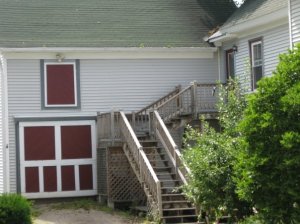
The "barn door" and steps to an inlaw apartment.

The "barn door" and steps to an inlaw apartment.

So we have here a two-story, three-bedroom house in great condition. Plus, an attached in-law apartment (currently rented for $600 a month) and a garage/workshop that looks like a small barn. Off-street parking in the driveway, a small upstairs deck and a medium-sized first-floor deck. And finally, a really big, beautiful, green, flat backyard, with gardens. Thanks to my niece, Dawn, for the great photos.

Pretty nice apartment, rents for $600 a month.

Pretty nice apartment, rents for $600 a month.

If there’s a downside to all of this, consider that the green backyard will be covered with deep, white snow all winter. The house is located, after all, in northeast Maine.

The far-north location, formidable winters, and reasonable price are what this Maine house has in common with the mobile home in North Dakota that I mentioned in a post last week. Maybe if you want to live simply and frugally, it helps to go north.

It is worth noting that the Maine house, though very reasonably priced, is not dirt-cheap like the North Dakota mobile home. The big difference is in public services and convenience. The isolated, small town in North Dakota is nearly “Off The Grid.” Population 75, in the middle of nowhere, and you can’t get a cell phone signal.

Even an old-fashioned bathtub. I guess it's 100 years old, just like the house.

Even an old-fashioned bathtub. I guess it's 100 years old, just like the house.

In Bangor-Brewer, Maine, my niece is definitely “On The Grid.” Bangor may be far away from everything else in New England, but it’s big enough to offer all the city services, and small enough that you’re never far from where you want to go. Library, churches, schools, stores, an international airport, a symphony orchestra and opera house, a minor-league baseball team. What more could you possibly need?  I nearly forgot the Eastern Maine Medical Center in downtown Bangor, and the University of Maine eight miles down the road.

I knew I should have paid more attention in geography class. You can buy a house at a reasonable price and live in civilized comfort, if you know where to look.
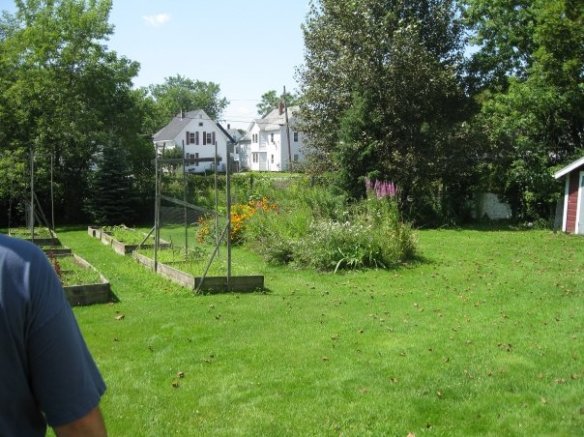
Big backyard. Green in summer, white in winter. Great pictures, Dawn.

Big backyard. Green in summer, white in winter. Great pictures, Dawn.

Four Nonessentials I Hate To Quit

I’ve already written about my telephone land line and 11 other nonessentials that I’ve given up, in order to save money and live within my means.

None of them was as hard to give up as cigarettes, which I quit a long, long time ago. Of those nonessentials, I’ve relapsed on only two, which come as a package: cable  TV and internet service. I presently have cable and internet access thanks to a housemate, and it seems only fair for me to pay my share.

A few other nonessentials, I must admit, I have refused to give up so far, although I’ve cut way back on some of them. Here are four nonessentials that are particularly hard to quit:

  • Dry cleaning, I’ve always washed my own underwear and stuff, but for most of my adult life I’ve made regular use of the dry cleaning industry. Dress pants and suit coats, blazers and sweaters, even ties, I have routinely taken to the dry cleaner. This is expensive. Hence the expression, “Taken to the cleaners.” If the label says “dry clean” or “professional cleaning only,” I still must obey. But my simplified life doesn’t require me to wear fancy duds every day, so I’ve been able to cut way back on the dry cleaning.
  • Having dress shirts professionally laundered, starched and pressed.  This I used to consider  an “essential.” It was my one concession to dressing appropriately for work. A wrinkled shirt simply does not project a professional image, in my opinion. No more! In the spring of 2009, I went cold turkey on pro shirt laundering. I taught myself to iron, and even tried spray starch, with varying degrees of success. For the future, I intend to buy dress pants and dress shirts that are drip-dry, and preferably require no ironing.
  • Haircuts. I refuse to give up haircuts completely. However, I get haircuts much less frequently, and go to an old-fashioned “barber,” not a more expensive “stylist.” I let the barbers cut my hair as short as they want; it makes it that much longer before I have to come back and pay for another haircut. Also, I’ve taught myself to trim the hair around my ears with a razor.
  • Coca-Cola. Not a necessity! I know this, intellectually. But as a practical matter, I’m as hooked on caffein now as I used to be on nicotine. I have failed miserably to give up Coke, or even cut down on my consumption. To me, Coca-Cola seems like an essential. The combination of all that caffein and sugar gives me a real kick. I know it’s not good for me, but I need it to get through the day. That’s my story, and I’m sticking to it. I’m sure other people have the same problem with coffee.

I surely have overlooked other expendable nonessentials. Please let me have your nominations in the comments section. Thanks.

The Geography of Frugal Living: North Dakota

The simple life is a very personal thing. You can live your version of a simple lifestyle just about anyplace. Anyplace you can afford, that is.

The rich can live simply anywhere they want. Paris Hilton and Nicole Ritchie even tried to live simply on a television reality show, "The Simple Life."

The rich can live simply anywhere they want. Paris Hilton and Nicole Richie tried it in a rural setting on the TV reality show, "The Simple Life." Far as I know, this photo from the show was NOT taken in North Dakota.

For many of us, the simple life implies a frugal lifestyle, by choice or by necessity. That’s where geography comes in.

Only the wealthy can choose to live simply in an area with a high cost of living. For the rest of us, our ability to simplify our lives is greatly enhanced in a place where housing and other essentials are less expensive. 

Unfortunately, places with low costs of housing are often economically depressed areas, with few job opportunities. For most of us, no matter how much we simplify our lifestyle, we will still need a source of income to support our simple needs.

North Dakota made it onto the front page of  The Washington Post (08-14-09) by being one of those magical places where the cost of living is low and jobs are relatively abundant. Under the headline, “Road to Recovery: Woman’s Path to Work Ends in Rural, and Job-Rich, North Dakota,” reporter Eli Saslow tells the story of a woman who moved more than 1,000 miles, from Ohio to North Dakota, to find a job. And the woman, Janet Morgan, 63, found that things cost less — a lot less — in wide-open North Dakota.

Everything from mobile homes to lawyer’s fees are available at prices that would be impossible in New York City or San Francisco. Janet Morgan bought a mobile home for $7,500 in Glenfield, ND, with a $100 down payment, according to The Post.

Of course the opportunity to live simply and frugally requires some sacrifices.  Glenfield, ND, has a population of 75 and sits in the middle of nowhere, the Great Plains, USA. It sounds like Glenfield is at the very edge of “The Grid” of modern services that most of us take for granted. Ms. Morgan cannot get a cell phone signal, and has to commute 150 miles each way to her job in Bismarck, ND.  The job doesn’t pay all that well. The winters can be long, cold and lonely. Welcome to the frugal version of a simple lifestyle! The change that Janet Morgan is making is not for the faint-hearted.

The Post capsulizes the economic situation in North Dakota:

“Open space and open jobs, which is why Morgan and thousands of others have moved to North Dakota during the past year. The state, once known primarily for its remoteness, is enjoying a new reputation as a haven amid economic collapse. It has the country’s lowest unemployment rate at 4.2 percent, a budget surplus of $1.2 billion, and more than 9,000 unfilled jobs.”

With the attention generated in the blogosphere by The Post’s story, those 9,000 jobs may not go wanting for long. Then again, how many people are willing to uproot themselves and move to a cold, flat, mostly empty state? 

I will give you something that The Post didn’t: a link to the North Dakota Web site. A couple of other job-hunting sites for North Dakota: NorthDakotaJobs.com and www.jobsND.com. Good luck.

But please, think three times before you move 1,000 miles for a job.

Thinking About Simplicity — Save Money On My Top Ten Nonessentials

Being downwardly mobile, I’ve got to keep pruning the low-hanging fruit, the non-essentials. In the last post, I cut the telephone land line and the monthly phone bill.  I’ve also whittled away at a long list of other non-essentials as I gradually scaled back my lifestyle from “affluent” to “working poor.” Here’s my top ten list (plus one):

  1. House (Apartment) Cleaning Service. Probably the most expensive of the non-essentials, and the first to go. For years, a cleaning service came every two weeks to do the necessary little chores I was too lazy to do. (Can you believe I paid for a cleaning service, even when I lived in a small one-bedroom apartment?)
  2. Vacations. I’ve never been bitten by the travel bug. Still, I used to get away for one weekend every season of the year, when I was affluent. And I usually took a real one-week vacation in the summer or fall. Now I haven’t had a real vacation in years. I acknowledge that forgoing vacations, year after year, is a sacrifice. But if I did vacation, I’d do it on the credit card, digging myself deeper into debt. Not a good idea.
  3. Cable TV. When I lived alone, I made do with rabbit ears. Cable, even basic cable, was a luxury I could easily live without.
  4. Home Internet Service. Same as Cable TV, above. Most of us weren’t even aware of the Internet a decade ago. Now we act like it’s a necessity. It’s not. I dropped it along with the cable TV, and used the free public Internet access at the library. However, when I share housing with another person, I usually split the cost of cable and internet. It seems like the neighborly thing to do.
  5. Newspapers. This was a tough one. All my life, I’ve read at least one daily newspaper. At the height of affluence, I subscribed to my local  paper seven days a week, plus the out-of-town New York Times. The bill for The Times was $1 a day, and well worth it. But The Times was obviously low-hanging fruit. It had to go. Later, I cancelled the local paper as well. The monthly saving was small but necessary. (I never thought the day would come that I couldn’t afford a daily newspaper.) I still buy ONE Sunday newspaper at the newsstand, when I’m feeling flush. Otherwise, I get my news from TV, or I go to the library and read the newspapers to my heart’s content, for free.
  6. Ice Cream. I switched from the premium Hagen Daz to an everyday brand. Since the doctor advised a low-fat diet, I cut way back on even the less-expensive brand, more to save my health than to save money.
  7. Pizza Delivery. I resisted this extravagance for a long time. (I might be too lazy to clean my own apartment, but I was willing to fetch my own carry-out pizza.) As the years went by, I surrendered to our cultural addiction to ease and convenience. Pizza delivery is handy when you have friends over and don’t cook. But my days of entertaining lavishly with delux pizzas (no anchovies or black olives, please) are over. I still enjoy pizza whenever I can, but I don’t have it delivered.
  8. Eating out. As a lifelong bachelor, I prided myself on preparing my own breakfast of cereal and a banana at home. But for lunch and dinner, I habitually patronized one neighborhood restaurant or another. I was a generous tipper, too, if I do say so myself. That lifestyle is a only a pleasant memory. Now, I look for price cuts at the supermarket, and eat almost every meal at home.
  9. Buying Books. One of my few extravagances was buying and reading new books, mostly paperback, but often enough, expensive hardbacks. When I read, I like to highlight important passages, and you can’t do that unless you own the book. It’s a luxury I can no longer afford. The public library lets me check out books for free, but frowns on highlighting.
  10. Church and Charitable Donations. Now frugality is getting serious. In the affluent days, I sent checks several times a year to favorite charities (soup kitchens, disaster relief, and the like). There came a day when it seemed that I needed the money as much as the charities did. Next, I reduced my weekly church contribution  to an embarrassingly small sum. Lately, I’ve been skipping church contributions entirely, and feeling guilty. I’m determined to return to my habit of small donations to church soon, but not this week.
  11. Bottled water. This is my most recent economy. For years, I carried a bottle of spring water with me everywhere. I still buy bottled water by the gallon for use at home. Our well water is OK for showers and laundry, but not for drinking or cooking. But thanks to a handy, 27-ounce stainless-steel canteen, I no longer buy those outrageously expensive small bottles of water. See, I fill the canteen free, with tap water at work, or from the gallon jugs at home. I still carry water everywhere, but I’m saving money, and with no sacrifice.

There you have it: A list of non-essentials I can live without, and save money. Please add your own suggestions for saving money on low-hanging fruit under “comments.”

Much more to come on adjusting my lifestyle from affluent to working poor. Simply cutting the low-hanging fruit was not nearly sufficient to balance my budget. Soon, we’re going to take a hard look at the essentials.

Thinking About Simplicity — The Nonessentials (My Telephone Land Line)

When I realized that I was living beyond my means, and something had to give, I didn’t start chopping away at the essentials — shelter, health care, and transportation.

Of course not. No one wants to turn their lifestyle upside down overnight. Just chopping away at the low-hanging fruit is painful enough.

By low-hanging fruit, I mean the little things that don’t cost much. You begin carefully pruning the little things.

First thing I learned I could live without came by accident. The moderately priced apartments where I lived were converted to condos. I moved to the cheapest apartment I could find in a safe neighborhood. It was a “junior one-bedroom,” barely larger than the efficiency I live in now. I got telephone service turned on in the new apartment. Basic telephone service, plus the telephone company’s voicemail, for which I paid $5 a month extra.

One little problem: the voicemail didn’t work. It sounded an annoying tone when I picked up the receiver. The tone signaled that I had voicemail waiting. Not such a big problem, right? Except that the system also wouldn’t let me access the mailbox.  So I couldn’t get my messages and turn the annoying tone off. And I didn’t know how many important messages were stuck in the mailbox. How many people were mad at me because I hadn’t called back?  Worse still, as long as the annoying tone stayed on, I couldn’t get a dial tone I couldn’t get my messages, and I couldn’t make calls.

So I call the telephone company’s customer-service department. You know how that goes. The telephone company doesn’t like to answer the phone. You get a recorded message tree: Push one if you speak English; Push two to pay your bill; Push three to add expensive options; Push four if you speak Portuguese.  And so on.

Eventually, you get through to a live customer-service agent, who listens to your problem. First time, customer service tells me they’ll fix the problem right away. Three days later, I call back, and they say they’ll fix it. I keep calling. One time they tell me there is no problem. One time they tell me I will have to pay an extra service charge to get it fixed. One time I even speak to a supervisor, who promises to call me back. She never did.

Three things you can count on when you call customer service:  One, you get an answering system;  Two, the customer service agent can’t solve your problem, but wants to sell you additional telephone services; Three, at the end of every frustrating conversation, the customer service agent asks: “Did I provide excellent service today?”

I finally realized that my existing phone service would never work again. I had an idea. I’d cancel the phone service, wait a few days, then call and order new service. What a concept!

And you know what? After weeks of not being able to use my home telephone, I had an Epiphany. I realized that I can live without a land line!  Why was I paying for both a land line and a cell phone? And the cell phone even came with free voicemail.

That is the story of how I got rid of my monthly telephone bill, and lived happily ever after. Except that I was still spending way beyond my means; I needed to prune lots more low-hanging fruit.  To be continued . . .

Thinking About Simplicity — The Essentials

Food, shelter, and clothing. In a simpler age, those three were the basic human physical needs. In this modern age, most of us would add two more basics — health care and transportation.

I’ve been giving a lot of thought to the essentials these past seven years, once it became obvious that my earnings had peaked and were sliding downhill. One clings to a familiar standard of living as long as possible, past the point of reasonable indebtedness.

I knew that I was spending more than I earned each month, resulting in slowly mounting credit card debt. I could not ignore it forever. And in my late 50s, as I bounced from one hourly wage job to another, I realized that my ability to work hard and long hours was waning.

It was clear that I needed to live more simply and reduce spending.  If I could reduce spending enough, I would be able to work less.

“What am I spending this money on?” I asked.  “And what are the absolute bare necessities?”

My three major expenses were not food, shelter, and clothing. Shelter, yes. I lived in one of the most expensive suburbs in America. The price of a decent house was outrageous. The cost of renting a decent apartment, almost equally outrageous.

The other two money pits were the car, including gas, maintenance, repairs, insurance; and health care. The health care piece came in the form of health insurance, which remained within reach as long as I had a job that offered health benefits.

Clothing has become relatively inexpensive, since most of it is manufactured by cheap labor in faraway places. I already had more clothing than I needed, so clothing expenses were negligible.

Food is nonnegotiable. Food is the last necessity you give up. You can be homeless and walk everywhere, but you still have to eat. Fortunately, food is still relatively cheap because of efficient modern agribusiness. Also fortunately, I do not consume large quantities of food. Conclusion: Not much savings likely in the essential food category.

By process of elimination, the big savings would have to come from  housing, car, and health care.

Thinking About Simplicity, to be continued . . .