Economic Crisis, Political Turmoil, Consent of the Governed


All governments depend on the consent of the governed. That’s what we learned in high school, so it must be true.


We’ll see how that works in the real world of the 21st Century. Does the consent of the governed matter, in the global economy? Or in a world with imaginary national boundaries, do governments depend more on the consent of multinational corporations?


The political and social consequences of the Great Recession are beginning to manifest, but the results are unpredictable. For background, see World Economic Crisis Phase II, Political and Social Upheaval.


In North Africa and the Middle East, massive street protests oppose long-established regimes. It looks to me like mob rule. The mobs appear to have power to topple dictators, but mobs cannot control the establishment of a new order. As the dictators fall, power can be seized by opportunists, regardless of character, ability, or ideology.


In the U.S., Wisconsin and other states are attempting to impose budget austerity and blunt the power of the public-worker unions. It looks like rule by legislative majority. But legislating is a messy business in the U.S. Power in a state is divided between the governor and the legislature, which is itself fractured into two houses.


In the example of Wisconsin, Republicans have control of state government following the 2010 election. The rowdy opposition by Democrats and unions will almost surely prove ineffective. The legislative majority will have its way. But under democracy as it has evolved in the U.S., does the legislative majority represent the people, or do the legislators represent corporations and special interests that bankroll their election campaigns? In a modern democracy, power can be purchased by opportunists.


Today’s national election in Ireland may provide a first reliable reading on the consent of the governed in the 21st Century.  You can listen to and read a PBS report here.


Ireland, you may recall, was one of the first European economies to be staggered by the bursting of world financial and housing bubbles. The Irish voters will probably pass judgment on the austerity measures taken in Ireland, and on the bailout efforts by the European Union and the International Monetary Fund.


Irish turnout is reported at 70 percent. The ruling party is expected to be ousted, but it will take about two days to count the votes.


There are so many other economic shoes waiting to drop. The debt problems of Europe, England, America, and Japan remain awesome and unresolved. We still have the possibility of default, or a chain of defaults in Europe, and among states in the U.S.


You want far-out scenarios regarding the consent of the governed? Consider the breakup of one or more major political structures.


If the USSR could break up, it could happen in the European Union, or even in the U.S.  The stability of Pakistan is not guaranteed. And speaking of stability, what about Saudi Arabia?


I could muddle on, wondering about the price of gold, or airline tickets, or $5 gas. But I just confuse myself more with every line I write. I must be watching too much Cable TV News.

See also,  You Say You Want a Revolution?

— John Hayden

It Might Be More Serious Than ‘Uncertainty’

Maybe it’s time for the rulers of the world to start worrying?

Human governments are unstable by nature. Revolutionary change does not run on any logical schedule. Revolution can come when you expect it, or when you don’t. Who in the West could have predicted the fall of the Berlin Wall in 1989, followed by the breakup of the Soviet Union in late 1991?

The financial capitals of the U.S. and Europe have been in economic turmoil for three years. But the revolution comes first in the Middle East. In a matter of weeks, change comes to Tunisia and Egypt. In recent days, protests spread through the region — in Libya, Yemen, Syria, Bahrain.

In Egypt, the focus was secular. The concerns were poverty and democracy. In Bahrain, the conflict has religious overtones. Perhaps Saudi Arabia and Iran will be exempt. Perhaps not.

If it can happen in the Soviet Union, Eastern Europe, the Middle East, could it happen in America?

In Wisconsin?

In America, a great divide has opened between certain monied elites and the people who work for them. Certain elites have decided they don’t need government workers, and they’re not going to pay for people they don’t need. This drama has been playing out in towns and counties throughout America. A spirit of cooperation in the first year of budget cuts is wearing thin in the second and third years. Tempers are getting short on both sides of the budget tables. Some public workers are getting angry.

The standoff in Wisconsin between the Republican government and the people who work for the government is ugly and ominous. The Republicans intend to break the back of the public unions.

Nearly every other state is facing similar budget dilemmas, and many states are in worse shape than Wisconsin. Among the Republicans who have come to power, there is talk of layoffs and bankruptcies, but not of tax increases.

In the recent U.S. election campaigns, politicians promised to create jobs. It is just now sinking in that politicians intend first to eliminate many more jobs — in federal, state, and local governments.

Unemployment is above nine percent, but corporations and investors are hoarding cash, refusing to invest or hire. They plead uncertainty. Uncertainty on Wall Street, uncertainty about oil price and supply, uncertainty about taxation, uncertainty about public debt.

Look, life is uncertain.

The super-rich can tolerate uncertainty. Their money is in safe, offshore banks.

— John Hayden

Black Beans And Bread

The stomach is more powerful than the brain.

Hungry people are desperate people. The leader who can give the people black beans and bread, that leader RULES. It’s something to keep in mind as you watch the political-economic turmoil in Egypt, and other troubled lands.

My high school “Problems of Democracy” teacher, Mr. Thomas, repeated the words “black beans and bread” often, as he explained the iron grip of oppressive regimes, particularly Soviet-dominated Eastern Europe in the 1960s.

When people are starving, a dictator promises black beans and bread, said Mr. Thomas. If the dictator delivers black beans and bread to hungry people, that dictator rules.

Food inflation is often emphasized, when pundits list the grievances of the Egyptian people. Oppression, poverty, food shortages. There you have a recipe for revolution.

An arrogant answer like “Let them eat cake,” is a ticket to the guillotine. In the 21st Century, an arrogant answer of austerity, unemployment, and inflation might result in a one-way ticket out of the country.

Then there’s the short-sighted folly of using agricultural land to grow fuel, instead of food. I can hardly wait until some arrogant politician says, “Let them eat ethanol.”

I’ve heard that food shortages and inflation will likely worsen. Water shortages will soon be even more dangerous than food shortages. The food and water wars are only beginning.

— John Hayden

Unemployment and $3 Gasoline in the U.S., Austerity and Street Protests in the Capitals of Europe

BOOK SHIELDS IN ROME. One of many photos circulating in European newspapers and blogs, of protests against government austerity plans. This one shows students in Rome using book-like shields. Tomorrow, you'll likely see similar street theater in London. But only if you have access to European sources.

The beautiful people on CNBC, the Wall Street propaganda channel, chat happily about how high stocks might fly, and the price of gold and oil.  It’s surreal.

Even as they talk, the economy of the Western world is teetering on the edge of chaos. Students protest daily in the capitals of Europe against draconian austerity plans designed to screw the middle class and working class, and especially the younger generations. European governments seem intent on staving off default by cutting deeply into funding for education, arts and humanities. As you can see, ConsterNation is an international state of mind.

You need direct European sources to keep up with events over there. For instance, news and photos of the book protests in Rome can be found at this Italian blog by Italian novelists. If you can read Italian, you could look at their main blog.

Baroque in Hackney reports that students in London will mount a similar protest on Thursday. Ms. B even provides the address where you can go on Tuesday to help make life-sized books for the demonstration, if you happen to be in London. If not, there’s plenty of time to get there by Thursday. It’s a small world, so they tell me.

“With Arts and Humanities a particular target for UK cuts this is a literal display of literary resistance.”  — Ms. B

For more inside information (and videos) from the U.K., you could look at Coalition of Resistance.

Until recently, the U.S. cable channels had been reporting on the debt crises in Greece and Ireland. But as the contagion threatens to spread throughout the southern half of Europe, coverage in the U.S. has all but disappeared. You’ll not likely see film or photos of protests in Europe on CNBC, or any other news channel.

Could the U.S. news blackout on European protests be a conspiracy to keep Americans from knowing the extent of economic turmoil, at least until after the Christmas shopping season? When did I become so cynical? Maybe the news blackout is to prevent protest fever from jumping the Atlantic and infecting U.S. students. Maybe it’s to prevent panic.

Let’s go to the NUMBERS.

Even as the beautiful TV people talk, unemployment in the U.S. is 9.8 percent, officially, and possibly twice that much, in reality. Members of the U.S. Armed Forces are fighting and dying in Afghanistan and Iraq, and for their service they will receive a 1.4 percent pay increase, the lowest in many years. The price of gasoline is $2.97 a gallon, where I live, and more than $3, in urban areas. The snow is knee-deep, or higher, in Buffalo, N.Y.; and the temperature is going down to 30 degrees tonight in Orlando, Florida.

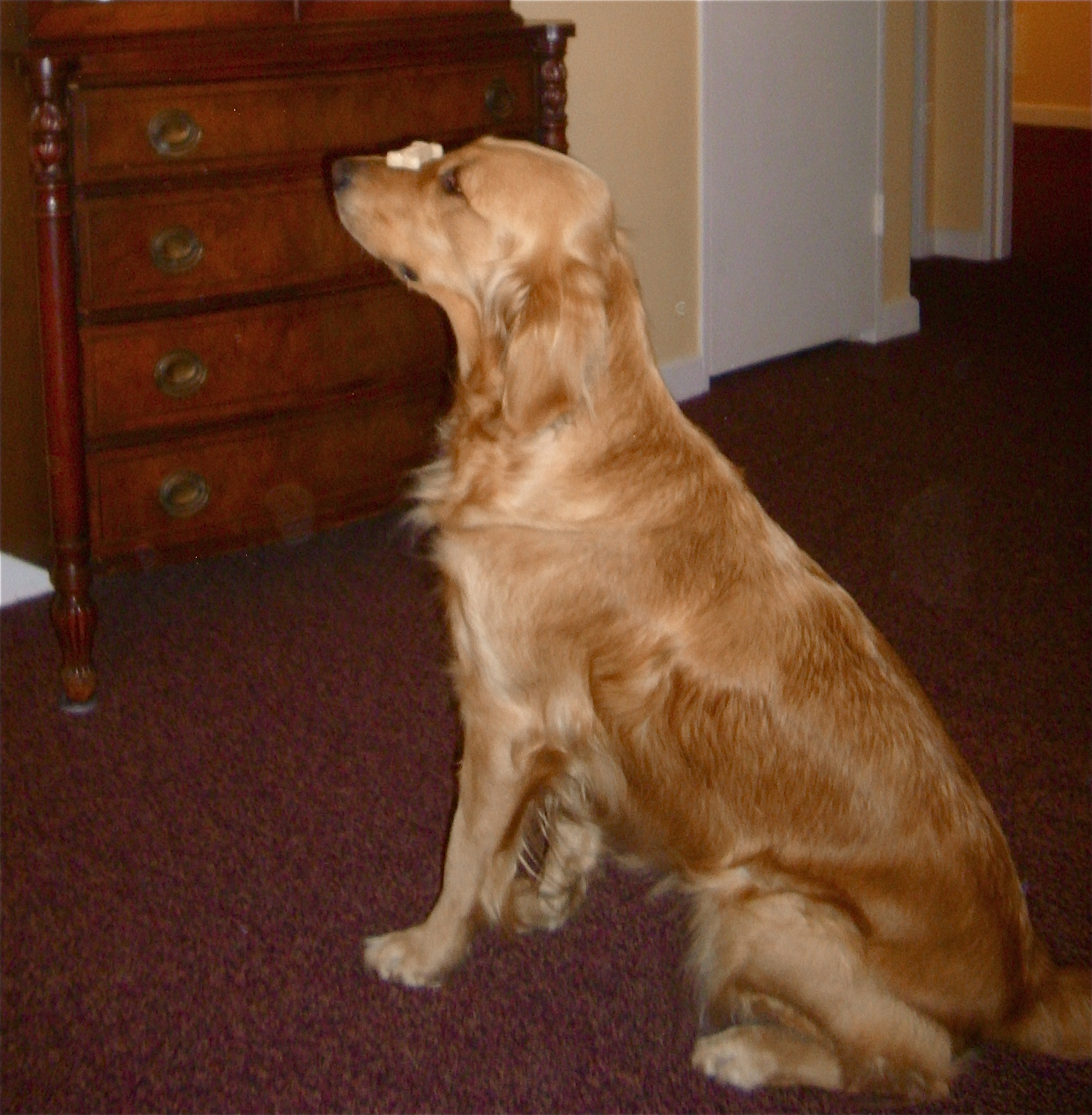
LILY HAS AWESOME POWERS OF CONCENTRATION WHEN A DOG BISCUIT IS BALANCED ON HER NOSE.

And Lily, the golden retriever, has about a one-in-three chance of balancing a dog biscuit on her nose, tossing it in the air, and catching it in her mouth. I had to add the true story about Lily and the dog biscuit for a little comic relief.

No one can predict the future. But let me make a few guesses. The temperature will go up later this week in Florida, and the snow will melt in Buffalo, by late spring.

But across America, it is entirely possible that unemployment will remain above 10 per cent and gasoline will remain above $3. For how long? Forever.

And what will the austerity plan agreed to by the U.S. government and the Wall Street tycoons look like? I will not hazard even a guess.

— John Hayden

“You Say You Want a Revolution?”

A picture is worth a million words. There seems to be a difference of opinion throughout Europe (and in America, too) concerning money, and debt. Also, some mild disagreement about who should pay the price and make the sacrifices, and who should get bailed out.

Schoolgirls link hands to protect a police van during student protests in London. -- Peter Marshall photo.

Baroque in Hackney reports that a younger generation — “The Kids” — is seizing responsibility because their elders are cowed by the powers that be. Ms. B’s post is enlightening. I urge you to read it.

How far will the wealthy elites in Europe and America push the children of the former middle-class? If you want to know which way the wind is blowing, please read this article by Jonathan Jones from The Guardian. Here’s a brief excerpt:

“For this picture tells a lot, very quickly. It tells us the menace of violence is real as anger grows among groups directly afflicted by the coalition’s cuts. Yet it also reveals that most protesters are peaceful, idealistic, with a sense of history and of the gravity of their actions. Most of all it tells us how amazingly young many of them are.

Future historians may well write that the Conservative-Liberal coalition was doomed the day schoolchildren took to the streets to assert their right to a university education.”

People are protesting in the streets in France (Social Security); England (college tuition); Ireland (budget cuts); and the European Union is getting ready to bail out the biggest banks in Greece, Ireland, Portugal, Spain, and maybe Italy. The U.S. already bailed out its bankers, and people protested with their votes.

So this is the way it’s going to be? The rich get richer; the middle-class get screwed?

“You say you want a revolution
Well, you know
We all want to change the world
You tell me that it’s evolution
Well, you know
We all want to change the world
But when you talk about destruction
Don’t you know that you can count me out
Don’t you know it’s gonna be all right
all right, all right

You say you got a real solution
Well, you know
We’d all love to see the plan
You ask me for a contribution
Well, you know
We’re doing what we can
But when you want money
for people with minds that hate
All I can tell is brother you have to wait
Don’t you know it’s gonna be all right
all right, all right”

— The Beatles

I’ve written about the consequences of what I would call “capitalism off the hook” before. I didn’t think the reaction in the streets and at the voting places would be so swift or serious.

With apologies to Buffalo Springfield, I don’t think it’s paranoia. I think, “There’s something happening here. What it is ain’t exactly clear.”

Mr. Jones of The Guardian describes what’s happening as follows:

“We can look at this picture and see a mass movement rapidly evolving as a generation goes beyond merely taking to the streets and starts finding a larger meaning in its rebellion, and imposing order in new ways. What these girls are showing us is that this is not just about rage. It is a defiant stand for youth and hope.”

Do you think President Barack Obama and Fed Chairman Ben Bernanke understand what’s happening?

“The Kids” and their “cowed” parents understand that they’re being screwed. Government leaders understand the consequences of tax cuts for the rich and budget cuts for the poor.

The wealthy elites understand that they’re screwing the poor, and what’s left of the middle-class. The wealthy always believe they have a right to exploit the poor.

So it looks like it’s the Powerful elites against “The Kids.” You can call it “class warfare,” if you want. I’m afraid that the Powerful will make precious few concessions to “The Kids,” at least not without an ugly struggle. How it will play out, no one knows.

— John Hayden

Suck Up To The Rich, But Kick The Poor When They’re Down

Dorothea Lange's "Migrant Mother," a...

Image via Wikipedia

It has been said: “Nothing succeeds like success.”

And:  “Nobody loves you when you’re down and out.”

That about sums up the unforgiving political climate in this raw election year.

One statehouse candidate in my corner of America says she wants to make our state “Millionaire-friendly.” Wait a minute. Today’s big news is the fast foreclosure scandal, and this candidate is worried that millionaires don’t have enough friends?

I don’t know whether to laugh . . . or cry.

Meanwhile, several candidates here are keen to make seasonal workers ineligible for unemployment compensation, in the midst of the worst depression since . . . The Depression.

Around here, we have plentiful work in summer, nothing in winter. Unemployment compensation for seasonal workers has been part of the business and economic equation — the social contract, if you will — for decades. Not anymore.

In this new, winner-take-all system, some local leaders ridicule the unemployed. The poor are “gaming the system,” they say.

Supermarket clerks laugh at folks who have to pay with food stamps. Folks lucky enough to be working scapegoat the unemployed. Don’t touch their food stamps; they might be contagious.

Cozy up to the rich.  Give the poor a kick in the teeth.

Politicians know how to choose their friends. But do voters know how to choose their politicians? Is this a great country, or what?

— John Hayden

Social Security at 62, Because You Never Know What Might Happen Next

I didn’t wake up yesterday knowing I’d have the opportunity to take a picture of a Studebaker pickup truck. I didn’t even know that Studebaker MADE pickup trucks.

See, you never know what you might learn on any given day, and you never know what might happen next. Expect the unexpected. So here’s this shiny burgundy Studebaker pickup waiting for me in the church parking lot.

Which leads to the point of this post. Life is too short to waste it writing only serious blog posts. Going forward, I will give priority to posts and photos that make me smile. Or that surprise me with the unexpected. If there’s any time left over, I might write something serious.

Perhaps this editorial policy will make Life After 60 a more interesting blog, while not losing sight of the reality that ordinary Americans might still be making an unscheduled crash landing in a storm of economic change.

I see this concept of writing the fun posts first as a sign of maturity. Delayed gratification has its place. But since I’m an over-sixty Baby Boomer, and I’m not flying as high as I used to, it seems like a perfectly mature and logical decision to eat dessert first.

To put it another way, since I’m losing altitude, it makes perfect sense to start collecting Social Security at age 62. The economy being what it is, and with age discrimination being a fact of life, it’s not surprising that Social Security at 62 is a trend among my generation (folks who are old enough to remember, with a smile, the Studebaker, the Edsel, and the Rambler.)

ATTITUDE ADJUSTMENT FOR THE AUTUMN OF LIFE -- EAT DESSERT FIRST.

ATTITUDE ADJUSTMENT FOR THE AUTUMN OF LIFE — EAT DESSERT FIRST.

Fear and Anger: Walk Away From It

Thursday, there was a whiff of panic in the air, as the Dow went through a 1,000-point intraday swing.

Friday, American eyes were locked, with a sense of “deja vu,” on the financial train wreck in Europe. The credit engine in Europe may be on the verge of seizing up, like it did in America in 2008.

This week, Greece; next week, the Continent?  Germany and France are rushing to avert crisis, but probably too late. It doesn’t help one bit that Britain woke up Friday morning with a fractured Parliament. Can the new Parliament possibly be more dysfunctional than the American Congress? And next week, strikes are scheduled in Europe.

For the average human being, this would be a good time to be far away from and fully independent of free markets; out of debt; and growing your own vegetables in dirt and fresh air. In other words, simplicity never looked so good.

Next time someone flies into a rage over a parking space or a line at the supermarket, give them plenty of room to vent. And don’t take it personally. It’s not about the parking space or the line. People are angry about events not under their control.

This would be a good weekend to go fishing, in a quiet place, far from the maddening crowd. Take along someone you like. Eat comfort food. Read a good, long book, or two short books, and call me in the morning.

— John Hayden

CAUTION: World Economic Crisis Phase II, Political and Social Upheaval

[picapp align=”center” wrap=”false” link=”term=greece&iid=8708516″ src=”c/8/c/e/General_Strike_Paralyses_12da.jpg?adImageId=12763080&imageId=8708516″ width=”380″ height=”253″ /]
[picapp align=”center” wrap=”false” link=”term=greece+riots&iid=8709135″ src=”b/1/4/6/General_Strike_Paralyses_3ccb.jpg?adImageId=12762992&imageId=8709135″ width=”380″ height=”242″ /]
[picapp align=”center” wrap=”false” link=”term=greece+riots&iid=8708965″ src=”c/3/c/1/General_Strike_Paralyses_44fd.jpg?adImageId=12763050&imageId=8708965″ width=”380″ height=”253″ /]

Inhabitants of Spaceship Earth are suffering through an ongoing economic crisis. I say “crisis,” only because my mind cannot grasp the enormity of total worldwide economic “collapse.” Whatever you call it, we are living in a period of  economic change and dislocation.

Now begins Phase II of the crisis, in which the pain from economic dislocation begets social and political unrest. Some obvious symptoms:

  • Failure of the United States political system to compromise on universal health care, or on immigration policy.
  • Rise of the Tea Party protest movement in the U.S.
  • States in the U.S., and nations in Europe, on the brink of insolvency.
  • Rioting in Greece against government austerity measures.
  • Demonstrations in Arizona against a state crackdown on Mexican immigrants.

Unpredictable acts of nature — such as Hurricane Katrina and the volcano in Iceland — or manmade disasters — such as an offshore oil spill in the Gulf of Mexico — send shock waves through the unstable economy.

[picapp align=”center” wrap=”false” link=”term=Arizona+protests&iid=8676035″ src=”6/2/5/c/Thousands_turn_out_138e.JPG?adImageId=12763327&imageId=8676035″ width=”380″ height=”322″ /]

On all sides, people remain in determined denial and resist acknowledging or sharing culpability for economic damage.  Wall Street arrogantly resists financial restrictions. Voters everywhere reject tax increases.

Social cohesion breaks down as elites withdraw, militias form, terrorism spreads. Groups and individuals protect self-interest, rather than support community interest. Social and political divisions harden, willingness to cooperate or compromise evaporates, battle lines are drawn. The governing emotions are anger, and fear.

[picapp align=”center” wrap=”false” link=”term=arizona+protest&iid=8675439″ src=”b/8/c/7/Thousands_turn_out_e2c7.JPG?adImageId=12763385&imageId=8675439″ width=”380″ height=”311″ /]

Economic fear could turn into panic on any given day. But perhaps the economic crisis will subside over time, and lead to needed reforms. Meanwhile, the ride will be bumpy. We may be seeing only the beginning of protests and riots. Social and political unrest might continue and intensify for a long time, possibly leading to localized violence, chaos, or anarchy.

No one can predict the future. Fasten your seatbelt and hope for the best.

— John Hayden

[picapp align=”center” wrap=”false” link=”term=arizona+protest&iid=8676272″ src=”5/d/6/7/Thousands_turn_out_cea1.JPG?adImageId=12763355&imageId=8676272″ width=”234″ height=”336″ /]

America’s Past, America’s Future

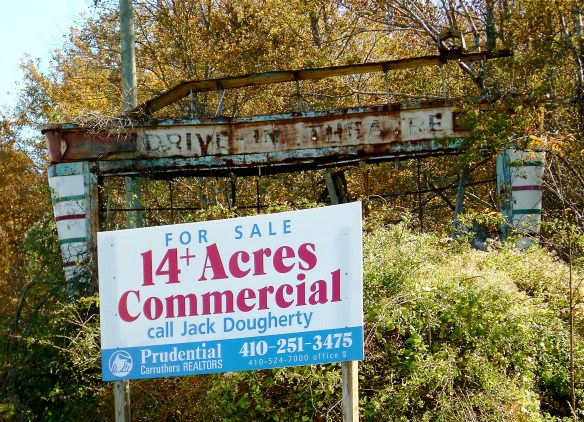
Authentic Americana:  There used to be a drive-in movie theater right here. The rusted roadside sign remains. AUTHENTIC AMERICANA:  There used to be a drive-in movie theater right here. People sat in their cars, or in lawn chairs on the back of pickup trucks, and enjoyed movies under the stars.  The rusted roadside sign is a reminder of a simpler past.

By definition, the “past” is over, and the “future” is waiting to be born. The place where we live is the present moment. We breathe, work, build, learn, change, love and forgive, right now, in this present moment.

As my years fly by, I am coming more to value the present moment. So much of my life was future-oriented, striving to get an education, a job, a mate. Waiting for the right time. Chasing success. Postponing gratification. I often missed the opportunity to live and love in the moment, to enjoy life in the moment, and those moments are gone.

Both success and failure are illusions, I suppose. These days I try to live simply and frugally in the present moment. And what of our larger society?

FUTURE ON HOLD: There's a bright new sign in front of the wreckage of the old drive-in movie sign. The 14 acres where folks once enjoyed movies outdoors on summer evenings, that real estate is still here.

FUTURE ON HOLD: There's a bright new sign in front of the wreckage of the old drive-in movie sign. And the 14 acres where folks enjoyed movies outdoors on summer evenings -- that real estate is idle.

America, and the American economy, also live in the present moment. But at present our industrial base is hollowed out by years of deindustrialization. Too many of America’s leaders put their faith in finance, not factories. Factories mean work; finance means fast money.

The fate of the old drive-in movie theater is instructive. Someone could still make a living showing outdoor movies, is what I think. But the land is  too valuable for that simple use. More money could be made by a more complicated use. In the future.

The irony is that under prevailing economic conditions, no investor can risk buying the land and building something grander.

As a result, in the present moment, the value of the 14 acres is being wasted.