Better Off?

Question:  “Are you better off than you were four years ago?”

Answer: YES, Mr. ROMNEY, AS A MATTER OF FACT, WE ARE BETTER OFF THAN WE WERE FOUR YEARS AGO!

Four years ago, we were looking into the abyss. Four years ago, Wall Street and the banks were trembling. Four years ago, the American automobile industry was on the eve of destruction. Every job associated with the auto industry was about to go away. Forever. Four years ago, we were fighting two wars. No end in sight. Or was it three wars? It’s hard to remember. Four years seems like a long time. Hard to remember what it was like. It’s like a nightmare that we woke up from. A catastrophic plane crash that we walked away from. YES, the truth is, we are better off.

— John

Raise the Social Security Retirement Age? Huh?

English: Demonstration in Barcelona on January...

Demonstration in Barcelona on January 22 against raising the retirement age (Photo credit: Wikipedia)

People are living longer, therefore the U.S. needs to raise the Social Security retirement age.

The above statement fills me with despair. It can be spoken with a straight face only by a young person or a rich person who doesn’t understand:  a) What it feels like to be sixty-something in the 21st century, and b) The place of the American worker in the market for human labor,  given the new-normal, flat-world economy.

Full disclosure: I come at this retirement age question from a Baby Boomer point of view. I celebrated (?) a 64th birthday in June. For which I’m grateful. It means I’m one of the survivors. I am now enjoying my 65th summer on the planet Earth, which is one of my favorite planets.

Continue reading

Five Warning Signs of Continuing Economic Collapse

It’s not Armageddon. But it’s not economic recovery. We’re not all going to live happily ever after.

The Statue of Liberty front shot, on Liberty I...

We’ll not be returning to the status quo ante 2006. That’s gone forever. The assumption of endless growth and prosperity is over in America. The American Dream of the past half-century is cooked.

What about more jobs, jobs, jobs for American workers, like the politicians pretend they believe? They can’t deliver it. Not going to happen. Glimmers of recovery here and there, maybe; but it will be the exception, not the rule.

Reindustrialization of America? Maybe a little bit, but new industry won’t need factories filled with unskilled workers. Or any kind of workers. Automation, robotization, computerization. All signs point to fewer jobs, not more jobs.

The promise of more jobs and economic recovery is a lie, or at least a mirage. I have to believe that many knowledgeable people in high places are aware of the truth. But they dare not say it out loud. Too many Americans are still in denial.

In order for people to accept the loss of the endless growth and prosperity model, they have to be able to replace it with a substitute. Leaders of government and business have not been able to come up with a substitute. They don’t know what to do except dissemble, and hope for a miracle.

The signs of continuing collapse in the near term and medium term are all around. Here are five of the most important warning signs, Continue reading

North Dakota Oil And Natural Gas Boom: Open Questions

English: Sunflowers in Traill County, North Da...

Sunflowers in Traill County, North Dakota. (Photo credit: Wikipedia)

North-dakota

North Dakota landscape (Photo credit: Wikipedia)

North Dakota is a happening place. I wish I had time to write a full update to my 2009 post on the geography of frugal living in North Dakota, which continues to attract readers every day. Clearly, frugal living is not the central issue in 2012.

Much has happened in the past three years, and I imagine the changes in North Dakota must be fascinating. This week’s news that North Dakotans will vote on whether to eliminate property taxes gives a hint of what’s going on. While most states struggle with unmanageable budgeting problems, and some totter on the edge of insolvency, North Dakota is apparently flush with revenue.

North Dakota’s prosperity seems entirely connected to the booming energy industry. The state has the lowest unemployment rate in the nation. I imagine that workers are flocking to the state, and housing must be in short supply.

North Dakota is flat

The Northern Plains: Big sky, flat prairie. It’s easy to forget that people live and work here, too.(Photo credit: Matthew Bietz)

Any comments from folks on the scene in North Dakota would be welcome.  All the positive news raises a few questions:

  • How many of the newcomers will adapt to the harsh North Dakota winters? Conversely, how will the people of the rural and somewhat insular Northern Plains adapt to the influx of newcomers?
  • Are prices rising and shortages developing? How much will wages and prices fluctuate in coming months and years?
  • Could the North Dakota boom be the first part of a boom-and-bust cycle?
  • How will U.S. energy policy develop regarding innovations in oil and natural gas extraction?  And pipelines?
  • Exactly what are the environmental implications of whatever is going on, deep underground in North Dakota? Are adequate precautions being taken, or are corners being cut?
  • How will the new wealth be divided? Will longtime North Dakota residents and landowners be ripped off or forced out? Will workers be paid fairly, or will most of the gains accrue to large energy companies? Will the energy industry take over or buy out North Dakota government and politics?
  • The boom can’t be limited to North Dakota only. What about South Dakota, and Montana? And Canada? Are the Northern Plains in danger of becoming an economic colony of the global oil and gas industry?

Anyone with answers or opinions is welcome to comment.

You want to know more about North Dakota? Of course you do. You can go right to the source.

— John Hayden

Map of North Dakota

Map of North Dakota (Photo credit: Wikipedia)

Category:U.S. State Population Maps Category:N...

North Dakota state population density map based on Census 2000 data.  (Photo credit: Wikipedia)

Typewriters, Stick Shifts, and Newspapers

Typewriters were as significant in the lives of my generation as computers and cell phones are today. For the beginning of the story about typewriters, see Me And The Blog.

Thanks to my cousin, Barbara, for her comment:

“Too funny! I guess we took our spanking new typewriters for granted. My father used his company discount to purchase them. They became a standard Christmas gift. Like you, though, I learned to type at school on an old standard model. Once that year was over, I swore I would never use one again!!! I did, however, learn to drive a standard shift car. I was always happy I did as I could drive any model car out there.”

Gear shift stick of my Mazda Protege SE 1999.

Stick shift on the floor of a 1999 Mazda Protege. (Photo credit: Wikipedia)

Hurray! In some ways, my siblings and cousins are more versatile, more adaptable, than the smarty-pants younger generation. We can drive a stick shift!

How many 25-y-o computer geniuses can do that? Huh? I double dare computer geeks to get into a car with a manual transmission and  drive it around the block. (Please do not try this at home if small children live in the neighborhood.) I believe a 25-y-o could probably figure out how to use a rotary phone, if locked in a room with one for 24 hours.

Barbara’s comment prompted another memory about the IBM typewriter.  (Most of the words in bold type are no longer in common use in the English language. You’ll only need to know those words if you’re taking a class in Ancient History.)

IBM Selectric typeball

IBM Selectric typeball (Photo credit: Wikipedia)

When I went to work at Congressional Information Service, Inc., in 1977, we had excellent modern IBMs. Then we  upgraded to the ultimate, the IBM Selectric.

And then (drumroll please), the entire office computerized! They dragged me kicking and screaming away from my typewriter and FORCED me to type on a computer. We used a word processing program called Wordstar!  You can forget about Wordstar. It will not be on the test. You will never hear about Wordstar again!

Typebars in a 1920s typewriter

Typebars in a 1920s typewriter (Photo credit: Wikipedia)

Before long, I learned to live with word processing, but that was not the final act. Eventually, I was an unwilling but nonetheless culpable participant in the conversion ruination of two perfectly good newspapers to “pagination.”

(Backstory:  Before computers, reporters typed news stories on  strips of newsprint. copyboy  fetched the story, “take” by “take,” and delivered it to an editor, who scratched it up without mercy and added a headline. The editor rolled the “take” up and tossed it into a square duct, whence it fell by gravity — talk about primitive technology — to the composing room to be set in “hot type” by printers.  Now you know why the composing room was always at least one floor below the newsroom. Some newspapers also used “pneumatic tubes.”  Pneumatic tubes will not be on the test.

With the advent of word processing, stories were typed and edited on computer, but still sent to printers in the composing room to be set in “cold type” and “pasted up” to make a page.)

With pagination, the entire newspaper page was built in the newsroom by editors or page designers using a computer program such as Quark. I supervised conversion of the copy desk at one small newspaper to pagination using Quark; and was a bit player in conversion of a larger newspaper to pagination using Harris software.

Pagination eliminated the composing room, the printing trade, and many jobs. If you want to know what happened to the American middle class, here is a perfect example. A large part of the middle class was made up of union printers. Editors soon met the same fate. Most so-called newspapers don’t have editors any longer. They have “content managers.”

That about covers the history of the world from typewriters to pagination, and from manual transmission to hybrid cars.

In an emergency, my generation will always be able to drive a stick shift or dial a rotary phone. Of course, when the real emergency comes, I wonder how many of us will remember how to grow our own food? Or cook? Or make a fire? I will be among the first to starve or freeze.

Let’s not think about that anymore. Instead, I’m going to think about acquiring a standard typewriter and a Volkswagen Microbus, and driving off into the sunrise.

— John Hayden

American and European Workers in the New Economy

It’s possible that we’re on the brink of historic collapse. Maybe not the Dark Age that Jane Jacobs suggests in her final book. Maybe the decline and fall of the Roman Empire is not an apt comparison. Maybe it will be more like the decline and fall of the British Empire. Or the breakup of the Soviet Union. Maybe only partial collapse, failure of some systems, here and there.

Is the era of labor-intensive capitalism over in the U.S. and Europe?

You can trace the demise of the factory to decisions made in the 1950s. The actual dismantling of American industry began in the 1970s. By 1982, the process was so advanced that we spoke of the industrial heartland as the “rust belt.”

The remaining labor-intensive parts of American industry were taken apart and exported during the globalization of the 1980s and 1990s. After the manufacturing base was hollowed out to a shell, the next labor-intensive sector to collapse was the construction industry.

Capitalism remains strong. But for the first time, capitalism doesn’t need many workers, at least not in America and Europe. What about the knowledge industry? Won’t that provide jobs? Google is big, but its workforce, not so much. Yes, there will be jobs for the lucky, the talented, the highly educated. But ask a recent college grad how easy it is to find a job.

We have what’s left of retailing. Count the vacant stores at your local mall. Walmart thrives. We have fast food. Many jobs, minimum wage.

The new capitalism is technology-intensive and finance-intensive. And coming soon, computers that “think,” to compete with slow, old-fashioned humans.

As manufacturing jobs slipped away, the financial sector created an illusion of growth and wealth.

The workings of the financial sector are a mystery to me. But the events of the past few years have caused me to view banking and finance with fear and loathing. Based on what little I know, the world financial system — many currencies and fluctuating values, with competing central banks and regulators — is dysfunctional and completely irrational. Finance is a crazy system, more likely to create chaos than order. It’s FUBAR (go ahead, look it up).

The institutions of finance have no soul or conscience to oppose corruption. American banks, corporations and wealthy individuals are awash in money, while average Americans, especially underwater “homeowners,” are awash in debt. For whatever reasons, the wizards of finance refuse to spend or invest.

If high-tech, high-finance, American and European capitalism can profit without much labor input, what happens to the surplus workers?

Economic, political and social systems will have to adapt rapidly, or risk collapse. The European Union looks kind of unstable. In the U.S., some states are financial basket cases. Maybe collapse is happening now.

— John Hayden

Related articles

The Great Jobs “Creation” Debate: Confusion And Delusion

CAN ANY PRESIDENT REALLY "CREATE JOBS?" Public domain photo, Wikimedia Commons

See if you can find any cause-and-effect relationship in this repartee from Wednesday’s televised debate among Republican presidential candidates:

Moderator Brian Williams:  “Gov. Romney . . . Massachusetts ranked only 47th in job creation during your tenure as governor . . .”

MITT ROMNEY

Gov. Mitt Romney:  “We created more jobs in Massachusetts than this president (Barack Obama) has created in the entire country . . .”

Gov. Richard Perry:   “We created more jobs in the last three months in Texas than he created in four years in Massachusetts . . .”

Perry:  “. . . Michael Dukakis created jobs three times faster than you did, Mitt.”

RICK PERRY

Romney:  “Well, as a matter of fact, George Bush and his predecessor created jobs at a faster rate than you did, Governor.”

We are doomed if we base our debate about the economic crisis on a fallacy. The fallacy is that a governor or a president can create jobs, or fail to create jobs.

Truth is, the president of the U.S. and the governors of the states can not and do not directly create jobs, nor do they have any but the most ephemeral impact on economic conditions and events that affect jobs in the private sector.

If a governor decided by himself to add an employee to his executive staff, then I suppose you could give the governor credit for creating one job. If a governor decides to add a new bureaucratic agency, consisting of 100 state employees, then I suppose you could credit him with creating 100 jobs.

But the president and the governors do not have it within their power to add or subtract a single job from the private economy. Even the Federal Reserve Board has only feeble power to affect the economy, through manipulation of interest rates and money supply, and the FED is independent of the president and Congress.

Congress has limited power to indirectly stimulate the economy by increasing government spending. But just now, spending is out of favor, and many politicians and voters support cutting government spending and debt.

The only way government can directly impact private job creation is by funding a project or a program that must hire workers in the private sector. For example, the government could decide to build a bridge, or a water system. The government would contract with private business to build the bridge, and the business would hire workers.

Presto! New jobs are really created to build the bridge! That’s a direct cause and effect between the bridge and new jobs.  Plus, the bridge project and its workers have a ripple effect, adding more jobs in the community, and perhaps opening up the property on the other side of the bridge to new economic development. Simple, no?

— John Hayden

The Big JOBS Plan: What is Possible? What is the Goal?

Cover of

Cover of End of Work

The mob is clamoring for a big, definitive “plan” to “create” JOBS.

The problem is, we are all yearning for a return to the prosperity and good jobs of the 1950s. A return to Middle-class America. That model of American prosperity lasted for a half-century, even as it was eroding away. That model lasted through the inflating 1970s, the greedy 1980s and the bubbling 1990s.

The middle-class model of America, with good-paying jobs all around — it’s over. We aren’t going back to the 1950s. It’s impossible. That’s where President Barack Obama’s JOBS plan has got to start.   Continue reading

America, Out Of Balance

We are fixated on the question: Is America headed in the right direction or the wrong direction? A sizable majority answers, the wrong direction.  But if you ask the wrong question, you get an irrelevant answer.

I think the question is not one of “direction,” but “balance.” What would be the “right direction” anyway?  East or west?

America has come unhinged, out of balance. Everything is distorted, like in a hall of mirrors. American wealth, American politics, American society, all badly out of balance.

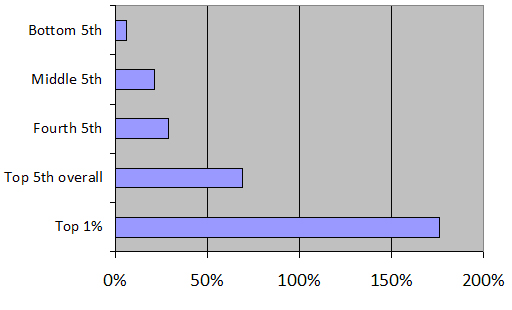
Inflation adjusted percentage increase in mean after-tax household income in the United States between 1979 and 2005. Wikimedia Commons.

Wages are too low.  CEO salaries are too high. Too much wealth goes to profits. Average Americans are “underwater,” while corporations hoard wealth.

We have too many poor people at the bottom; hardly anyone remaining in the middle.  And a relatively small cohort of the wealthy — and the associates and lackeys of the wealthy (who are nearly rich or merely affluent) — at the top.

All the money and the power is at the top, very little money and power at the bottom.

The financial sector is bloated, the industrial base is rusted and hollowed-out.

Demand is too low, and supply is too high. The supply-demand equation is a worldwide phenomenon. The whole world generally has an excess supply of nearly everything, including production capacity. Most telling, we have a worldwide surplus of labor.

Too much greed; too little love. Too much corruption and incompetence in all our institutions. A deficit of honesty and diligence.

Too many putting their faith in luck; giving up on work. Too much speculating, not enough investing.

The winners have more money than they can use; the losers are broke. We have a complete failure of compassion and justice. The winners are tired of hearing about the losers. They just want the losers to shut up. Sit down and shut up. Or better yet, lay down and die.

I wonder what would happen if all the Americans who don’t have the sense to lay down and die suddenly found their voice and their anger. Probably isn’t going to happen, because society is muddled by a surfeit of misinformation, lies, and myths.

Too much blather, not enough factual information.

Speaking of blather, it’s time for me to stop writing. It is easy enough to list the problems. I wish I could suggest some surefire solutions, but I don’t have any.

To sum up: I don’t  think America needs to change direction; rather, I believe we need to restore balance.

— John Hayden

Real Life Interferes With Blogging

Friends, I apologize for being away from ConsterNation for so long. Hard to believe I’ve not posted since the end of April.

What happened? Long story short, I got a job. I continue to make time for reading.  Later in this post, I’ll talk briefly about “My Antonia,” by Willa Cather, and “Babbit,” by Sinclair Lewis.   Continue reading