Thinking About Simplicity — The Nonessentials (My Telephone Land Line)

When I realized that I was living beyond my means, and something had to give, I didn’t start chopping away at the essentials — shelter, health care, and transportation.

Of course not. No one wants to turn their lifestyle upside down overnight. Just chopping away at the low-hanging fruit is painful enough.

By low-hanging fruit, I mean the little things that don’t cost much. You begin carefully pruning the little things.

First thing I learned I could live without came by accident. The moderately priced apartments where I lived were converted to condos. I moved to the cheapest apartment I could find in a safe neighborhood. It was a “junior one-bedroom,” barely larger than the efficiency I live in now. I got telephone service turned on in the new apartment. Basic telephone service, plus the telephone company’s voicemail, for which I paid $5 a month extra.

One little problem: the voicemail didn’t work. It sounded an annoying tone when I picked up the receiver. The tone signaled that I had voicemail waiting. Not such a big problem, right? Except that the system also wouldn’t let me access the mailbox.  So I couldn’t get my messages and turn the annoying tone off. And I didn’t know how many important messages were stuck in the mailbox. How many people were mad at me because I hadn’t called back?  Worse still, as long as the annoying tone stayed on, I couldn’t get a dial tone I couldn’t get my messages, and I couldn’t make calls.

So I call the telephone company’s customer-service department. You know how that goes. The telephone company doesn’t like to answer the phone. You get a recorded message tree: Push one if you speak English; Push two to pay your bill; Push three to add expensive options; Push four if you speak Portuguese.  And so on.

Eventually, you get through to a live customer-service agent, who listens to your problem. First time, customer service tells me they’ll fix the problem right away. Three days later, I call back, and they say they’ll fix it. I keep calling. One time they tell me there is no problem. One time they tell me I will have to pay an extra service charge to get it fixed. One time I even speak to a supervisor, who promises to call me back. She never did.

Three things you can count on when you call customer service:  One, you get an answering system;  Two, the customer service agent can’t solve your problem, but wants to sell you additional telephone services; Three, at the end of every frustrating conversation, the customer service agent asks: “Did I provide excellent service today?”

I finally realized that my existing phone service would never work again. I had an idea. I’d cancel the phone service, wait a few days, then call and order new service. What a concept!

And you know what? After weeks of not being able to use my home telephone, I had an Epiphany. I realized that I can live without a land line!  Why was I paying for both a land line and a cell phone? And the cell phone even came with free voicemail.

That is the story of how I got rid of my monthly telephone bill, and lived happily ever after. Except that I was still spending way beyond my means; I needed to prune lots more low-hanging fruit.  To be continued . . .

Thinking About Simplicity — The Essentials

Food, shelter, and clothing. In a simpler age, those three were the basic human physical needs. In this modern age, most of us would add two more basics — health care and transportation.

I’ve been giving a lot of thought to the essentials these past seven years, once it became obvious that my earnings had peaked and were sliding downhill. One clings to a familiar standard of living as long as possible, past the point of reasonable indebtedness.

I knew that I was spending more than I earned each month, resulting in slowly mounting credit card debt. I could not ignore it forever. And in my late 50s, as I bounced from one hourly wage job to another, I realized that my ability to work hard and long hours was waning.

It was clear that I needed to live more simply and reduce spending.  If I could reduce spending enough, I would be able to work less.

“What am I spending this money on?” I asked.  “And what are the absolute bare necessities?”

My three major expenses were not food, shelter, and clothing. Shelter, yes. I lived in one of the most expensive suburbs in America. The price of a decent house was outrageous. The cost of renting a decent apartment, almost equally outrageous.

The other two money pits were the car, including gas, maintenance, repairs, insurance; and health care. The health care piece came in the form of health insurance, which remained within reach as long as I had a job that offered health benefits.

Clothing has become relatively inexpensive, since most of it is manufactured by cheap labor in faraway places. I already had more clothing than I needed, so clothing expenses were negligible.

Food is nonnegotiable. Food is the last necessity you give up. You can be homeless and walk everywhere, but you still have to eat. Fortunately, food is still relatively cheap because of efficient modern agribusiness. Also fortunately, I do not consume large quantities of food. Conclusion: Not much savings likely in the essential food category.

By process of elimination, the big savings would have to come from  housing, car, and health care.

Thinking About Simplicity, to be continued . . . 

America’s Past, America’s Future

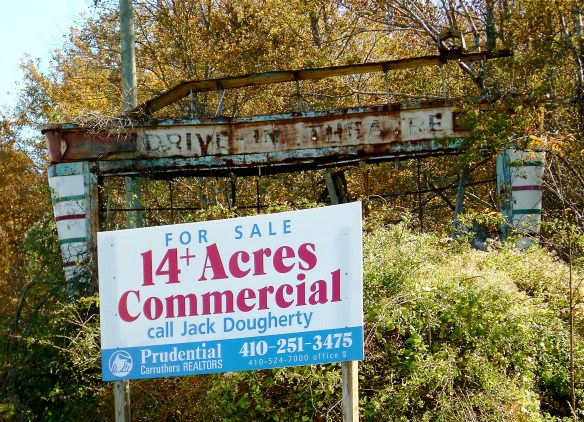
Authentic Americana:  There used to be a drive-in movie theater right here. The rusted roadside sign remains. AUTHENTIC AMERICANA:  There used to be a drive-in movie theater right here. People sat in their cars, or in lawn chairs on the back of pickup trucks, and enjoyed movies under the stars.  The rusted roadside sign is a reminder of a simpler past.

By definition, the “past” is over, and the “future” is waiting to be born. The place where we live is the present moment. We breathe, work, build, learn, change, love and forgive, right now, in this present moment.

As my years fly by, I am coming more to value the present moment. So much of my life was future-oriented, striving to get an education, a job, a mate. Waiting for the right time. Chasing success. Postponing gratification. I often missed the opportunity to live and love in the moment, to enjoy life in the moment, and those moments are gone.

Both success and failure are illusions, I suppose. These days I try to live simply and frugally in the present moment. And what of our larger society?

FUTURE ON HOLD: There's a bright new sign in front of the wreckage of the old drive-in movie sign. The 14 acres where folks once enjoyed movies outdoors on summer evenings, that real estate is still here.

FUTURE ON HOLD: There's a bright new sign in front of the wreckage of the old drive-in movie sign. And the 14 acres where folks enjoyed movies outdoors on summer evenings -- that real estate is idle.

America, and the American economy, also live in the present moment. But at present our industrial base is hollowed out by years of deindustrialization. Too many of America’s leaders put their faith in finance, not factories. Factories mean work; finance means fast money.

The fate of the old drive-in movie theater is instructive. Someone could still make a living showing outdoor movies, is what I think. But the land is  too valuable for that simple use. More money could be made by a more complicated use. In the future.

The irony is that under prevailing economic conditions, no investor can risk buying the land and building something grander.

As a result, in the present moment, the value of the 14 acres is being wasted.