Unknown's avatar

About Editor (Retired)

Newsman, blogger, editor, writer (and no longer young).

Divide And Conquer: The New Plan To End Social Security By Dividing America at 55

Now begins the cold-blooded campaign to destroy Social Security. The plan is to divide and conquer the American people along generational lines. Synchronize your calendars.

If you’re over 55, you’re a Social Security winner; if you’re under 55 you’re a Social Security loser. Life is a lottery based on a four-digit number, the year you were born.

The proponents of this cynical conspiracy intend to pit father against son, mother against daughter. The elders are comfortable, warm and well-fed. So what if the sons and daughters have to eat dog food in old age? Who cares?

FDR SIGNING THE SOCIAL SECURITY ACT, 1935. DO THESE PEOPLE LOOK LIKE COMMUNISTS? WikiMedia Commons Photo

Since the beginning, when President Franklin D. Roosevelt signed Social Security into law in 1935, some people have hated Social Security. The concept of lifting every elderly American off the dirt floor of poverty infuriates the cold-hearted and mean-spirited. The diehard opponents of Social Security live by their own “Golden Rule,” to wit:

“He who has the gold, rules.”

The spirit of Social Security is too good, too honest, too simple, too clear. Social Security is kindness and justice for every old man and old woman in America, backed by the full faith and credit of the United States government. Every old man and old woman deserves to live in dignity, with food to eat and a roof over their heads. What’s so hard to understand about that?

IDA MAY FULLER, RECIPIENT OF THE FIRST SOCIAL SECURITY CHECK. (THESE DAYS, YOU CAN GET DIRECT DEPOSIT.) SSA Photo


The Social Security safety net has been a blessing for every generation since the Great Depression. Medicare has been a life-saver for senior citizens in a health system run by unforgiving insurance companies. There is no good reason why Social Security and Medicare should not continue to be a blessing for today’s adults — whatever their age — and for their children and grandchildren. Where did this crazy idea of discriminating by age and generation come from? Oh, right. For the record, it came from Republicans.

(By the end of March2011, it appears clearly that Republicans intend to destroy Medicare and Medicaid first, by way of a scorched-earth budget policy. Please see my post, “Wilding in Washington: Last Stand of the White Men in Suits.”)

I’m 62, and no one I know among my contemporaries would wish upon their children and grandchildren a future without Social Security.

Only a fool would believe that children born in 2010 will be so healthy and wealthy, 65 years hence, that they will not need a safety net in old age. What is the logic, what is the fairness, in saying that America will keep faith with everyone over 55, and to hell with everybody under 55?

I wouldn’t stand for it, if I were 25 years old today, or 35, or 45. If you’re going to treat one group of people fairly, you must treat every group fairly.

Social Security is solvent right now. The propaganda claims it is not financially viable for the future. The propaganda is a lie. The most recent projections say it won’t run out of money until 2037.

All Social Security needs is minor adjustments to keep going past 2037, and going strong.  See 12 Ways To Fix Social Security.

Every machine needs routine maintenance. That is Social Security exactly. Congress made adjustments in the 1980s, and the machine has been running smoothly ever since. Right now is simply the time for the regular 100,000-mile maintenance.

To discriminate by age is not the American way. Divide American into the privileged and the have-nots at age 55? No way. Put your foot down. Open your window and scream. Just say no.

We can and must save Social Security for today’s 25-, 35-, and 45-year-olds.  With a little fine-tuning, Social Security will still be strong, for those over 55, and for all Americans. What do you think? — John Hayden

What Boomers Can Look Forward To, As We Grow Into The Third Part of Life

THE AUTUMN OF LIFE MIGHT INVOLVE SOME LOSSES AND SOME LETTING GO. DO YA THINK?


The second half of life is different from the first half. What worked in the first half might not work in the second half. So I have been told, and so I believe.

That the second half of life is “different” is, of course, obvious. But what are the differences, what are the adjustments we will have to make? These are not idle questions, for mature people trying to cope in the complex and confusing world of the 21st Century.

I’ve been thinking for some time that this Consternation blog — Consternation from the perspective of a Baby Boomer over 60 — ought to take a stab at these questions.

LIFE CAN BE A FEAST AT ANY AGE, EVEN IF IT'S HOMEMADE SOUP WITH A GLASS OF WINE.

Let’s start by clarifying the questions that I hope to examine, with your help. First, it seems more useful to look at life in thirds, and to say that the third one-third of life is different from the first one-third and the second one-third. Exactly what are the differences?

What are the conditions of life at each of the three stages? What are the problems, the challenges, the work you need to accomplish? Retirement does not necessarily mean the end of work. Particularly important, what are the changes you have to make, and the changes you have to accept, in the third part of life? Let’s stipulate that we Baby Boomers are probably going to continue to learn and grow, even this late in the game. Especially this late in the game.

Let’s acknowledge that the third part of life is going to bring some losses, some goodbyes, some letting go.  We’ll have some sadness, I expect, but hopefully also some joy and accomplishments. I hope for connectedness, rather than isolation. I imagine that a sense of connectedness and belonging will be very important.

AT MY AGE, YOU CAN TAKE A NAP WHENEVER YOU WANT. PAY NO ATTENTION TO THE GRAY HAIR. WAKE ME UP IN TIME FOR SUPPER.

The following video, which I stumbled upon at the Rowdy Kittens blog, might give us a common starting point, and some thoughts to ponder. It’s a talk by Brene Brown. She begins with the statement that, “Connection is why we’re here,” and goes on to issues of disconnection, shame, worthiness, belonging, and vulnerability.

The video is only 20 minutes long, and I hope you’ll give it a listen. Ms. Brown offers many insights on the human condition. She says that vulnerability is the core of shame, and vulnerability is also the birthplace of joy. I have no doubt that many Baby Boomers will have a sense of increasing vulnerability in the third part of life. Perhaps we will be able to embrace it as an opportunity.

Thanks to Rowdy Kittens and to the TED Web Site (“Riveting talks by remarkable people, free to the world”) for making Ms. Brown’s insights available to all.

I have no idea how many posts it’s going to take to examine the issues of the third part of life. I’m not prepared to venture any further in this post. Whether or not you listen to Ms. Brown’s talk, I hope you’ll consider offering some of your own thoughts in the comments area below. Your participation is welcome.

— John Hayden

eBooks and Indie Books Might Be the Greatest Revolution Since Printing

Johannes Gutenberg’s invention of moveable type and the printing press, in the 15th Century, was the most revolutionary development (my opinion) in the history of technology, the history of communication, the history of everything.

Using moveable type, a printer created lines of words and sentences. Wikimedia Commons photo

Mr. Gutenberg could never have imagined offset printing, the printing revolution of the 20th Century, so he definitely would not understand or believe the advent of the eBook, which could be a defining revolution of the 21st Century.

After all the technological revolutions of my lifetime (** See “A Personal Perspective,” below), I do not understand — and can hardly believe — the sudden rise of the eBook. Nonetheless, this week I purchased my first eBook.

Just another stack of books. Wikimedia Commons photo

I had associated eBooks with the development of digital book readers, starting with Amazon’s Kindle. (The price of the Kindle has dropped like a rock as competitors emerged, putting the technology within reach of even frugal folks like me.) With a Kindle or one of its imitators, you can download books, newspapers, magazines, etc., and carry them around in a small, handheld device, to be read at will. Amazon boasts that the Kindle could hold a small library of books.     Continue reading

What Prevents Surgeons And Hospitals From Providing Free Surgery To Save A Life?

Sunset at Organ Pipes

Image by Bill Gracey via Flickr

News organizations are reporting this evening that at least two patients have died in Arizona because the state has decided it can no longer afford to pay for organ transplants for low-income patients.

The organ transplants can cost from $200,000 to more than $1 million, according to NPR.  A list of 98 patients are potentially impacted in Arizona. NPR provided this explanation of the Arizona budget decision in November:

“In Arizona, 98 low-income patients approved for organ transplants have been told they are no longer getting them because of state budget cuts.

The patients receive medical coverage through the Arizona Health Care Cost Containment System (AHCCCS), the state’s version of Medicaid.” — National Public Radio

WTF?  How can a state justify refusing organ transplants to low-income patients, particularly in cases where the refusal amounts to a death sentence without a trial?

But there’s another question that’s even more compelling:

Why have no surgeons or hospitals offered to do the life-saving surgery for free?

What prevents a doctor or hospital from providing free life-saving treatment? DO THE SURGERY FOR FREE! Would that be un-American?

Am I missing something here? Would a surgeon or hospital spokesperson care to comment? Is there not a single, altruistic transplant surgeon in America? Is there not a single hospital affiliated with a religion that would be willing to provide free surgery as an act of charity, for God’s sake?

What? Would it set a bad precedent, or something?

— John Hayden

PostaDay2011 Raises A Philosophical Question: Is More Always Better?

William Shakespeare, chief figure of the Engli...

William Shakespeare, image via Wikipedia

WordPress.com, the best free blog platform in the whole World Wide Web, has thrown down a challenge to bloggers. I’m a joiner, so I’ll take up the challenge.

The goal of the WordPress challenge is to encourage bloggers to post more often. Two obvious options are to post every day during 2011 (that would put you on the path to being the Cal Ripken* of blogging), or to post once a week during 2011. I’m going for once a week.

Let me start by questioning the premise of the WordPress challenge. Most bloggers accept, as an article of faith, that we ought to post more often, ideally at least once a day. (Many people subscribe to the same theory about sex. That is, the more the merrier! And hey, doesn’t everybody do it at least once a day??)

Why? Where is it written that MORE, or MORE OFTEN, is better?

As a career journalist (both reporter and editor), I know from experience and observation that all writers have limits.

To be sure, the late, great Washington Post sports editor Shirley Povich wrote his sports column at least six days a week for years. But columnists usually write perhaps three columns a week, and no more.

William Shakespeare wrote an amazing number of plays and sonnets, back in the day. (But we don’t know very much about the life of Shakespeare. Were the works of Shakespeare all written by William Shakespeare? Or by four other playwrights using the same name?)

Cal Ripken, Shirley Povich, and William Shakespeare were uniquely gifted in their fields. But the WordPress challenge urges every blogger to post daily, if possible. Whereas Ripken, Povich, and presumably Shakespeare, devoted their lives to their professions, most bloggers are part-time amateurs. And before blogging, professional writers were backed up by editors and proofreaders. Bloggers are backed up by spellcheck, if we remember to use it.

So now we have this inferiority complex. Whatever it is we’re doing, we aren’t doing it OFTEN ENOUGH, which translates to the slogan of the assembly line: “Work faster.”

Work faster! (Is that the best you can do?) Work faster, work faster, work faster. Faster and faster!

Capitalism and the Protestant work ethic are relentless in their demand for more production, faster. We have become a society of guilt-ridden and exhausted drones. That’s in our work life. Blogging, for almost all of us, is a hobby, a leisure activity, an avocation. We want to get some satisfaction from blogging. Pushing ourselves to post every single day turns blogging into a discipline, like meditating every day, or going to the gym every day.

Discipline is good for you. But dare I say it: Blogging is supposed to be fun!

In addition to draining the fun out of blogging, the post-every-day work ethic will also drain the quality out of writing. Good writers know that writing takes some time (although miracles happen on deadline). Nearly every written page benefits from being set aside, to be reconsidered later. Nearly every page improves in the rewriting.

There, that’s almost enough. With a few more keystrokes, I’ll have 500 words. I have proven once again that any journeyman reporter can produce drivel on demand, every day if necessary.

Posting every day is not necessarily good for bloggers, or for their craft. Just my opinion.

— John Hayden

*Cal Ripken is the retired Baltimore Orioles shortstop, the “Ironman” who broke Lou Gerhig’s record of consecutive baseball games played. You could look it up.

Political Zeitgeist In America

Is there any political reality remaining in America? I’ve been trying to make sense of the political zeitgeist following the election of 2010. Two contradictory perspectives came into focus this week.

Vice President Joe Biden summed up the message from the electorate on “Meet the Press.” Voters want elected officials of both parties to work together and compromise, Mr. Biden said.

MICHELLE RHEE. -- Wikimedia Commons public domain photo

Michelle Rhee, an education reformer who used to be chancellor of D.C. public schools, stated a different position in “Newsweek.”

“I don’t think consensus can  be the goal.” said Ms. Rhee. And: “We can’t shy away from conflict.”

That’s the tension in American democracy — longing for peace and compromise on one hand; and an appetite for political conflict on the other. Voters who are comfortable with the status quo yearn for politics without conflict. They see reformers as troublemakers.

Reformers seeking change are impatient with compromise. They’re willing to tolerate a degree of political unpleasantness to achieve a goal. Compromise usually doesn’t bring them closer to the goal. Compromise simply kicks the problem down the road for a year or three.


THE AMERICAN ELECTORATE IS NOT ONLY POLARIZED AT THE EXTREMES. THE INDEPENDENTS IN THE MIDDLE HAVE LITTLE USE FOR EITHER SIDE. Wikimedia Commons public domain image.

It’s human nature to seek the easiest path, to avoid pain and sacrifice. So it’s not surprising that a majority wants compromise. That’s what happened this week, when President Obama crafted an agreement with Senate Republicans to extend current tax cuts for the wealthy, and at the same time extend unemployment compensation for the poor.

The tax-cut compromise is the easy path. It avoids pain all around. But it also adds billions to the national debt. The majority of voters got what they wanted, a minimum of conflict. They are pleased to kick difficult decisions about the national debt and economic austerity down the road.

Americans seem to be dangerously addicted to the easy path. European nations are engaged in national debates (often in the streets) over austerity measures to address their debt problems. America is falling behind on debt, just as we are falling behind in economic competitiveness.

Most troubling of all is that America has fallen way behind other advanced countries in education. Michelle Rhee knows about the public schools:

“The truth is that despite a handful of successful reforms, the state of American education is pitiful, and getting worse.”

If we’re not competitive on education, we won’t have a chance to be competitive economically. And the American electorate complacently ignores the education crisis. In fact, state and local governments are preparing to cut deeply into funding for education, in order to balance government budgets.

Ms. Rhee is quite forthright about the political path to improving education in America. And it’s definitely not the easy path.

“Public school reform is the civil-rights issue of our generation. Well, during the civil-rights movement, they didn’t work everything out by sitting down collaboratively and compromising. Conflict was necessary in order to move the agenda forward. There are some fundamental disagreements that exist right now about what kind of progress is possible and what strategies will be most effective. Right now, what we need to do is fight.”

Any questions? Yes, political conflict is necessary for problem-solving and progress. In some other countries, they resolve political differences through violent conflict. In America, we resolve political differences through elections. Settling our conflicts through civil debate, rather than violence, is the great achievement of democracy in America.

We need to start addressing our political conflicts, not avoiding them. The sooner the better.

— John Hayden

Secrets of Living Large In A Small Apartment

A TALL, SNOW-COVERED, OUTDOOR CHRISTMAS TREE IS THE RIGHT SOLUTION WHEN YOU LIVE IN A SMALL, INDOOR APARTMENT.

I’m making some progress on downsizing and simplifying my lifestyle. Two years ago, I moved from a large apartment in a pricey suburban neighborhood to a small apartment in a rural/seasonal resort area three hours from the cities.

I gave away a lot of stuff, and moved what was left helter-skelter into a one-room apartment. It has two windows in front and a door and screened porch in back. Cross-ventilation!

Rent is reasonable and includes all utilities. Priceless amenities are a quiet street that ends at the marsh; a parking space; a small fenced yard, with nothing but woods beyond; cable TV and high-speed internet service.

One-Room Apartment “Before” Pictures

CLUTTER GONE WILD.

CLUTTER ALL AROUND.

A COMPLETE GALLEY KITCHEN. EVEN A FIRE EXTINGUISHER, IN CASE I TRY TO COOK.

My neighborhood is an enclave of quiet affluence. Within sight, across the water, is a resort that can be rowdy in summer and a ghost town in winter. I might be the poorest church mouse on the block, but not the only one living on a tight budget. A few of the houses are little more than old beach cottages, but most are medium-size, modern homes with that suburban look. Some of the more spacious houses have million-dollar waterfront views. Within a short walk are two grand, waterfront homes that must be worth . . . I can’t even guess. One of them is a modern mansion.

No Extra Charge For Natural Beauty

THE MARSH IN WINTER. VISIBLE BY WALKING DOWN THE STREET. NATURAL BEAUTY AND PUBLIC SPACES ARE IMPORTANT AND USUALLY FREE.

But I digress. This post is not about living large in a mansion. Anyone could do that. And it’s not about living large in your car or a tent, which would be more of a challenge than I’m up to. We’re talking about a modest and attainable goal of living large in a small apartment. (If your apartment has a separate living room and bedroom, with a walk-in closet . . . well, that doesn’t qualify as small).

If It’s Big Enough For A Cat . . .

SAFE AT HOME. LOLA IS PERFECTLY CONTENT IN A SMALL APARTMENT.

My challenges with living large in a one-room apartment are the same ones I would have in a big house. Fundamentally, I have no “nesting instinct.” Plus, I’m disorganized. The only kind of order that comes naturally to me is “Robert’s Rules of Order.” For everyday life, the nesting instinct is more useful than Robert’s Rules.

My Rules Of Order

Here are Hayden’s Rules of Order for one-room apartment living:

  • Pay the rent on time. Otherwise, you will be living in your car.
  • I’ve got to get organized, and it can’t be forever put off until tomorrow. Two years is long enough.
  • A place for everything. Everything in its place. Efficient use of what little storage space you have is essential if you live in one room and you own more than one “thing.” One-room apartments generally don’t have wine cellars, garages, or attics. Not even walk-in closets. Drawers, shelves and hooks are essential. (The easiest kind of hook is a nail in the wall, but some landlords frown on this method.)
  • Furniture. Less is better. Replace all large pieces of furniture with small. I’ve replaced the sofa with a chair, and the double bed with a single bed. (It helps if you have the lifestyle of a monk). A toaster is better than a toaster-oven; a good radio/CD player is better than a complicated stereo system; a laptop is better than a desktop.)
  • You can break the small-furniture rule once. I still have the same medium-sized dining room table as when I lived in more spacious apartments. The table is clunky and dominates my one-room apartment. But it’s an all-purpose table. It serves as dining room table, kitchen table, and desk. I need a certain amount of surface area to be organized, whether the task is paying the bills or making soup.
  • Experiment. Find a way to make the furniture fit. I’m on the third rearrangement of my furniture. After two years, you get tired of playing “furniture checkers.”  Furniture checkers is a game in which you have to move one chair and jump over at least one other “thing” in order to get to your goal. There must be a way to arrange this furniture efficiently! I will have to find it by trial and error, since I have no interior design skills.

HOME OFFICE OF THE ConsterNation BLOGGING EMPIRE. SOMETIMES ALSO USED AS A POLITICAL CAMPAIGN HEADQUARTERS.

Clutter Is My Enemy

I’ve saved the most important secret of living large for last. As you can plainly see from the photos, I need to reduce clutter.

People sometimes criticize me for having too much “stuff.” I’ve gotten rid of enormous amounts of stuff, but I still have too much. Other people have their stuff all over the basement, the garage, the attic, the walk-in closet, the guest room. And that’s not all. Homeowners often rent a storage space for their extra stuff. Why don’t they simply give it away or sell it on eBay?

Everything I own is inside my one-room apartment, or inside my car, which is parked in the driveway. And there’s a limit to how much clutter I can hide in the trunk of the car.

To sum up, I need to get organized and reduce clutter. That’s not too much to ask. I call this challenge “My Apartment Project.” Two years is long enough to put it off. What you see here are the “before” pictures. Coming soon will be the “after” pictures. Wish me luck and stay tuned.

If you have any helpful tips on one-room apartment living, they would be welcome under “comments” below.

— John Hayden

Unemployment and $3 Gasoline in the U.S., Austerity and Street Protests in the Capitals of Europe

BOOK SHIELDS IN ROME. One of many photos circulating in European newspapers and blogs, of protests against government austerity plans. This one shows students in Rome using book-like shields. Tomorrow, you'll likely see similar street theater in London. But only if you have access to European sources.

The beautiful people on CNBC, the Wall Street propaganda channel, chat happily about how high stocks might fly, and the price of gold and oil.  It’s surreal.

Even as they talk, the economy of the Western world is teetering on the edge of chaos. Students protest daily in the capitals of Europe against draconian austerity plans designed to screw the middle class and working class, and especially the younger generations. European governments seem intent on staving off default by cutting deeply into funding for education, arts and humanities. As you can see, ConsterNation is an international state of mind.

You need direct European sources to keep up with events over there. For instance, news and photos of the book protests in Rome can be found at this Italian blog by Italian novelists. If you can read Italian, you could look at their main blog.

Baroque in Hackney reports that students in London will mount a similar protest on Thursday. Ms. B even provides the address where you can go on Tuesday to help make life-sized books for the demonstration, if you happen to be in London. If not, there’s plenty of time to get there by Thursday. It’s a small world, so they tell me.

“With Arts and Humanities a particular target for UK cuts this is a literal display of literary resistance.”  — Ms. B

For more inside information (and videos) from the U.K., you could look at Coalition of Resistance.

Until recently, the U.S. cable channels had been reporting on the debt crises in Greece and Ireland. But as the contagion threatens to spread throughout the southern half of Europe, coverage in the U.S. has all but disappeared. You’ll not likely see film or photos of protests in Europe on CNBC, or any other news channel.

Could the U.S. news blackout on European protests be a conspiracy to keep Americans from knowing the extent of economic turmoil, at least until after the Christmas shopping season? When did I become so cynical? Maybe the news blackout is to prevent protest fever from jumping the Atlantic and infecting U.S. students. Maybe it’s to prevent panic.

Let’s go to the NUMBERS.

Even as the beautiful TV people talk, unemployment in the U.S. is 9.8 percent, officially, and possibly twice that much, in reality. Members of the U.S. Armed Forces are fighting and dying in Afghanistan and Iraq, and for their service they will receive a 1.4 percent pay increase, the lowest in many years. The price of gasoline is $2.97 a gallon, where I live, and more than $3, in urban areas. The snow is knee-deep, or higher, in Buffalo, N.Y.; and the temperature is going down to 30 degrees tonight in Orlando, Florida.

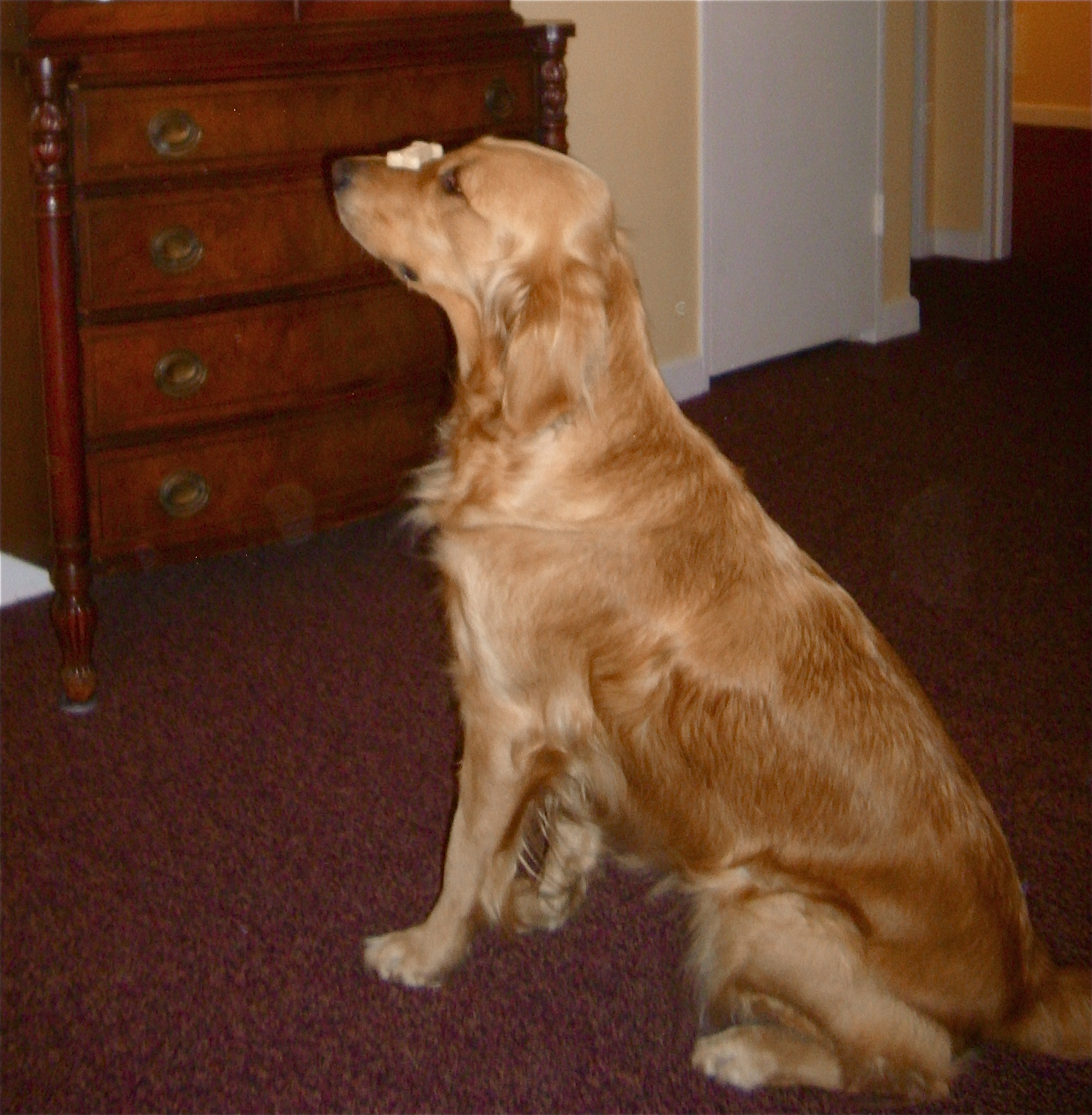
LILY HAS AWESOME POWERS OF CONCENTRATION WHEN A DOG BISCUIT IS BALANCED ON HER NOSE.

And Lily, the golden retriever, has about a one-in-three chance of balancing a dog biscuit on her nose, tossing it in the air, and catching it in her mouth. I had to add the true story about Lily and the dog biscuit for a little comic relief.

No one can predict the future. But let me make a few guesses. The temperature will go up later this week in Florida, and the snow will melt in Buffalo, by late spring.

But across America, it is entirely possible that unemployment will remain above 10 per cent and gasoline will remain above $3. For how long? Forever.

And what will the austerity plan agreed to by the U.S. government and the Wall Street tycoons look like? I will not hazard even a guess.

— John Hayden

“You Say You Want a Revolution?”

A picture is worth a million words. There seems to be a difference of opinion throughout Europe (and in America, too) concerning money, and debt. Also, some mild disagreement about who should pay the price and make the sacrifices, and who should get bailed out.

Schoolgirls link hands to protect a police van during student protests in London. -- Peter Marshall photo.

Baroque in Hackney reports that a younger generation — “The Kids” — is seizing responsibility because their elders are cowed by the powers that be. Ms. B’s post is enlightening. I urge you to read it.

How far will the wealthy elites in Europe and America push the children of the former middle-class? If you want to know which way the wind is blowing, please read this article by Jonathan Jones from The Guardian. Here’s a brief excerpt:

“For this picture tells a lot, very quickly. It tells us the menace of violence is real as anger grows among groups directly afflicted by the coalition’s cuts. Yet it also reveals that most protesters are peaceful, idealistic, with a sense of history and of the gravity of their actions. Most of all it tells us how amazingly young many of them are.

Future historians may well write that the Conservative-Liberal coalition was doomed the day schoolchildren took to the streets to assert their right to a university education.”

People are protesting in the streets in France (Social Security); England (college tuition); Ireland (budget cuts); and the European Union is getting ready to bail out the biggest banks in Greece, Ireland, Portugal, Spain, and maybe Italy. The U.S. already bailed out its bankers, and people protested with their votes.

So this is the way it’s going to be? The rich get richer; the middle-class get screwed?

“You say you want a revolution
Well, you know
We all want to change the world
You tell me that it’s evolution
Well, you know
We all want to change the world
But when you talk about destruction
Don’t you know that you can count me out
Don’t you know it’s gonna be all right
all right, all right

You say you got a real solution
Well, you know
We’d all love to see the plan
You ask me for a contribution
Well, you know
We’re doing what we can
But when you want money
for people with minds that hate
All I can tell is brother you have to wait
Don’t you know it’s gonna be all right
all right, all right”

— The Beatles

I’ve written about the consequences of what I would call “capitalism off the hook” before. I didn’t think the reaction in the streets and at the voting places would be so swift or serious.

With apologies to Buffalo Springfield, I don’t think it’s paranoia. I think, “There’s something happening here. What it is ain’t exactly clear.”

Mr. Jones of The Guardian describes what’s happening as follows:

“We can look at this picture and see a mass movement rapidly evolving as a generation goes beyond merely taking to the streets and starts finding a larger meaning in its rebellion, and imposing order in new ways. What these girls are showing us is that this is not just about rage. It is a defiant stand for youth and hope.”

Do you think President Barack Obama and Fed Chairman Ben Bernanke understand what’s happening?

“The Kids” and their “cowed” parents understand that they’re being screwed. Government leaders understand the consequences of tax cuts for the rich and budget cuts for the poor.

The wealthy elites understand that they’re screwing the poor, and what’s left of the middle-class. The wealthy always believe they have a right to exploit the poor.

So it looks like it’s the Powerful elites against “The Kids.” You can call it “class warfare,” if you want. I’m afraid that the Powerful will make precious few concessions to “The Kids,” at least not without an ugly struggle. How it will play out, no one knows.

— John Hayden

My Life Organized Into “Projects”

Social Security Poster: old man

Image via Wikipedia

So now I realize that my wayward life has become a series PROJECTS.

I use the word “project” in the baseball sense. Major League teams are eager to sign talented young players who are promising “prospects.” Note the difference between a prospect and a project.

A “prospect” has a real chance to make it in the Major Leagues, after a year or two in the minors. Baseball scouts have high expectations for a prospect. He probably gets a bonus simply for signing a contract. Hence, the term, “bonus baby.” Millions, sometimes, for raw talent.

A “project,” on the other hand, is a young player who appears to possibly have the makings of a Major Leaguer. But the wise old men of baseball understand that this player needs a lot of coaching, and maybe years of seasoning in the minors. Developing this rookie into a Major Leaguer is a project for the long term.  The outcome is by no means certain.

My projects are never going to the Major Leagues, but they will require perseverance to reach humble goals. I’ve already mentioned the first two projects:

  • My Austerity Project. The first part of this project is simply keeping a record of how much money I spend every day, with a goal of bringing my budget under control. The record keeping is easy enough, and I’m sticking with it every day. The frequency of unbudgeted expenses, however, is discouraging. The $328.33 for routine 50,000-mile maintenance on my car this past week, for example. This project is going to be like pushing a rock up a hill every day.
  • My Fitness Project. I mentioned that I got a good deal on a one-year gym membership. So far, I’ve been using the gym every third day, sometimes walking on one of the in-between days. I’d like to ratchet up the Fitness Project to every other day at the gym. Even better would be working out almost every day. Just showing up is clearly 80 percent of the Fitness Project. So far, so good.

In addition to Austerity and Fitness, the care and organization of my small and disorderly living space has achieved the status of full-fledged project. My Apartment Project. More on this to come soon, with “before” pictures.

And now I see that the Holiday Project is upon us again. This is primarily a Survival Project. The Holiday Project will make all the other projects more challenging. Normal life resumes on Jan. 2, 2011.

After the holidays looms My Job Project. Talk about a humble project! It’s weighing on my mind a little. But not too much, thanks to Social Security.

I feel a rant coming on soon about politicians who want to solve the national budget and debt crisis by killing Social Security. They want to throw aging workers under the bus. Or put us on an iceberg and let us drift out to sea.

Excuse me, but I’ve been paying taxes into Social Security since I went to work at McDonalds at age 16. Social Security is not like welfare, or even food stamps. My Social Security is b0ught and paid for. I own it. It belongs to me. Do I make myself clear?

As you can see, I’m dealing with a full load of projects here. And I haven’t even mentioned the Laundry Project, which has reached the top of the priority list for tomorrow, or the Blogging Project, the one that keeps me typing until the middle of the night.

If it weren’t for the Blogging Project, consisting of three different blogs (which is two blogs too many), I’d have more time to focus on the important projects.

— John Hayden