I haven’t read this new epic, but I think it might be a landmark in ebook publishing. It’s worth a look. — John
A Storm Hits Valparaíso – Released Today!.
Related articles
- 2011: The Self-Publishing Year In Review (davidgaughran.wordpress.com)
I haven’t read this new epic, but I think it might be a landmark in ebook publishing. It’s worth a look. — John
A Storm Hits Valparaíso – Released Today!.

ANN PATCHETT
Blogger’s note: This review was originally published in December 2007, in three installments, on my first WordPress blog, Maryland On My Mind. Time flies, posts get buried, new blogs are born, and great books live forever. The original review has been deleted from the old blog in compliance with search engine policy. — John Hayden
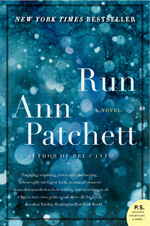 Dec. 8, 2007 — When you read about Bernard Doyle, the former Boston mayor with great ambitions for his sons, you can’t help but free-associate: Kennedy. At least I can’t. Two of the sons are named Tip and Teddy!
And then I free-associate: Skeffington. Bernard Doyle and Frank Skeffington. Two Irish-Catholic mayors who loved their city, and were beloved by many. The voters turned on both of them. Doyle told a lie to protect his family and faded away without achieving his own ambitions. Skeffington stayed on too long. Again, I free-associate: William Donald Schaefer, late great mayor of Baltimore.
Ann Patchett reminds me of Edwin O’Connor. I discovered O’Connor’s 1956 novel, The Last Hurrah, in high school, and read all his other books. The two authors have insights about the same subjects — people, politics, family, God — and breath-taking writing talent, honed by attention and effort.

Cover of End of Work
The mob is clamoring for a big, definitive “plan” to “create” JOBS.
The problem is, we are all yearning for a return to the prosperity and good jobs of the 1950s. A return to Middle-class America. That model of American prosperity lasted for a half-century, even as it was eroding away. That model lasted through the inflating 1970s, the greedy 1980s and the bubbling 1990s.
The middle-class model of America, with good-paying jobs all around — it’s over. We aren’t going back to the 1950s. It’s impossible. That’s where President Barack Obama’s JOBS plan has got to start. Continue reading
America is not in the grip of mass hysteria. It’s more like mass acedia.
Americans are jamming the Congressional switchboards with telephone calls, as political and economic chaos draws near, but what’s the message? We have no consensus for constructive action. And surprisingly, we lack even a widely shared impulse to avoid self-destructive behavior. What we see and hear is more like a combination of teen-aged indifference and childish impatience: “Do something. Do Anything. Just stop bothering me.”
Democratic processes are failing, and we have no King Solomon, no leader with the sure wisdom to know the right thing to do in the present circumstance. Continue reading
Friends, I apologize for being away from ConsterNation for so long. Hard to believe I’ve not posted since the end of April.
What happened? Long story short, I got a job. I continue to make time for reading. Later in this post, I’ll talk briefly about “My Antonia,” by Willa Cather, and “Babbit,” by Sinclair Lewis. Continue reading
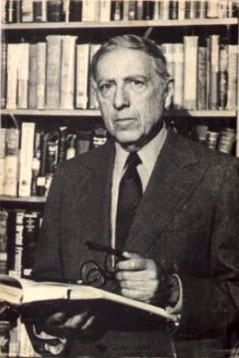
HERMAN WOUK
Originally published 03-25-2011
I finished Herman Wouk‘s “War and Remembrance,” a fictionalized but authentic novel of World War II, last night. The book left me overwhelmed and exhausted, and wanting urgently to pin down the most important of Herman Wouk’s keen insights into human folly and war.
Quite an accomplishment, for an author to cover the entire, bloody history of World War II — the ultimate manmade catastrophe — to bring some order out of the chaos, and write down the story for an ordinary reader like me to understand.
The Black Swan has landed in Japan.

Fair-use of Copyright cover from “The Black Swan” via Wikipedia.
The earthquake(s) and tsunami(s) in Japan, and their terrible consequences, are straight out of “The Black Swan,” by Nassim Nicholas Taleb. The subtitle is: “The Impact of the HIGHLY IMPROBABLE.” (No, we’re not talking about a ballet film.) If you plan to continue living in the unpredictable world of the 21st Century, you probably should read “The Black Swan.” Just my opinion. Mr. Taleb’s home page is here.
A Black Swan is an event that’s “outside the realm of regular expectations, because nothing in the past can convincingly point to its possibility,” Mr. Taleb writes.
Johannes Gutenberg’s invention of moveable type and the printing press, in the 15th Century, was the most revolutionary development (my opinion) in the history of technology, the history of communication, the history of everything.
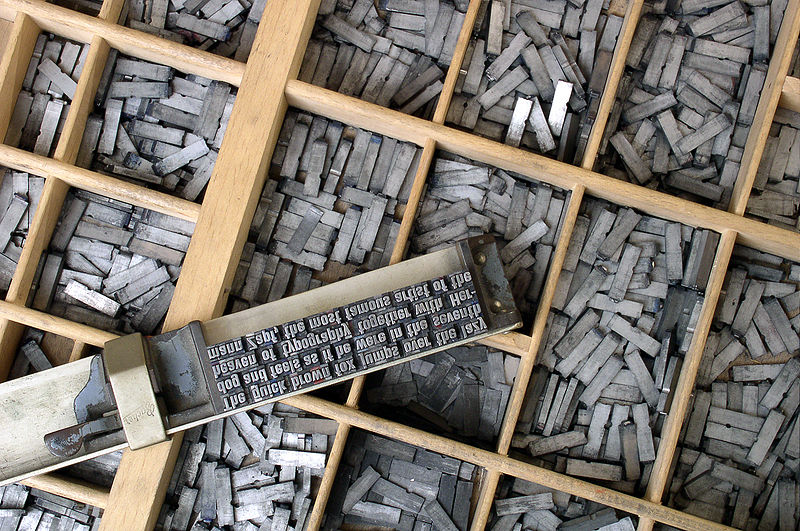
Using moveable type, a printer created lines of words and sentences. Wikimedia Commons photo
Mr. Gutenberg could never have imagined offset printing, the printing revolution of the 20th Century, so he definitely would not understand or believe the advent of the eBook, which could be a defining revolution of the 21st Century.
After all the technological revolutions of my lifetime (** See “A Personal Perspective,” below), I do not understand — and can hardly believe — the sudden rise of the eBook. Nonetheless, this week I purchased my first eBook.

Just another stack of books. Wikimedia Commons photo
I had associated eBooks with the development of digital book readers, starting with Amazon’s Kindle. (The price of the Kindle has dropped like a rock as competitors emerged, putting the technology within reach of even frugal folks like me.) With a Kindle or one of its imitators, you can download books, newspapers, magazines, etc., and carry them around in a small, handheld device, to be read at will. Amazon boasts that the Kindle could hold a small library of books. Continue reading
 Here’s a book review of interest to all of us who grew up during the 1950s. The book is “Revolutionary Road,” by Richard Yates, and the review is over at Baroque In Hackney.
Here’s a quote from the review that rings true with me:
“Of course, it’s a tragedy. But it’s a nasty tragedy. It’s not a tragedy about the price of conformity, it’s more about the danger of imagining yourself better than everyone else. It’s the fifties turned inside out, and I found myself laughing out loud in inappropriate places, just for the joy of it.”
So many of us imagine ourselves as “better than everyone else.” The Tea Party leaps to my mind. Continue reading
Liam and Eunice were in the blush of romance, last we saw them. That didn’t last long, naturally. What “Noah’s Compass” needs is a little more love and a little less reality. I won’t spoil the story by revealing the details of the relationship’s failure. It was painful, and sad, and just plain disappointing. But you knew that.
 Living Simply And Still On The Grid