The Ultimate RV Downsize

The concept of living in a very small house fascinates at least some readers of my blog. Here is an extremely thoughtful post about homelessness, and some options for moveable shelter. These ideas probably beat sleeping in your car.

barbara's avatarThe RVing Lifestyle

Talk about innovative, this shopping cart pop-up would have to take the prize.  Shelter comes in many shapes and sizes as you can see but I totally get it. If our economy continues to decline we will see more of the camper kart pop-ups.

State of Homelessness in America 2011

Since the release of Homelessness Counts: Changes in Homelessness from 2005 to 2007, the Alliance has chronicled changes in the levels of homelessness in the nation and in individual states and communities to chart the progress toward the goal of ending homelessness. This comprehensive examination not only reveals national and state level homeless counts, but also delves into economic indicators and demographic drivers – taking an in-depth look at risk factors for homelessness. Built upon the most recent nationally available data from the federal Departments of Housing and Urban Development, Health and Human Services, Justice, and other…

View original post 638 more words

AMERICAN VALUES — “That Used To Be Us”

From That Used To Be Us, by Thomas Friedman and Michael Mandelbaum; Chapter 13, “Devaluation:”

THOMAS FRIEDMAN, Wikimedia Commons

“. . . something else that happened with the end of the Cold War and the passing of the baton from the Greatest Generation to the baby boom generation: an erosion of important, traditional American values that long underpinned our public and commercial life. . . .

“A well-functioning political system must be rooted in something deeper than itself:   Continue reading

The Big JOBS Plan: What is Possible? What is the Goal?

Cover of

Cover of End of Work

The mob is clamoring for a big, definitive “plan” to “create” JOBS.

The problem is, we are all yearning for a return to the prosperity and good jobs of the 1950s. A return to Middle-class America. That model of American prosperity lasted for a half-century, even as it was eroding away. That model lasted through the inflating 1970s, the greedy 1980s and the bubbling 1990s.

The middle-class model of America, with good-paying jobs all around — it’s over. We aren’t going back to the 1950s. It’s impossible. That’s where President Barack Obama’s JOBS plan has got to start.   Continue reading

Living Small In The Big Apple

When I think about the tiny house movement, I usually think “rural.” But I suspect a lot more folks are living large in a small space in big cities, than in the countryside. Makes sense, because in cities, you calculate rent by the square foot.

Here’s an extreme example, and just goes to show what you can do, if you’re organized (and don’t own a lot of stuff).

(Quick-take rating for this post: 69 words.)

Rightsizing Your House

This slideshow requires JavaScript.

How much living space do I need?

This week, I discovered a new community of  small, bare-bones cottages here on the Eastern Shore of Maryland, and it got me thinking about how much space is enough.

A lot of folks are intrigued by the tiny house concept. These cottages probably don’t quite meet the standard for “tiny.” Most are one-bedroom, living room, bath, and galley kitchen. Some have two bedrooms. You can look here for more pictures and floor plans.  The rooms are SMALL, but the Web site doesn’t give dimensions.

I estimate the cottages have about as much space as a small,  one-bedroom garden apartment. No doubt, many people in Manhattan live in high-rise apartments smaller than this. And tiny “alley” rowhouses were once commonplace in Baltimore.

This is no-frills living, but I prefer to think of it as a simple lifestyle. You get a front door, a few small windows, a roof. A small closet, but none of the clever, built-in storage niches you find in custom-built tiny houses. You want amenities? The community has a laundry room with  six washers.

Neighbors on both sides. Togetherness. Community! You’ve got as much space as in a modest trailer park, or less. Looking down a row of cottages, I get a flash of a Depression-era work camp. (Not that there’s anything wrong with that.)

Not exactly the splendid privacy that many small-house advocates imagine. But I’ve always wondered if the concept of a 12 X 12 cabin on a remote mountainside isn’t contradictory. Elitist even. I mean, a tiny house with your own, private, national park? It is true that when you opt for simplicity, you may also find grandeur. Monks usually take vows of poverty, but sometimes live in impressive old monasteries.

No grandeur is included with the austere cottages pictured above. Don’t be misled because they’re near a beach resort. These cottages are clearly designed for workers, not tourists.

Rent is $600 a month for the one-bedroom models, plus utilities. A modern water and sewer system is paid for by the owners. Your cable TV bill looks like a BIG EXPENSE, in this scenario, especially if you also want Internet access. I’ve been spoiled by cable TV and Internet the past few years. Wonder if I could do without? Remember, we’re talking about simplicity and frugality. TV and Internet are not necessities, like food and water. Or are they?

I could still write on my computer, just not connected to the Net. When I need the Net, I’d go to the library, and use the fast, free WiFi.

I could listen to FM music or news over FREE airwaves. (Imagine that! Free radio. TV signals used to be free, too, but free TV was too good to last forever.)

Long story short, housing is adapting, if only a little, in response to the crash. Are people choosing a simpler lifestyle? Or in the new normal, do people have no alternative? Time will tell, but I doubt that cottages as small as the ones pictured here will become commonplace in America. Other countries, maybe.

For those who want to reduce their carbon footprint, a small cottage is a big step forward. I’m nagged by one reservation: Beware the fine, thin line between simplicity and poverty. Spacious suburban manses — the ideal goal for many Americans — are clearly not a necessity. Space is a nice luxury, if you can afford it.

But I wonder if tiny houses are more a novelty than a viable alternative? Most folks feel more at ease with a bit of elbow room. Space enough for two people to slow dance, at least. An extremely tiny house could be tough on the spirit, it seems to me.

I’m in favor of living space that is, as Goldilocks put it, “Just right.” It’s an individual thing. Or a matter of negotiation, for a couple. Between huge and tiny, a modest cottage might be a reasonable compromise.

— John Hayden

For photos of my own efficiency apartment, take a look here.

You can learn about the Tiny House Movement at  “How I Met My Tiny House Hero,” by Tammy Strobel.

“It’s the dogs that count”: a tale of the New Austerity (via Baroque in Hackney)

While I’m working myself into a lather, writing my next post about THE END of Civilization in America, you have time to enjoy this spirit-lifting essay by Ms. B, a gifted British blogger. She manages to cover many of the things that really matter — dogs, austerity, friendship. Ms. B makes her points deftly and moves on. She doesn’t beat you over the head, again and again, about the same boring issues, the way I do.

"Its the dogs that count": a tale of the New Austerity Well, I promised you dogs. The sad truth is that this picture was scanned in yesterday morning and has been sitting since then, waiting for a post. It has taken that long to find a few minutes. I have a friend whose mother was a doughty woman from Bristol, who knitted and sewed and made do and mended, and who recycled absolutely everything. A good, solid, practical, no-nonsense woman, in the old  mould. She died about ten years ago, if  not maybe … Read More

via Baroque in Hackney

You Decide: How Much Is A Worker Worth? What Is Fair Pay?

Last night, I attended a meeting about social justice issues. Naturally, the controversy about public worker salaries and unions in Wisconsin came up.

One person commented, “The workers in Wisconsin are not poorly paid.” As if that were a known fact.

We all have preconceived notions about how much certain workers are paid. (When we say “public workers,” we’re often thinking of  teachers, firefighters, and police officers. It is important to point out that by the very nature of state and local government, large numbers of the workers are in traditionally low-paying  jobs requiring low levels of skill or education.)  What do you think is fair pay? Please vote.

Which workers are we talking about? Teachers? Police officers? School maintenance workers? School cafeteria workers? Bus drivers? Road repair crews? Attorneys, engineers, accountants? Public health nurses? Truck drivers? Clerks who process paperwork or answer the phone?

Does a police officer deserve to be paid an adequate living wage? Does a trash collector? Should fair pay be enough for the worker to support himself or herself only? Or should the pay be high enough to also support a child? Two children?

Was answering these questions difficult, impossible, easy? Who should set pay rates? The governor, the private market, the unions, collective bargaining, lottery? Put them all  on the ballot for the voters to decide in a referendum?

How much should bloggers be paid? What? Never mind!

John Hayden

Secrets of Living Large In A Small Apartment

A TALL, SNOW-COVERED, OUTDOOR CHRISTMAS TREE IS THE RIGHT SOLUTION WHEN YOU LIVE IN A SMALL, INDOOR APARTMENT.

I’m making some progress on downsizing and simplifying my lifestyle. Two years ago, I moved from a large apartment in a pricey suburban neighborhood to a small apartment in a rural/seasonal resort area three hours from the cities.

I gave away a lot of stuff, and moved what was left helter-skelter into a one-room apartment. It has two windows in front and a door and screened porch in back. Cross-ventilation!

Rent is reasonable and includes all utilities. Priceless amenities are a quiet street that ends at the marsh; a parking space; a small fenced yard, with nothing but woods beyond; cable TV and high-speed internet service.

One-Room Apartment “Before” Pictures

CLUTTER GONE WILD.

CLUTTER ALL AROUND.

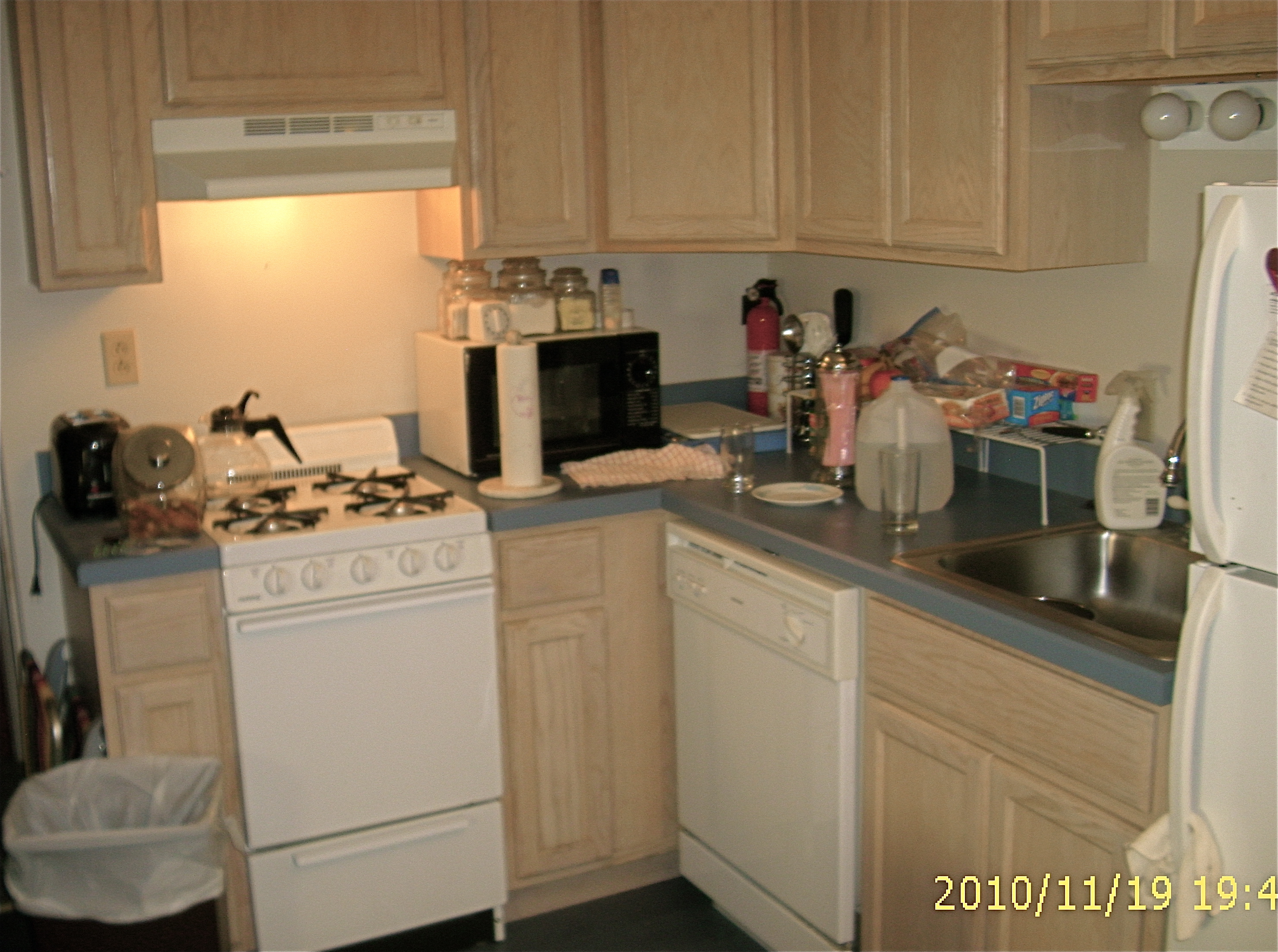
A COMPLETE GALLEY KITCHEN. EVEN A FIRE EXTINGUISHER, IN CASE I TRY TO COOK.

My neighborhood is an enclave of quiet affluence. Within sight, across the water, is a resort that can be rowdy in summer and a ghost town in winter. I might be the poorest church mouse on the block, but not the only one living on a tight budget. A few of the houses are little more than old beach cottages, but most are medium-size, modern homes with that suburban look. Some of the more spacious houses have million-dollar waterfront views. Within a short walk are two grand, waterfront homes that must be worth . . . I can’t even guess. One of them is a modern mansion.

No Extra Charge For Natural Beauty

THE MARSH IN WINTER. VISIBLE BY WALKING DOWN THE STREET. NATURAL BEAUTY AND PUBLIC SPACES ARE IMPORTANT AND USUALLY FREE.

But I digress. This post is not about living large in a mansion. Anyone could do that. And it’s not about living large in your car or a tent, which would be more of a challenge than I’m up to. We’re talking about a modest and attainable goal of living large in a small apartment. (If your apartment has a separate living room and bedroom, with a walk-in closet . . . well, that doesn’t qualify as small).

If It’s Big Enough For A Cat . . .

SAFE AT HOME. LOLA IS PERFECTLY CONTENT IN A SMALL APARTMENT.

My challenges with living large in a one-room apartment are the same ones I would have in a big house. Fundamentally, I have no “nesting instinct.” Plus, I’m disorganized. The only kind of order that comes naturally to me is “Robert’s Rules of Order.” For everyday life, the nesting instinct is more useful than Robert’s Rules.

My Rules Of Order

Here are Hayden’s Rules of Order for one-room apartment living:

  • Pay the rent on time. Otherwise, you will be living in your car.
  • I’ve got to get organized, and it can’t be forever put off until tomorrow. Two years is long enough.
  • A place for everything. Everything in its place. Efficient use of what little storage space you have is essential if you live in one room and you own more than one “thing.” One-room apartments generally don’t have wine cellars, garages, or attics. Not even walk-in closets. Drawers, shelves and hooks are essential. (The easiest kind of hook is a nail in the wall, but some landlords frown on this method.)
  • Furniture. Less is better. Replace all large pieces of furniture with small. I’ve replaced the sofa with a chair, and the double bed with a single bed. (It helps if you have the lifestyle of a monk). A toaster is better than a toaster-oven; a good radio/CD player is better than a complicated stereo system; a laptop is better than a desktop.)
  • You can break the small-furniture rule once. I still have the same medium-sized dining room table as when I lived in more spacious apartments. The table is clunky and dominates my one-room apartment. But it’s an all-purpose table. It serves as dining room table, kitchen table, and desk. I need a certain amount of surface area to be organized, whether the task is paying the bills or making soup.
  • Experiment. Find a way to make the furniture fit. I’m on the third rearrangement of my furniture. After two years, you get tired of playing “furniture checkers.”  Furniture checkers is a game in which you have to move one chair and jump over at least one other “thing” in order to get to your goal. There must be a way to arrange this furniture efficiently! I will have to find it by trial and error, since I have no interior design skills.

HOME OFFICE OF THE ConsterNation BLOGGING EMPIRE. SOMETIMES ALSO USED AS A POLITICAL CAMPAIGN HEADQUARTERS.

Clutter Is My Enemy

I’ve saved the most important secret of living large for last. As you can plainly see from the photos, I need to reduce clutter.

People sometimes criticize me for having too much “stuff.” I’ve gotten rid of enormous amounts of stuff, but I still have too much. Other people have their stuff all over the basement, the garage, the attic, the walk-in closet, the guest room. And that’s not all. Homeowners often rent a storage space for their extra stuff. Why don’t they simply give it away or sell it on eBay?

Everything I own is inside my one-room apartment, or inside my car, which is parked in the driveway. And there’s a limit to how much clutter I can hide in the trunk of the car.

To sum up, I need to get organized and reduce clutter. That’s not too much to ask. I call this challenge “My Apartment Project.” Two years is long enough to put it off. What you see here are the “before” pictures. Coming soon will be the “after” pictures. Wish me luck and stay tuned.

If you have any helpful tips on one-room apartment living, they would be welcome under “comments” below.

— John Hayden

My Life Organized Into “Projects”

Social Security Poster: old man

Image via Wikipedia

So now I realize that my wayward life has become a series PROJECTS.

I use the word “project” in the baseball sense. Major League teams are eager to sign talented young players who are promising “prospects.” Note the difference between a prospect and a project.

A “prospect” has a real chance to make it in the Major Leagues, after a year or two in the minors. Baseball scouts have high expectations for a prospect. He probably gets a bonus simply for signing a contract. Hence, the term, “bonus baby.” Millions, sometimes, for raw talent.

A “project,” on the other hand, is a young player who appears to possibly have the makings of a Major Leaguer. But the wise old men of baseball understand that this player needs a lot of coaching, and maybe years of seasoning in the minors. Developing this rookie into a Major Leaguer is a project for the long term.  The outcome is by no means certain.

My projects are never going to the Major Leagues, but they will require perseverance to reach humble goals. I’ve already mentioned the first two projects:

  • My Austerity Project. The first part of this project is simply keeping a record of how much money I spend every day, with a goal of bringing my budget under control. The record keeping is easy enough, and I’m sticking with it every day. The frequency of unbudgeted expenses, however, is discouraging. The $328.33 for routine 50,000-mile maintenance on my car this past week, for example. This project is going to be like pushing a rock up a hill every day.
  • My Fitness Project. I mentioned that I got a good deal on a one-year gym membership. So far, I’ve been using the gym every third day, sometimes walking on one of the in-between days. I’d like to ratchet up the Fitness Project to every other day at the gym. Even better would be working out almost every day. Just showing up is clearly 80 percent of the Fitness Project. So far, so good.

In addition to Austerity and Fitness, the care and organization of my small and disorderly living space has achieved the status of full-fledged project. My Apartment Project. More on this to come soon, with “before” pictures.

And now I see that the Holiday Project is upon us again. This is primarily a Survival Project. The Holiday Project will make all the other projects more challenging. Normal life resumes on Jan. 2, 2011.

After the holidays looms My Job Project. Talk about a humble project! It’s weighing on my mind a little. But not too much, thanks to Social Security.

I feel a rant coming on soon about politicians who want to solve the national budget and debt crisis by killing Social Security. They want to throw aging workers under the bus. Or put us on an iceberg and let us drift out to sea.

Excuse me, but I’ve been paying taxes into Social Security since I went to work at McDonalds at age 16. Social Security is not like welfare, or even food stamps. My Social Security is b0ught and paid for. I own it. It belongs to me. Do I make myself clear?

As you can see, I’m dealing with a full load of projects here. And I haven’t even mentioned the Laundry Project, which has reached the top of the priority list for tomorrow, or the Blogging Project, the one that keeps me typing until the middle of the night.

If it weren’t for the Blogging Project, consisting of three different blogs (which is two blogs too many), I’d have more time to focus on the important projects.

— John Hayden

Austerity Project, Day 10

ITPB Health Club

Image via Wikipedia

It’s too soon to know whether the Austerity Project will be a success. I’m defining “success” to mean reducing my spending to match my income.

The total damage for Austerity Project, Week No. 1, was $189.13. Issues from Week No. 1: I ate pizza three times. That number has to come down. My biggest single expenditure was a fill-up at the gas station, with regular at $2.76 a gallon, for a total of $33.68. After rent, health insurance, and food, gas for the car is my next highest monthly expense. Soon I’m going to need an oil change and some regular maintenance, which is not included in the monthly budget. And looming in February is the $700 annual payment for car insurance, which is also off-budget.

The first day of Week No. 2 was my first day with no expenditures. Not a penny. Tuesday was $16.23 for miscellaneous household goods at Walmart.

Today, I signed up with a health club, aka “gym,” with a commitment of $19.95 a month for the next year! I did not make this decision lightly. There is no health club line in my monthly budget. I don’t know where the $19.95 a month is coming from. But you have to admit it’s a good price for a health club membership.

With a fancy new health club opening, there’s something of a price war going on among health clubs in my area. I found the $19.95 price at a so-called “bare bones” club. It doesn’t have a sauna or whirlpool or spa. The locker room is small. No towel service. But the place is bright and airy, and they’ve got more equipment than I’ll ever use.

I’m thinking that at age 62, with creakiness in the bones and weakness in the muscles, the health club membership comes close to qualifying as an essential.

It’s not as if I’ve been inactive in the past year. For much of that time, I worked as a security guard, which was mostly walking, walking, walking around a large building and grounds. In other words, my job was to be a moving, human scarecrow. Since August, I’ve spent a lot of time on political campaigning, which also involved lots of walking. I got a sunburn, and then a tan, on my face, but I can’t say I feel any healthier for all the walking. The campaigning resulted in two disappointing losses, first my own in the primary, and then the candidate I volunteered for in the general election.

Now, with the security guard job and the campaign over, and winter coming on, I feel like I’m facing rapid deterioration if I don’t keep these old bones moving. The health club is less than $1 a day, and it will give me another place (in addition to the library) where I can go to get out of the rain and snow.

I’m starting the health club adventure at near rock bottom (I always feel rock bottom this time of year, with the shortening daylight and the sun low in the sky). Job one is to get myself to the health club almost every day. It will be interesting to see if the exercise makes a difference. Any improvement in health of mind and/or body will be well worth the $19.95.

Stay tuned. I’ll keep you posted.

— John Hayden