
American ambassador killed in Libya. As century follows bloody century, does humankind learn anything? The cycle of violence and war never ends. It seems, in fact, to accelerate.
Category Archives: History
Factory Girls and Boys
Reply
This post, “Factory Girls and Boys,” documents child labor in the early years of the 20th century. The photos make me extremely angry. Not long ago, I wrote a post titled, “Austerity, The New Slavery.” More and more, I become convinced that modern capitalism depends for its existence on the exploitation of cheap labor. “Business ethics” really is an oxymoron. In America alone, we had widespread slavery and child labor, out in the open, in broad daylight! And not in the distant past. American industry has always supported immigration for a steady supply of cheap, expendable labor. The White House and the Capitol were built by slaves, the railroads were built by immigrants, and the industrial sweatshops were operated by women and children. After slavery and child labor were abolished, unions gained a toehold. Minimum wage laws and occupational safety laws were enacted over the objections of business. Not surprising that in the second half of the 20th century, industrialists began to move American factories to any faraway land where labor is cheap, plentiful, and unregulated. Thanks to historian and blogger Donna Seger and photographer Lewis Wickes Hine for opening my eyes.
— John Hayden
Related articles
- How Many Kids Made Your Clothes? A New App Will Tell You Before You Buy (fastcoexist.com)
- Samsung to audit 250 of its suppliers in China amid allegations of child labor violations (cbsnews.com)
- Fab Flash: Gap and New Child Labor Claims (fabsugar.com)
- Child Slaves in the 21st Century (sonofjames.wordpress.com)
- Four Reasons Everyone Should Thank Unions On Labor Day (thinkprogress.org)
- Child labor in the beginning of the last century (flickr.net)
- Child labor still issue on Ivory Coast cocoa farms (thehimalayantimes.com)

I always feel a bit sorry for myself on Labor Day weekend, as it’s back-to-school time and usually I am engaged in a mad dash to get my course syllabi done. Of course this is ridiculous, as I have the cushiest job ever and most of the summer I’ve been free to do as I liked. It’s good to remind myself what labor really is, and nothing does that better than the photographs of Lewis Wickes Hine (1874-1940), who transitioned from educator to social activist, all the while armed with a camera. In 1908 Hine became the official photographer for the National Child Labor Committee (NCLC) and began his life’s work: documenting child labor across the United States. This was a time when one in six children between the ages of five and ten worked outside the home in “gainful occupation”, and the percentage increases dramatically for children over the…
View original post 536 more words
The Present Moment Does Not Linger
Summertime, and the living is easy.
Unless you live and work at the beach. Then it’s a busy and sometimes stressful time. Work, sleep, eat, repeat.
If you’re a farmer, you might say, “Make hay while the sun shines.”
If you’re a baseball player, you might say, “It’s a long season, and you’ve got to trust it.”
I suppose we all might say, along with ‘Crash’ Davis, the perennial minor league slugger in “Bull Durham:”
“Some days you win, some days you lose, and some days it rains.”
Or, as the part-owner of a boardwalk 5-and-10-cent store told me more than 30 years ago: “You can make money in Ocean City, if you know what you’re doing.” Not that I paid much attention to making money, then or now.
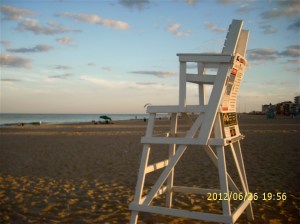
These photos of a lifeguard stand on the beach catch the sunlight fading into dusk, along with the cloud shapes in the sky, which never remain the same for more than a minute. Let the record show that the photos were shot four days after the Solstice, in the Sixth Month of the Twelfth Year in the First Century of the Third Millennium, AD. Not that it matters.
In June of 2012, I began my 65th year, Continue reading
Supreme Court Health Care Decision Divides The States
Fascinating complexity in the decision written by Chief Justice John Roberts upholding the Affordable Care Act!

President George W. Bush, a Republican, announces his nomination of John Roberts to be Chief Justice of the U.S. Supreme Court (Photo credit: Wikipedia)
First of all, Justice Roberts, a conservative Republican appointee, voted with the High Court’s “liberal” justices to create the 5-4 majority upholding the law. Republicans and conservatives across the U.S. hysterically called him a “traitor.” Wait. Isn’t a patriot’s first loyalty to the United States of America, not to any political party?
The frightening possibility is that some partisans no longer see loyalty to the U.S. as a patriot’s first loyalty. It’s possible that some of the more extreme Tea Party loyalists have already seceded from the United States in their own troubled minds.
John Roberts’ “Can-Do” Doctrine Scandalizes Conservatives
“I will find a way or make one.” — Admiral Robert E. Peary, American explorer
“As between two possible interpretations of a statute, by one of which it would be unconstitutional and by the other valid, our plain duty is to adopt that which will save the act.” — Justice Oliver Wendell Holmes
By all accounts, Chief Justice John Roberts believes that the Supreme Court of the U.S. should try to find a way to uphold a law enacted by Congress, rather than declare it unconstitutional. In other words, declare a Congressional act unconstitutional only if it really is unconstitutional.
John Roberts Is Man Of The Hour

Official 2005 photo of Chief Justice John G. Roberts (Photo credit: Wikipedia)
The Supreme Court decision today on the Affordable Care Act, AKA “Obamacare,” shocked my system. It was the first jolt of optimism about the future of America that I’d felt in months. And I hadn’t expected to have any reaction at all.
Chief Justice John Roberts is the man of the hour. With one stroke he won for himself a place in American history.
I can’t claim full understanding of the High Court’s ruling upholding the Affordable Care Act. My gut reaction is it changes everything. It goes far beyond the legal issues at hand. This ruling might be the turning point that saves the American system.
Austerity Is The New Name For Slavery

(Photo credit: 401K 2012)
Slavery is the oldest economic system in the world, and the most persistent. Just as surely as accounting and lawyering were not the first professions, capitalism and communism were not the first economic systems.
Slavery is also, I believe, one of the oldest forms of social structure. I imagine the tribe was the first social structure, closely followed by enslavement, but it might have been the other way around.
It is said that Satan goes by many names, and I believe that slavery also goes by many names.
The world has hardly ever been secretive about slavery. It’s been openly practiced from Biblical times to modern times. Continue reading
Typewriters, Stick Shifts, and Newspapers
Typewriters were as significant in the lives of my generation as computers and cell phones are today. For the beginning of the story about typewriters, see Me And The Blog.
Thanks to my cousin, Barbara, for her comment:
“Too funny! I guess we took our spanking new typewriters for granted. My father used his company discount to purchase them. They became a standard Christmas gift. Like you, though, I learned to type at school on an old standard model. Once that year was over, I swore I would never use one again!!! I did, however, learn to drive a standard shift car. I was always happy I did as I could drive any model car out there.”

Stick shift on the floor of a 1999 Mazda Protege. (Photo credit: Wikipedia)
Hurray! In some ways, my siblings and cousins are more versatile, more adaptable, than the smarty-pants younger generation. We can drive a stick shift!
How many 25-y-o computer geniuses can do that? Huh? I double dare computer geeks to get into a car with a manual transmission and drive it around the block. (Please do not try this at home if small children live in the neighborhood.) I believe a 25-y-o could probably figure out how to use a rotary phone, if locked in a room with one for 24 hours.
Barbara’s comment prompted another memory about the IBM typewriter. (Most of the words in bold type are no longer in common use in the English language. You’ll only need to know those words if you’re taking a class in Ancient History.)

IBM Selectric typeball (Photo credit: Wikipedia)
When I went to work at Congressional Information Service, Inc., in 1977, we had excellent modern IBMs. Then we upgraded to the ultimate, the IBM Selectric.
And then (drumroll please), the entire office computerized! They dragged me kicking and screaming away from my typewriter and FORCED me to type on a computer. We used a word processing program called Wordstar! You can forget about Wordstar. It will not be on the test. You will never hear about Wordstar again!

Typebars in a 1920s typewriter (Photo credit: Wikipedia)
Before long, I learned to live with word processing, but that was not the final act. Eventually, I was an unwilling but nonetheless culpable participant in the conversion ruination of two perfectly good newspapers to “pagination.”
(Backstory: Before computers, reporters typed news stories on strips of newsprint. A copyboy fetched the story, “take” by “take,” and delivered it to an editor, who scratched it up without mercy and added a headline. The editor rolled the “take” up and tossed it into a square duct, whence it fell by gravity — talk about primitive technology — to the composing room to be set in “hot type” by printers. Now you know why the composing room was always at least one floor below the newsroom. Some newspapers also used “pneumatic tubes.” Pneumatic tubes will not be on the test.
With the advent of word processing, stories were typed and edited on computer, but still sent to printers in the composing room to be set in “cold type” and “pasted up” to make a page.)
With pagination, the entire newspaper page was built in the newsroom by editors or page designers using a computer program such as Quark. I supervised conversion of the copy desk at one small newspaper to pagination using Quark; and was a bit player in conversion of a larger newspaper to pagination using Harris software.
Pagination eliminated the composing room, the printing trade, and many jobs. If you want to know what happened to the American middle class, here is a perfect example. A large part of the middle class was made up of union printers. Editors soon met the same fate. Most so-called newspapers don’t have editors any longer. They have “content managers.”
That about covers the history of the world from typewriters to pagination, and from manual transmission to hybrid cars.
In an emergency, my generation will always be able to drive a stick shift or dial a rotary phone. Of course, when the real emergency comes, I wonder how many of us will remember how to grow our own food? Or cook? Or make a fire? I will be among the first to starve or freeze.
Let’s not think about that anymore. Instead, I’m going to think about acquiring a standard typewriter and a Volkswagen Microbus, and driving off into the sunrise.
— John Hayden
Related articles
- Americans Are In Love With Stick Shifts Once Again (businessinsider.com)
- Typewriters are making a comeback among collectors and users – USATODAY.com (exitlanguages.wordpress.com)
- Manual typewriter to world: ‘I am not dead yet!’ (news.cnet.com)
“A Storm Hits Valparaiso” Ebook released
I haven’t read this new epic, but I think it might be a landmark in ebook publishing. It’s worth a look. — John
A Storm Hits Valparaíso – Released Today!.
Related articles
- 2011: The Self-Publishing Year In Review (davidgaughran.wordpress.com)
Who Speaks For The People?
Today, Dispatches from ConsterNation publishes a guest post by Judy Davis:
Since the election of Woodrow Wilson in 1912, the Democratic Party has used our government to make laws which have improved working conditions, provided elderly support, promoted racial equality, protected the environment and addressed other social concerns. Wilson established the Federal Reserve Board, making banking safer and monitoring financial markets. The Clayton Antitrust Act allowed workers to petition for better working conditions, shortened work days and initiated child labor laws.
Franklin Delano Roosevelt’s “New Deal” programs provided relief, recovery and reform to ease the Great Depression. FDR is responsible for initiating Social Security, which provides Old Age, Survivors and Disability insurance. Through FDR’s efforts, the U.S. Bureau of Reclamation increased water development facilities in the U.S. and provided work for the unemployed.
What do these two leaders have in common? They were Democrats!
John Fitzgerald Kennedy established the Peace Corps and negotiated a ban on nuclear weapons testing with the United Kingdom and Soviet Union.
His successor, Lyndon B. Johnson, passed numerous socially significant programs, including the Civil Rights Act of 1964 and “The War on Poverty” – Medicare, Medicaid, Head Start, Work Study and food stamps.
Jimmy Carter is a human rights advocate and has worked to promote peace in the Middle East and limit the number of nuclear weapons. He encouraged energy conservation to ensure an energy-secure nation.
Bill Clinton passed the Omnibus Budget Act, which cut taxes for 15 million low-income families, made tax cuts available to 90 percent of small businesses, and raised taxes on the wealthiest 1.2 percent of taxpayers.
President Barack Obama has regulated banking and credit cards, extended health and unemployment benefits, implemented hate crime legislation, passed an economic stimulus package spurring job creation, modified bankruptcy terms, reinforced Iran sanctions, and reformed health care. No small feat for less than 2.5 years!
“Each time a man stands up for an ideal, or acts to improve the lot of others, or strikes out against injustice, he sends forth a tiny ripple of hope.” — ROBERT F. KENNEDY, from www.democrats.org/issues.
Democrats speak for the people! We are responsible for each other and should provide the safety nets needed to ensure basic rights for all.
— Judy Davis
 Living Simply And Still On The Grid