Real Life Interferes With Blogging

Friends, I apologize for being away from ConsterNation for so long. Hard to believe I’ve not posted since the end of April.

What happened? Long story short, I got a job. I continue to make time for reading.  Later in this post, I’ll talk briefly about “My Antonia,” by Willa Cather, and “Babbit,” by Sinclair Lewis.   Continue reading

Another Black Swan Lands — Super Storm In The South — How Much We Depend On Each Other

Farmer and sons walking in the face of a dust ...

FATHER AND SONS WALKING IN A DUST STORM IN OKLAHOMA IN 1930s. Image via Wikipedia

The Black Swan has landed again, this time in the American South, a Super Storm that roared through Tennessee, Mississippi, Alabama, Georgia, and South Carolina. The tornadoes that ran with this storm wrecked communities all along its path. The worst devastation appears to have been in Alabama.

When has America seen an inland storm of such magnitude? Our worst storms usually develop over water. In the East, the most powerful weather events are hurricanes. Other natural disasters in my memory are earthquakes, tsunamis, blizzards. Major flooding happens along inland rivers. But an inland storm like this? How often, if ever, has a storm system like this been seen in the history of North America?

The only comparison I can conjure is the Dust Bowl — famously “The Worst Hard Times” — of the 1930s. The worst coincidence of natural and manmade disasters in at least a  century, I would have to say, was the Dust Bowl, which coincided with the worst economic disaster, the Great Depression, which was immediately followed by World War II, the worst military-criminal disaster. I suppose it should be stipulated that the conditions for the Dust Bowl were created by human means.

To many people, it feels like disasters, both natural and manmade, are striking with increasing frequency and ferocity. In the past few years: Hurricane Katrina, earthquake in Haiti, the Gulf Coast oil spill, earthquake and nuclear crisis in Japan, multiple wars in the oil region of the Middle East, and now multiple uprisings and civil wars.

We Need Civilization and Cooperation

The first thing people do in natural disasters of such proportion is look around to see what remnants of organized civilization remain standing. Assistance is called for, and expected, from local police and fire agencies, National Guard, Red Cross, and FEMA. Disasters remind us not only how fragile is human life, but also how fragile are human institutions, and civilization itself.

It is more than troubling to realize that millions of American citizens, and their elected representatives, are at this very moment hoping and planning — you might say, “plotting” — to bring down the government of the United States of America, and with it, possibly, the worldwide economy. That would indeed create the worst catastrophe, and the greatest suffering, since the combination of Depression, Dust Bowl, and World War.

It’s almost beyond comprehension, but it’s true. Many Americans now hate government so much that they would prefer anarchy. As police and shocked bystanders say after an especially heinous crime: “This must be the work of insanity or Evil.”

Can you think of another explanation?

— John Hayden

Government Shutdown Feels Like Beginning Of The End For America

Human beings have created many empires in recorded history. Every one of them, from the Roman Empire, to the Ottoman Empire, to the British Empire, on which the sun never set — every great empire has failed.

And here we have the U.S. House of Representatives and the U.S. Senate on the brink of shutting down the government of the United States of America — ON PURPOSE!  If there were any logic, any sense in the world, closing the U.S. government would be treason.

Last time politicians shut down the government, in 1995, it was able to reopen in a few days with no more serious consequence than closing a few national parks.

However, there is no guarantee for the future.  The law of unintended consequences is in effect. We live in the 21st century, the century of the “Black Swan.” Major events, or chains of events, that are unpredictable and highly improbable can happen. You can learn more about the “Black Swan” here.

Politicians who would shut the U.S. government — on purpose! — are tempting fate. Our ancestors fought a Revolutionary War to establish this government. We fought a Civil War to hold the Union together. American soldiers died in foreign wars. And now modern politicians are willing risk throwing it all away over a budgetary dispute? Whatever the unintended consequences, Republicans and Democrats will share the dishonor equally.

We live in perilous times. The U.S. is embroiled in three foreign wars. We recently survived the worst worldwide financial crisis since the Great Depression, but many countries continue to struggle with economic and debt problems of dangerous proportions. Portugal is begging for a bailout by the European Union and the International Monetary Fund. Portugal is the third European nation to require financial rescue. Japan, after two lost decades of economic stagnation, has been driven to its knees by an epic earthquake. Its nuclear power plants spew radiation, poisoning Japan’s food and water.

Enemies wish to destroy us. We’re threatened by terrorists from abroad, and by homegrown terrorists. War might be unleashed at any time, in Yemen, or the Ivory Coast, or an attack from North Korea or Iran. India and Pakistan are always on the verge of war. So are the Israelis and Palestinians.

What’s my point? Events like a government shutdown can spin out of control. One unexpected consequence cascades into others, until the entire edifice trembles. Who could have predicted that a World Trade Center building might collapse? Both towers disappeared into rubble before lunch on a single day.

On top of all the dangers in the world, U.S. politicians are going to shut down the U.S. Government? For a few days? If politicians cannot agree to keep the government open this week, will they agree to reopen it next week? What if two weeks go by? Three? The longer the crisis continues, the more difficult it will be to end. Be afraid of the “Black Swan.”

Some remnant remains after an empire fails. Rome exists as a city to this day. The British islands remain a functioning nation, with shrunken power. The Mayan civilization left ruins. Descendants of the Mayan people live today throughout Central America.

North America will remain, and millions of people will live in the historical United States. Modern civilization will continue, probably. Beyond that, there are no guarantees for the U.S. as a nation. A federal shutdown  for more than a few weeks would force the states to fend for themselves. A shutdown could lead to default on the sovereign debt, or weakening of U.S. armed forces.

Once started, a process of devolution and decay may accelerate out of control, and who has power to stop the chaos?

— John Hayden

War and Remembrance: Lessons of 20th Century History Lost in the Corruption and Arrogance of the 21st Century

HERMAN WOUK

Originally published 03-25-2011

I finished Herman Wouk‘s War and Remembrance,” a fictionalized but authentic novel of World War II, last night. The book left me overwhelmed and exhausted, and  wanting urgently to pin down the most important of Herman Wouk’s keen insights into human folly and war.

Quite an accomplishment, for an author to cover the entire, bloody history of World War II — the ultimate manmade catastrophe — to bring some order out of the chaos, and write down the story for an ordinary reader like me to understand.

Continue reading

ANOTHER STINKING WAR

Collage of images taken by U.S. military in Ir...

Photos from the war in Iraq. Image via Wikipedia

UPDATED MARCH 21, 2011:  After eight years of war in Iraq and 10 years in Afghanistan, the U.S. has decided that two wars in that part of the world are not enough.

On Saturday, French warplanes and U.S. and British missiles attacked Libya.

Forget a “no fly zone.” The Allies went to war. We aimed modern weapons of destruction at Libya, and pulled the trigger.

Continue reading

Just Like Old Times? (via The Hip Flask)

Republished below is an exceptionally good post, from a blog I’ve just discovered. The subject is bar culture, and I think it will be of interest to many in my generation.

This is as good a time as any to toast the bars of my misspent youth: The Raw Bar in Bethesda; Gentleman Jim’s in Twinbrook; Mr. Henry’s at Tenley Circle; The Schnitzel Haus and the Pirate’s Den in Ocean City; Ireland’s Four Provinces on Connecticut Ave.

And special mention to the bars whose names I can’t remember: That MJC bar? on Upper Wisconsin Ave? Got it, it was called The Lodge. I think it was the first place I drank a beer, when I was 18. And a few blocks south, the Grog and Tankard.

If I habituated all those bars, and lived to remember, I must have had a rollicking good time! The smoking and drinking was a horrendously unhealthy lifestyle. And I admit that I drove my car home from all of those bars, over and over, weekend upon weekend, and in Ocean City, night after night. It is only by the grace of God that I was spared a serious accident. In fact, I never even got a ticket.

I’m thankful I was able to quit smoking at 29, and drinking by about 35. I had good friends who never quit, and they are dead now.

Was life as simple as I remember it then, in the 1960s and 1970s? We can’t have been all that innocent! We had Vietnam, and Civil Rights, and Assassinations, and Watergate. But we still believed in the intrinsic goodness of America, and the U.S. government, and Wall Street.

Without further ado, here’s the post that sparked my bar nostalgia:

Just Like Old Times? A Three Part Lamentation on Modern Drinking Culture Part 1: Progress? The idea of progress and drinking has been on my mind lately.  New drink creations, new styles of decor, and re-imaginations of old classics seem to be all the rage.  New technology follows these new trends, be it bars that pitch their Wi-Fi hotspots or boast of countless high-definition televisions.  These technologies have become ubiquitous in bars and pubs, which has made fi … Read More

via The Hip Flask

eBooks and Indie Books Might Be the Greatest Revolution Since Printing

Johannes Gutenberg’s invention of moveable type and the printing press, in the 15th Century, was the most revolutionary development (my opinion) in the history of technology, the history of communication, the history of everything.

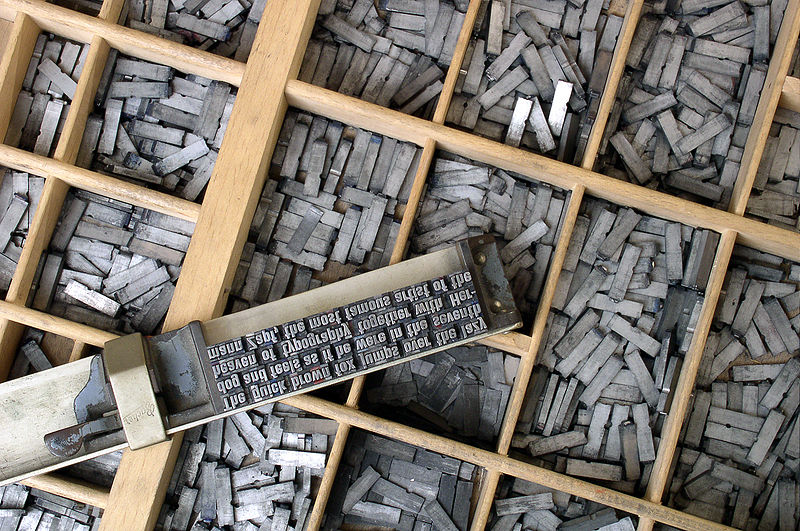
Using moveable type, a printer created lines of words and sentences. Wikimedia Commons photo

Mr. Gutenberg could never have imagined offset printing, the printing revolution of the 20th Century, so he definitely would not understand or believe the advent of the eBook, which could be a defining revolution of the 21st Century.

After all the technological revolutions of my lifetime (** See “A Personal Perspective,” below), I do not understand — and can hardly believe — the sudden rise of the eBook. Nonetheless, this week I purchased my first eBook.

Just another stack of books. Wikimedia Commons photo

I had associated eBooks with the development of digital book readers, starting with Amazon’s Kindle. (The price of the Kindle has dropped like a rock as competitors emerged, putting the technology within reach of even frugal folks like me.) With a Kindle or one of its imitators, you can download books, newspapers, magazines, etc., and carry them around in a small, handheld device, to be read at will. Amazon boasts that the Kindle could hold a small library of books.     Continue reading

“Revolutionary Road”

Here’s a book review of interest to all of us who grew up during the 1950s. The book is “Revolutionary Road,” by Richard Yates, and the review is over at Baroque In Hackney.

Here’s a quote from the review that rings true with me:

“Of course, it’s a tragedy. But it’s a nasty tragedy. It’s not a tragedy about the price of conformity, it’s more about the danger of imagining yourself better than everyone else. It’s the fifties turned inside out, and I found myself laughing out loud in inappropriate places, just for the joy of it.”

So many of us imagine ourselves as “better than everyone else.” The Tea Party leaps to my mind.   Continue reading

Memorial Day Thoughts, 2010

SOLDIER AT ATTENTION ON THE BOARDWALK AT OCEAN CITY, MD, MEMORIAL DAY, 2010.

Faith Of Our Fathers

My father was born in 1920. He was a teenager in the Depression, and a young adult at the start of World War II. He was a skinny young man, to tell the truth.  All of 5-foot-7, maybe 120 pounds, and one arm shorter than the other, believed to have been stunted by polio as an infant. He called it, “My bum arm.”

A CLOSER VIEW OF THE SOLDIER. HE IS A REAL LIVE MAN, STANDING IN THE SUN, WITH SKIN AND UNIFORM PAINTED GOLD.

My father’s name is Bernard John Hayden, Sr.  He was drafted and went for the Army physical. Hundreds of young men lined up, buck naked, in an armory, and went from doctor to doctor around the floor. One doc made sure their heart was beating, another made sure they could see, and so on, like an assembly line. The nation was on wartime footing, and government in those days was efficient.

Last stop on the assembly line was the doctor who made the final decisions. He looked at the reports from the other docs, and looked my father up and down. It must have been painfully obvious that this young man with the bum arm was not promising soldier material.

The head doctor said to my father: “So what’ll it be? In or out?” He was letting the draftee make the decision.

Everyone was going into the Army, and my father didn’t want to be exempted from service.The one-word answer was “In,” and just that fast the choice was made.

In due time, my father was stationed at the Panama Canal. It was possibly the most strategic transportation target in the world. Perhaps surprisingly, the Germans and the Japanese never attacked. Probably they were otherwise occupied in Europe and the Pacific. But I like to think that my father and his friends, on guard in the tropical heat of the Canal Zone, prevented an enemy attack by their willingness to serve. They were America’s “Greatest Generation.”

I CALL THIS LADY IN SILVER “MS. LIBERTY.” SHE IS STANDING ON THE BOARDWALK, SOMETIMES GRACIOUSLY GIVING HER HAND TO PASSERS-BY.

At Holy Savior Church Saturday afternoon, the priest dispensed with his normal homily, but spoke for a few minutes about Memorial Day.  We would not be free this weekend, the priest said, except for God and America’s veterans.

At the end of Mass, the priest asked all veterans present to stand and be recognized.  I have to report that fewer than 20 percent of the congregation stood, and they were mostly older men and women. Times have changed, and in the America of 2010, military service is no longer a universal duty. I don’t know if that is a step forward or a step back, if the goal is peace.

Two widely quoted, relevant statements by great men:

“He shall judge between the nations, and impose terms on many peoples.  They shall beat their swords into plowshares, and their spears into pruning hooks; One nation shall not raise the sword against another, nor shall they train for war again.”

— Isaiah chapter 2; verse 4 (written about 742-735 B.C.)

“I am tired of fighting . . . Hear me, my chiefs. I am tired. My heart is sick and sad. From where the sun now stands, I will fight no more forever.”

— Chief Joseph, Nez Perce Indians, Oct. 5, 1877, at Bears Paw, Montana

So many questions, blowin’ in the wind . . .

— John Hayden

BP Offshore Oil Disaster Is A Game-Changing Event

[picapp align=”center” wrap=”false” link=”term=BP+oil+spill&iid=8750386″ src=”6/6/0/c/Workers_continue_to_362e.JPG?adImageId=12806051&imageId=8750386″ width=”380″ height=”253″ /]

[picapp align=”center” wrap=”false” link=”term=BP+oil+spill&iid=8746904″ src=”7/4/b/f/Gulf_Oil_Spill_23de.jpg?adImageId=12806039&imageId=8746904″ width=”380″ height=”253″ /]

The mile-deep gusher at BP’s offshore oil well in the Gulf of Mexico has ended President Barack Obama’s proposal for new offshore oil drilling, just as surely as the collapse of the stock market, and the housing and credit bubbles, snuffed out President George W. Bush’s plan to invest Social Security funds in the stock market.

In the wake of the BP oil disaster, thousands of people chanting “Drill baby, drill,” would seem surreal.

Thus are presidential policy options narrowed by unpredictable forces.  Leaders deal with the world as it is, not as they wish it to be.

Events not only narrow a president’s choices; events can change the direction of a president’s attention, like a river cutting a new channel. Events can force a president’s hand, as war forces a choice between guns and butter.

It is left to great men to answer the question: “What do we do now?” And then to do it well.

Great men affect history by choosing wisely among limited options. Even more, perhaps, great men affect history by thoroughness of planning and excellence of implementation. Gen. Dwight D. Eisenhower became great because he thoroughly planned and successfully implemented the invasion of Normandy.

George W. Bush became a bungler because he made the wrong military decision, war in Iraq.  Then he compounded the error by failing to plan and implement the war.

Abraham Lincoln made the right choices, but would he be considered a great president if he had lost the Civil War?

Now President Obama’s policy initiatives at home appear increasingly limited by political and economic realities.  I hope that events do not force the president to turn his attention to war.

— John Hayden