Recession Vegetable Soup

Now that I’m unemployed again, I’m planning to create a Recession Vegetable Soup. The predominant vegetables will be potatoes and onions, seasoned with salt and pepper. Long on vegetables but not much protein. Why do I have the sinking feeling that this adventure will turn out to be neither simple nor frugal?

Step One: Buy a pot large enough to make soup or stew. And I have an aversion to those non-stick coatings on most new pots and pans (what chemicals do they make that stuff with?)  Note that whenever I embark on a project, I always discover that I don’t have the necessary tools. This is why I gave up trying to fix my own car.

I’ve come to consider Walmart as my supplier of first resort, based on their claim that they “sell for less.”  However, I found what I needed at one of the big-box specialty stores — a shiny eight-quart stainless steel stockpot with a glass cover — for $20. Six quarts would have been adequate, but  the eight-quart size is what they had. So it goes.

The $20 price at the big-box store was less than anything comparable at Walmart, demonstrating once again that it pays to shop around. So I guess the purchase qualifies as frugal. It was also simple, since it didn’t need to be delivered or installed, and there’s no assembly required!

How many soups and stews am I going to have to make this winter to justify spending $20 to buy the pot?

Watch this space for the recipe and a progress report.

How Many Blogs Is Too Many?

Blogging can take over your life, if you’re not careful. I know I’ve been ignoring Life After 60, Simplified, lately, but I haven’t forgotten it. I’ve simply been focusing my blogging energy on my main blog, Maryland On My Mind.

Some bloggers are so proficient! They can juggle multiple blogs. And then there’s me. I feel like I’m not doing all I could be doing with MOMM, but I don’t want to abandon Life after 60, either.

Obviously, it would simplify my life to have only one blog. But I’m already trying to cover Maryland politics and life in Ocean City, plus frequent side trips into national politics and economic change, in MOMM. They  say a blog is best if focused like a laser on one subject. So I want draw some boundaries for MOMM. Two of my major interests (life after 60, and simplicity) simply don’t fit there. What to do?

I’m pondering three courses of action. You can help me decide. Please vote.

Voluntary Simplicity — Really?

A friend says she is a member of the involuntary simplicity movement.  That sounds about right.

Many people, perhaps, have chosen voluntary simplicity. The Desert Fathers come to mind.

In my lifetime, the hippies. And some idealistic people who lived in communes. For a time.

Adventurers, frontiersmen, explorers, the American Indian?  Scholars, artists and writers (but only if they are in a position to work without distraction).

Some who devote their lives to service: doctors, nurses, teachers, clergy. Mother Theresa. St. Francis of Assisi.

Monks and nuns. Lighthouse keepers.

Farmers. But I think farming is simple mostly in the minds of people who have never farmed.

The homeless? Homelessness is the opposite of simplicity. It is an everyday struggle for survival.

The wealthy? Ah. The wealthy may be in a position to choose voluntary simplicity, if they wish.

The workaholic, perhaps.

I am still thinking.

Geography of Frugal Living, According to AARP

“Where to Find the Simple Life” is a big feature story in the September/October issue of AARP Magazine. It provides some interesting information on five small cities that AARP touts as having “rich culture, great food, low stress.” I have a better title for the story: “Five Trendy Places to Live.”

“Who wouldn’t want to call these affordable cities home?” AARP asks. And I agree, all five of the small cities chosen for the AARP spotlight sound like charming places. Probably affordable too, but affordability is a relative thing. AARP’s demographic information is from Bert Sperling’s bestplaces.net. 

 AARP’s Five Best Places to Live the Simple Life:

  1. Tuczon, Ariz., population 525,500; median housing price, $155,500. “Buzz of downtown — with its plentiful restaurants, funky Fourth Avenue arts district, and world-renowned annual Mariachi Conference.”
  2. Greenville, S.C., population 59,000; median housing price, $151,080. “The Greenville area claims one of the highest international-investment-per-capita levels in the nation.”
  3. Montpelier, Vt., population 7,800; median housing price, 159,060. “Norman Rockwell, with a twist of politics.”
  4. Logan, Utah, population 48,000; median housing price, $143,860. “Travel writers call Logan’s Bear Lake the Caribbean of the Rockies, because of its bright turquoise color and white-sand beaches.”
  5. Ames, Iowa, population 55,000; median housing price, $159,270. “Broad lawns, leafy neighborhoods, pretty parks and ponds.”

Hmmm. Montpelier is the only one of these towns I’ve been too, and I agree. I’d like to live there. Burlington, Vt., is a nice city, too. Vermont is one of the most beautiful and charming states. If you’re looking to live frugally, as I am, Vermont might not be the best place. I could be wrong on that.

Tuczon and Greenville sound like up-and-coming sunbelt cities to me. Simple living and affordable lifestyle? I would need convincing.

Now, Utah seems to be a likely place for simple and affordable living. I’ve never been there, but I’d like to visit.  Never been to Ames, either. Iowa sounds promising, especially if you want to do some farming.

These five sound like wonderful small cities. I doubt any of them are as affordable as the places I’ve posted about in North Dakota and Maine. On the other hand, all five of AARP’s cities would have a decidedly more moderate climate than the northernmost reaches of the U.S.

Simplify Or Perish


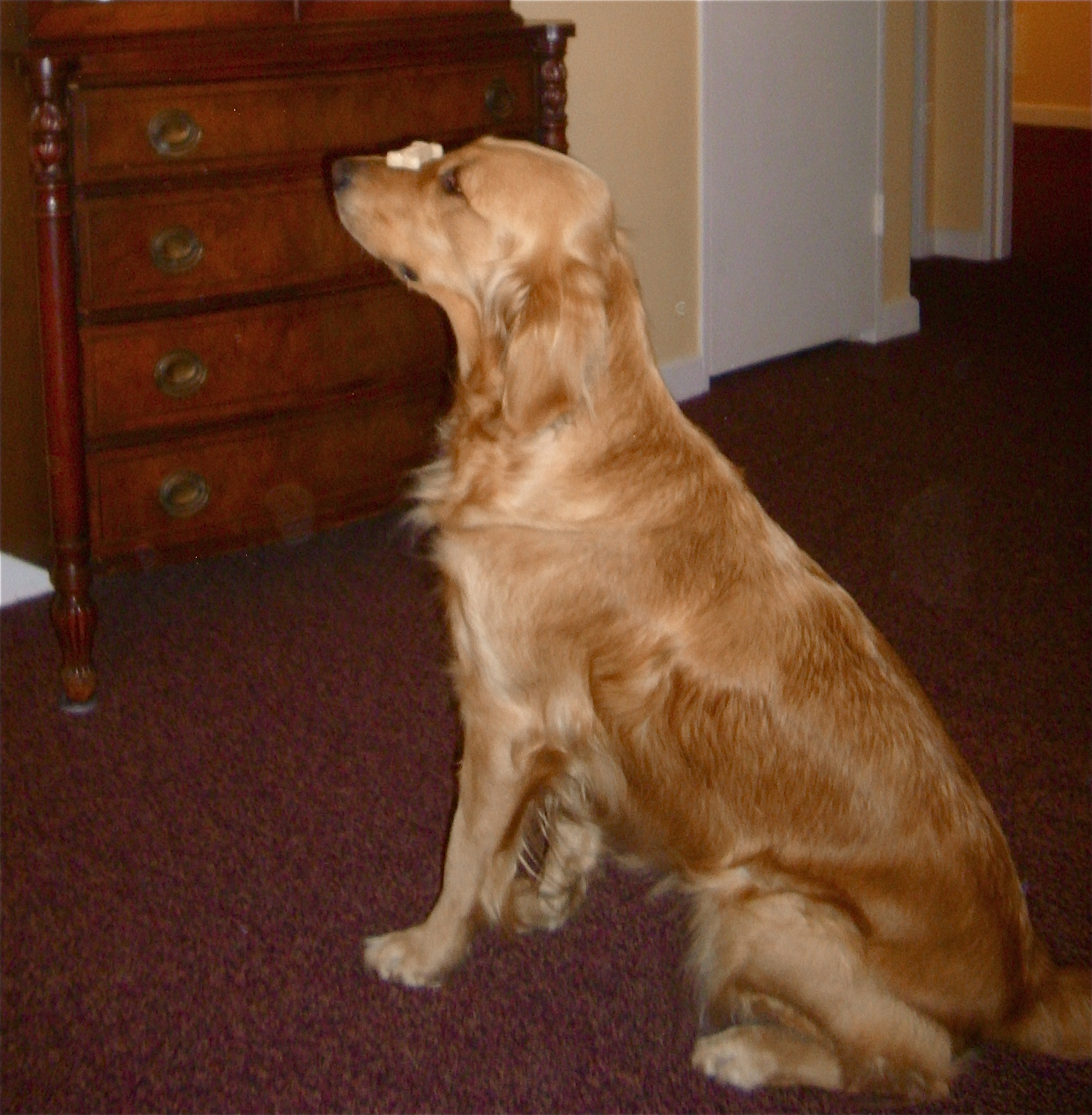
Golden Retriever with dog biscuit on nose

LILY WITH A DOG BISQUIT ON HER NOSE. NOT A PROBLEM. LILY KNOWS HOW TO SIMPLIFY THIS SITUATION.

My first encounter with simplicity came in a chess game, when I was a boy.

Sometimes I found myself on the defensive. My opponent had the momentum, I was constantly reacting to his moves. I needed a “game-changer.” When I could see no better option, I resorted to simplification.

In chess, I learned two quick ways to simplify. A player can “castle,” which is the only gambit in chess that allows you to move two pieces at once. Your king switches places with one of your rooks. This allows your king to escape immediate pressure, and possibly creates a whole new dynamic on the chess board.

The other way to simplify in chess is a last resort. You “exchange” pieces of equal value. For instance, you take your opponent’s knight, knowing that one of your own knights will be captured. You sacrifice your knight for your opponent’s, and both knights are removed from the board. The result is a “simplified” game, perhaps working to your advantage.

If the exchange involves the most powerful chess pieces, sacrificing a queen for a queen, the result can be dramatic simplification. Without the queens, the players may be reduced to a frustrating game of attrition, possibly leading to stalemate rather than checkmate.

lilly

In real life, as in chess, you often have to give up something in return for simplification.

I can choose a new major in college; fire my boss (i.e., quit my job); end a friendship or relationship. I can give up a hobby or recreation that takes time away from responsibilities; change a harmful habit or behavior, improve my diet, quit smoking.

As in chess, I may have to give up something, sacrifice something.  Changes usually require thought and decision-making, even discernment. Not every change leads to simplicity. Sometimes we need to make a change to challenge ourselves more, not less; to grow; to be more productive. Small changes may have greater consequences than we imagined.

Some changes can be turning points.  A career change, a marriage or divorce, a geographic relocation — all these have the power to change the course of your life.

A desire for ease or simplicity is not sufficient reason to walk away from a responsibility. Many times, life requires us to take up new responsibilities. Necessary change may make life more complicated, not more simple.

But even shouldering heavy responsibilities can sometimes simplify life. The responsibility may be greater, but the way forward may be clearer. By giving up what is unnecessary or distracting, we may be able to focus on what is important.

As the author Marsha Sinetar says, attention is power. Giving full attention to what is important is a kind of simplicity.

Simplicity is not for every person or every situation. When I study, I like to study in silence. But many people prefer to study while listening to music. People are very different in their abilities, talents, and needs. My doctor once pointed out that intelligence is like computing power. Some computers have more processing power than others. Some people can tolerate more complexity than others. Some people thrive on complexity.

I’ve often found myself working with people who have faster brains than mine. I’ve often compensated by working longer hours to keep up. This can lead to fatigue or even burnout. So I often seek simplicity, either through focused concentration, or simple lifestyle. Not many responsibilities, only one or two. Not many interests and recreations, one or two is enough.

I’ve always been attracted to simplicity. As a boy, I though Dunkin’ Donuts had an excellent business concept, and later, McDonald’s. They concentrated on a limited menu. Donuts and coffee; or hamburgers, French fries, and milkshakes. They focused on consistent quality and service.

Simplicity is not for everyone. I don’t agree with self-help gurus who say, “Everyone should do this,” or “Everyone must do that.”  You hear that everyone should meditate; the world would be better if we were all vegetarians; everyone should exercise four times a week; everyone should give up sugar and salt; everyone should use mass transportation, or ride a bicycle to work. All good suggestions, but not for everybody. People are different, and one size does not fit all.

Many people thrive on complexity.  I need to simplify in order to survive.

— John Hayden

Simplicity 101, The Blog

Remind me again: Why do we need ANOTHER blog about “simplicity?”

Everything you need to know about simplicity. NOT. The DVD cover for "The Simple Life" DVD, with Paris Hilton and Nicole Richie.

Everything you need to know about simplicity. NOT. Here's the cover for "The Simple Life" DVD, with Paris Hilton and Nicole Richie.

Is there anything left to say about simplicity — or frugality, for that matter — that hasn’t already been covered? We even had a popular TV “reality” show, “The Simple Life.” If it’s been on TV, who needs a blog?

I have a whole shelf of books about simplicity, and there must be thousands of blogs and Web sites on the subject.

I intend to add a separate page to this blog, listing and reviewing books about simplicity (when I get around to it.) In the meantime, to give you a sense of where I’m coming from, here are three of the best on my bookshelf:

  • The Greening of America, by Charles A. Reich, first published by Random House in 1970. The book was a phenomenon in its day. My friends and I passed it around, adding notes on any empty pages.
  • Small is Beautiful, Economics as if People Mattered, by E.F. Schumacher, first published by Blond & Briggs in London, in 1973. The concept that small might be better than big was innovative, almost revolutionary, at the time.
  • Graceful Simplicity: The Philosophy and Politics of the Alternative American Dream, by Jerome M. Segal, published by University of California Press in 1999. 

The Greening of America and Small Is Beautiful were groundbreaking, pop-culture hits. Nearly three decades later, Graceful Simplicity had a more subdued impact. 

As for blogs and Web sites, I intend to provide links to many that I like the best. Already, the short list in my sidebar has links from AARP to Zen.

So who needs another blog about simplicity — specifically the blog you’re reading right now, “Life After 60, Simplified?”  I really can’t justify it, except to say that it’s a matter of perspective. Once, I had an office with a window on the ninth floor. Across the street was a church and a high school. I memorized the air-handling equipment and watched the repairs on the flat roof of the church. I could read the greetings of bygone graduating classes, spray-painted on the pitched roof of the high school. I could even see the athletic field on the other side of the school. I knew that summer was nearly done when I saw the football team begin morning drills in the August heat. 

The tops of the roofs of the church and the school were hidden in plain sight. I could see them clear as day, every day, because of my perspective from the ninth floor. But pedestrians on the street had not a clue about the roofs of the buildings, or the practice field beyond.  That information was not visible or knowable from street level.

What I mean to say is that this blog will offer a different perspective than most of the other books and blogs about simplicity. I’ll write about simplicity from my perspective, the perspective of a 61-year-old baby boomer.

One more thing. Many of the best books and blogs about simplicity are written by people more knowledgeable than I am. I’ll be writing about simplicity and frugality from a personal point of view. You should know that I’ll be learning about simplicity (or making it up) as I go along. Much of what I write will probably seem basic (over-simplified?) to people who have lived simply and thought about simplicity for a long time.

So you might even call this blog “Simplicity for Beginners” or “Simplicity 101.”  Other bloggers will understand this next sentence: Whether or not anyone really needs to read this blog, I need to write it.

Welcome to Life After 60, Simplified. Your contributions and comments will be appreciated.

Thinking About Simplicity — The Essentials

Food, shelter, and clothing. In a simpler age, those three were the basic human physical needs. In this modern age, most of us would add two more basics — health care and transportation.

I’ve been giving a lot of thought to the essentials these past seven years, once it became obvious that my earnings had peaked and were sliding downhill. One clings to a familiar standard of living as long as possible, past the point of reasonable indebtedness.

I knew that I was spending more than I earned each month, resulting in slowly mounting credit card debt. I could not ignore it forever. And in my late 50s, as I bounced from one hourly wage job to another, I realized that my ability to work hard and long hours was waning.

It was clear that I needed to live more simply and reduce spending.  If I could reduce spending enough, I would be able to work less.

“What am I spending this money on?” I asked.  “And what are the absolute bare necessities?”

My three major expenses were not food, shelter, and clothing. Shelter, yes. I lived in one of the most expensive suburbs in America. The price of a decent house was outrageous. The cost of renting a decent apartment, almost equally outrageous.

The other two money pits were the car, including gas, maintenance, repairs, insurance; and health care. The health care piece came in the form of health insurance, which remained within reach as long as I had a job that offered health benefits.

Clothing has become relatively inexpensive, since most of it is manufactured by cheap labor in faraway places. I already had more clothing than I needed, so clothing expenses were negligible.

Food is nonnegotiable. Food is the last necessity you give up. You can be homeless and walk everywhere, but you still have to eat. Fortunately, food is still relatively cheap because of efficient modern agribusiness. Also fortunately, I do not consume large quantities of food. Conclusion: Not much savings likely in the essential food category.

By process of elimination, the big savings would have to come from  housing, car, and health care.

Thinking About Simplicity, to be continued . . .