Austerity Project, Day One

On this first day of November, in the Year of Our Lord 2010, it’s time for me to begin.

After a lifetime of free spending, I’m changing my ways. I’ve never had expensive tastes, and in the past two years, I’ve downsized my lifestyle and focused on simple living.

Now, I have to get really serious. In June, I turned 62, and in August, I received my first Social Security payment, direct-deposited into my checking account. For a variety of reasons, it looks like I’ll never have a middle-class job again. So it’s me and Social Security, and whatever part-time or seasonal work I can find. The rent is covered, and a few other items that I still think of as “necessities.” (Food comes to mind.) But there’s no budget line for “discretionary spending.” There’s no financial margin for error or excess.

Therefore, I will begin today, Nov. 1, 2010, to keep a record of everything I buy, everything I spend, down to the dollar. Hopefully down to the penny. I call it my Austerity Project. I should have done this a long time ago.

I have one of those old-fashioned elementary-school composition books, bright red color, made in India, I forget how much I paid  for it. (See, that’s my problem. I never pay attention to how much I pay for the things I think I need. I need it, so I buy it.)

In this bright-red composition book, I will record every expenditure, every day. On this, the first day of the Austerity Project, I did one load of laundry at the laundromat ($3.25). While waiting for the clothes to dry, I had the off-season special from the Pizza place next door ($4.23, including tax, for two slices and a large Coke). I invested in an eight-pack of budget paper towels, which were on sale at Food Lion ($5.08). I bought a gallon of Turkey Hill iced tea and two bananas at Super Fresh ($3.65).

Total damage for Day One: $16.21.

Today was the last day of the 2010 election campaign, and tomorrow, Election Day, will be a long day volunteering at the polls. So I knew these first two days of the project were going to be hard on the budget. Tomorrow, I’ll probably grab a quick lunch at McDonald’s or someplace. The polls are open 7 a.m. to 8 p.m., so that probably means a couple shots of caffein during the day. Maybe a doughnut. Hey, Election Day is a special day for me. I’ll even go to a  party after the polls close.  Whether it’s a funeral or a celebration, I’ll buy at least one Coke at the cash bar.

Wednesday, the day after, will be hangover day, nothing to do but drive around and take down the campaign signs. No more excuses about hamburgers at McDonald’s or Cokes at 7-Eleven.

I never thought it would come to this. But then, I never was much of a realist.

I never thought a newspaper or a Coke would be a luxury I couldn’t afford. I can still enjoy those luxuries, but now, I must have discipline to drink the Coke at home, and read the newspaper at the library.

I’ll keep you posted on how it’s going.

— John Hayden

Mac or Windows? Drawing the Line on Frugality.

[picapp src=”2/b/4/7/Apple_Reports_Quarterly_c8b3.jpg?adImageId=7115867&imageId=5513100″ width=”500″ height=”329″ /]

I can compromise on cola, for the sake of frugality, but you gotta take a stand on principle somewhere.

I think I’ll draw my line at computers and operating systems. Two years ago, I paid twice the price for my Mac iBook from Apple, compared to a generic Windows laptop. Never regretted it. Would do it again (not that I can afford a new computer right now).

The point is, I don’t NEED a new computer. Apple keeps sending me free software updates over the Net. If I had bought the Windows laptop two years ago, that balky version of Windows would be obsolete, and I’d be faced with buying the new Windows or a new computer.

My brand loyalty to Apple is stronger than ever. I’m determined to hold out for an iPhone, or at least an iPod, when I can afford it. Right now, Apple is still coming out with significant improvements to the iPhone on a regular basis, and reducing the price as well. So I’m content to wait another year or two until the iPhone is fully evolved, and the price is lower.

Waiting to make an important purchase is a good approach to frugality. Paying more for a product that won’t be obsolete in six months can be thrifty in the long run. Immediate gratification is over-rated.

Coke and/or Pepsi? Now I’m Getting Serious About Frugality

Coke has always been my cola.  Yes, I can taste the difference!  I usually stock up on extra Coke when it’s on sale. But when Pepsi is on sale and Coke is not, I stayed with the Coke.

Just this week I’ve realized that brand loyalty is an extravagance I can no longer afford. Unfortunately, I’ve also noticed that Pepsi seems to be on sale a lot more than Coke. A few weeks ago I was able to buy two-liter bottles of Coke for $1 at one of those “dollar” stores. Then it went up to $1.25.

I’ve searched the supermarkets and the discount stores in the past week. The regular price for a two-liter Coke seems to be $1.79. The lowest price I found was $1.25. But Pepsi is on sale for 99 cents!

Breaking a lifetime habit, I decided I simply could not justify paying 26 cents more for the taste of Coke. Just like that, Coke was no longer an essential in my everyday life. Does this count as an epiphany?

Now I’m getting serious about thrift. You’ll know I’m deadly serious when I shake the cola habit and switch to water or tea.


Best Places To Retire, According To Money Magazine

Bangor, Maine, Is Among Top 25

Geography of Frugality? Some of the Top 25, But Not All.

A little bit of Main Street in downtown Bangor, Maine.

A little bit of Main Street in downtown Bangor, Maine.

It’s a good thing my niece and her husband, along with my sister, have a signed contract to buy a wonderful 100-year-old house in Brewer, Maine. Money Magazine has named Brewer’s neighbor, Bangor, Maine, as one of the 25 best places to retire in the U.S. Do you think house prices might go up?

Money mentions Bangor’s “four-season” climate as one of the area’s attractions. But I’m thinking retirees will not stampede to enjoy the frosty, northern climate. More likely, retirees will consider some of the magazine’s Sun Belt recommendations. Bangor and it’s twin city, Brewer, just across the Penobscot River, will remain unspoiled by fame, is my prediction.

Some, but not all, of the cities recommended by Money could qualify for my “geography of frugality” concept. Here are the top five on the list of 25:

  1. Port Charlotte, Fla., home prices down a whopping 63 percent; price of an average, three-bedroom house, $170,000.
  2. Palm Springs, Calif., home prices down 44 percent; average three-bedroom house, $$250,000.
  3. Traverse City, Mich., home prices down 20 percent; average three-bedroom house, $250,000.
  4. Pinehurst, N.C., home prices down 27 percent; average three-bedroom house, $300,000.
  5. Surprise, Ariz., home prices down 48 percent; average three-bedroom house, $150,000.

Hmm, Port Charlotte and Surprise sound like good places to hunt for bargain-priced  housing, if you’re interested in the Sun Belt. But Pinehurst, where an average three-bedroom house is $300,000, doesn’t sound so frugal. Money Magazine provided the average price for three-bedroom houses for all 25 cities listed. Unfortunately, it  gave the percentage price decline only for the first five.

In Bangor, number 23 on Money’s list, the average price of a three-bedroom house is $165,000. My relatives snapped up their bargain house for less than $150,000. Bangor also has an international airport, a great bus system (I have this fantasy of saving money by living without a car), cultural attractions, and major regional medical facilities.

Then there’s the city of Philadelphia, at Number 10 on Money Magazine’s list. With an average three-bedroom house costing $375,000, Philly is way too pricey, in my opinion. I think I’ll investigate Surprise, Ariz., where prices are down a whopping 48 percent.

Geography of Frugal Living: Pennsylvania

Last summer, my brother, Tom, and I took a quick weekend trip to explore some small towns in hilly, west-central Pennsylvania, between Altoona and Johnstown. We focused on a triangle of small towns — Ebensburg, Cresson and Loretto — and mostly ignored the two small cities.

I would nominate all three towns for any list of “coolest small towns” in America. Ebensburg is the largest of the three, a picturesque county seat with a Wal-Mart on the outskirts. Wonderful, big old houses, and a nice miles-long walking and bike trail on the right-of-way of an abandoned railroad line.

Cresson is a bit smaller, a railroad town and birthplace of Robert E. Peary. It has a small college and wonderfully friendly people. There’s a great family restaurant at the stoplight in the center of town, and a bed-and-breakfast next to the railroad tracks. The bed-and-breakfast promises visitors they should see a minimum of one train per hour during their stay.

Loretto is really nothing more than a village. But what a village! Loretto has its own university (St. Francis University), a monastery with beautiful landscaping, and a cathedral. This part of Pennsylvania has lots of Catholics!

Now comes the following report from Tom on his latest small-town discovery in central Pennsylvania:

Re affordable places to live . . .

Last weekend, visited Huntingdon, Pa., population 6,800, about 30 miles south of State College, Pa. (The main campus of the University of Pennsylvania and home of  Nittany Lions football is at State College.)

Huntingdon was voted 5TH “coolest small town” in America in a recent poll by Budget Travel magazine.

I looked at a four-bedroom house in historic downtown area that seemed too good to be true. With a price of $90,000, this house was 2,000+ square feet, in great shape, with a large garage and small but nicely landscaped yard. The house was a short walk to stores and restaurants, public library, numerous churches, Amtrack train station, the Juniata River, etc.

Huntingdon is the county seat of Huntington County so there is the courthouse and municipal buildings as well. The town also is home to two colleges and a hospital.

It all looked so nice I’m planning to go back this weekend and explore some more. Have an appointment with a Realitor to look at a three-bedroom house listed at $70,000. I’ll give you an update if you like. Love the blog!  Tom

Thanks for the report, Tom. Maybe we should write a book about small towns. 

Please take some digital photos of Huntingdon and send them to me as attachments to an e-mail. Thanks.

Geography of Frugal Living, According to AARP

“Where to Find the Simple Life” is a big feature story in the September/October issue of AARP Magazine. It provides some interesting information on five small cities that AARP touts as having “rich culture, great food, low stress.” I have a better title for the story: “Five Trendy Places to Live.”

“Who wouldn’t want to call these affordable cities home?” AARP asks. And I agree, all five of the small cities chosen for the AARP spotlight sound like charming places. Probably affordable too, but affordability is a relative thing. AARP’s demographic information is from Bert Sperling’s bestplaces.net. 

 AARP’s Five Best Places to Live the Simple Life:

  1. Tuczon, Ariz., population 525,500; median housing price, $155,500. “Buzz of downtown — with its plentiful restaurants, funky Fourth Avenue arts district, and world-renowned annual Mariachi Conference.”
  2. Greenville, S.C., population 59,000; median housing price, $151,080. “The Greenville area claims one of the highest international-investment-per-capita levels in the nation.”
  3. Montpelier, Vt., population 7,800; median housing price, 159,060. “Norman Rockwell, with a twist of politics.”
  4. Logan, Utah, population 48,000; median housing price, $143,860. “Travel writers call Logan’s Bear Lake the Caribbean of the Rockies, because of its bright turquoise color and white-sand beaches.”
  5. Ames, Iowa, population 55,000; median housing price, $159,270. “Broad lawns, leafy neighborhoods, pretty parks and ponds.”

Hmmm. Montpelier is the only one of these towns I’ve been too, and I agree. I’d like to live there. Burlington, Vt., is a nice city, too. Vermont is one of the most beautiful and charming states. If you’re looking to live frugally, as I am, Vermont might not be the best place. I could be wrong on that.

Tuczon and Greenville sound like up-and-coming sunbelt cities to me. Simple living and affordable lifestyle? I would need convincing.

Now, Utah seems to be a likely place for simple and affordable living. I’ve never been there, but I’d like to visit.  Never been to Ames, either. Iowa sounds promising, especially if you want to do some farming.

These five sound like wonderful small cities. I doubt any of them are as affordable as the places I’ve posted about in North Dakota and Maine. On the other hand, all five of AARP’s cities would have a decidedly more moderate climate than the northernmost reaches of the U.S.

The Geography of Frugal Living: Maine

They don't build houses like this anymore. Stained-glass, ornamental woodwork, radiator heat and wallpaper. And that's just the entrance hall to this 100-year-old house in Brewer, Maine.  

They don’t build houses like this anymore. Stained-glass, ornamental woodwork, radiator heat and wallpaper. And that’s just the entrance hall to this 100-year-old house in Brewer, Maine.

The cost of living is not fair. Especially not the cost of housing. It’s all a matter of geography.

My niece and her husband, along with my sister, have acquired a charming old house, apparently in better-than-mint condition, at a price that would be unthinkable in most of the major metro areas of the U.S., even after the collapse of the real estate bubble.

A charming kitchen with new appliances.

A charming kitchen with new appliances.

The 100-year-old house is near Bangor, Maine. Outside, it looks like thousands of other old houses in New England. Plain white siding, pitched roof.  Kitchen, dining room, living room on the first floor; three bedrooms on the second floor; attic on top and basement below. Ordinary. 

Being 100 years old, the house is sturdily built, well-insulated, has beautiful hardwood floors and old-fashioned radiator steam heating. Most everything else inside has been replaced or updated, and there’s tasteful wallpaper on all the rooms. Everything, it seems, is in perfect condition. The house had been on the market 45 days. My niece snapped it up for less than $150,000. Eat your heart out, house-hunters in Boston, Washington, and San Francisco.

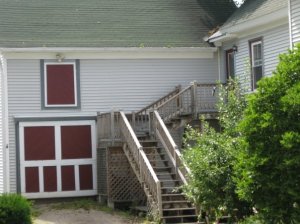
The "barn door" and steps to an inlaw apartment.

The "barn door" and steps to an inlaw apartment.

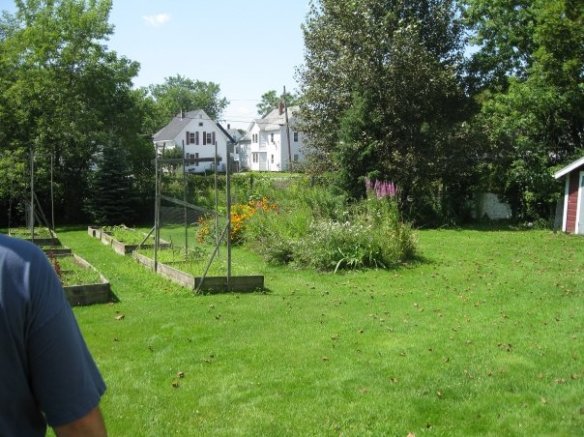
So we have here a two-story, three-bedroom house in great condition. Plus, an attached in-law apartment (currently rented for $600 a month) and a garage/workshop that looks like a small barn. Off-street parking in the driveway, a small upstairs deck and a medium-sized first-floor deck. And finally, a really big, beautiful, green, flat backyard, with gardens. Thanks to my niece, Dawn, for the great photos.

Pretty nice apartment, rents for $600 a month.

Pretty nice apartment, rents for $600 a month.

If there’s a downside to all of this, consider that the green backyard will be covered with deep, white snow all winter. The house is located, after all, in northeast Maine.

The far-north location, formidable winters, and reasonable price are what this Maine house has in common with the mobile home in North Dakota that I mentioned in a post last week. Maybe if you want to live simply and frugally, it helps to go north.

It is worth noting that the Maine house, though very reasonably priced, is not dirt-cheap like the North Dakota mobile home. The big difference is in public services and convenience. The isolated, small town in North Dakota is nearly “Off The Grid.” Population 75, in the middle of nowhere, and you can’t get a cell phone signal.

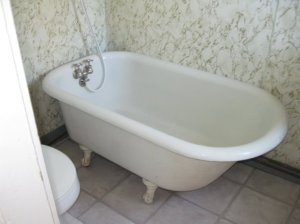
Even an old-fashioned bathtub. I guess it's 100 years old, just like the house.

Even an old-fashioned bathtub. I guess it's 100 years old, just like the house.

In Bangor-Brewer, Maine, my niece is definitely “On The Grid.” Bangor may be far away from everything else in New England, but it’s big enough to offer all the city services, and small enough that you’re never far from where you want to go. Library, churches, schools, stores, an international airport, a symphony orchestra and opera house, a minor-league baseball team. What more could you possibly need?  I nearly forgot the Eastern Maine Medical Center in downtown Bangor, and the University of Maine eight miles down the road.

I knew I should have paid more attention in geography class. You can buy a house at a reasonable price and live in civilized comfort, if you know where to look.

Big backyard. Green in summer, white in winter. Great pictures, Dawn.

Big backyard. Green in summer, white in winter. Great pictures, Dawn.

Four Nonessentials I Hate To Quit

I’ve already written about my telephone land line and 11 other nonessentials that I’ve given up, in order to save money and live within my means.

None of them was as hard to give up as cigarettes, which I quit a long, long time ago. Of those nonessentials, I’ve relapsed on only two, which come as a package: cable  TV and internet service. I presently have cable and internet access thanks to a housemate, and it seems only fair for me to pay my share.

A few other nonessentials, I must admit, I have refused to give up so far, although I’ve cut way back on some of them. Here are four nonessentials that are particularly hard to quit:

  • Dry cleaning, I’ve always washed my own underwear and stuff, but for most of my adult life I’ve made regular use of the dry cleaning industry. Dress pants and suit coats, blazers and sweaters, even ties, I have routinely taken to the dry cleaner. This is expensive. Hence the expression, “Taken to the cleaners.” If the label says “dry clean” or “professional cleaning only,” I still must obey. But my simplified life doesn’t require me to wear fancy duds every day, so I’ve been able to cut way back on the dry cleaning.
  • Having dress shirts professionally laundered, starched and pressed.  This I used to consider  an “essential.” It was my one concession to dressing appropriately for work. A wrinkled shirt simply does not project a professional image, in my opinion. No more! In the spring of 2009, I went cold turkey on pro shirt laundering. I taught myself to iron, and even tried spray starch, with varying degrees of success. For the future, I intend to buy dress pants and dress shirts that are drip-dry, and preferably require no ironing.
  • Haircuts. I refuse to give up haircuts completely. However, I get haircuts much less frequently, and go to an old-fashioned “barber,” not a more expensive “stylist.” I let the barbers cut my hair as short as they want; it makes it that much longer before I have to come back and pay for another haircut. Also, I’ve taught myself to trim the hair around my ears with a razor.
  • Coca-Cola. Not a necessity! I know this, intellectually. But as a practical matter, I’m as hooked on caffein now as I used to be on nicotine. I have failed miserably to give up Coke, or even cut down on my consumption. To me, Coca-Cola seems like an essential. The combination of all that caffein and sugar gives me a real kick. I know it’s not good for me, but I need it to get through the day. That’s my story, and I’m sticking to it. I’m sure other people have the same problem with coffee.

I surely have overlooked other expendable nonessentials. Please let me have your nominations in the comments section. Thanks.

The Geography of Frugal Living: North Dakota

The simple life is a very personal thing. You can live your version of a simple lifestyle just about anyplace. Anyplace you can afford, that is.

The rich can live simply anywhere they want. Paris Hilton and Nicole Ritchie even tried to live simply on a television reality show, "The Simple Life."

The rich can live simply anywhere they want. Paris Hilton and Nicole Richie tried it in a rural setting on the TV reality show, "The Simple Life." Far as I know, this photo from the show was NOT taken in North Dakota.

For many of us, the simple life implies a frugal lifestyle, by choice or by necessity. That’s where geography comes in.

Only the wealthy can choose to live simply in an area with a high cost of living. For the rest of us, our ability to simplify our lives is greatly enhanced in a place where housing and other essentials are less expensive. 

Unfortunately, places with low costs of housing are often economically depressed areas, with few job opportunities. For most of us, no matter how much we simplify our lifestyle, we will still need a source of income to support our simple needs.

North Dakota made it onto the front page of  The Washington Post (08-14-09) by being one of those magical places where the cost of living is low and jobs are relatively abundant. Under the headline, “Road to Recovery: Woman’s Path to Work Ends in Rural, and Job-Rich, North Dakota,” reporter Eli Saslow tells the story of a woman who moved more than 1,000 miles, from Ohio to North Dakota, to find a job. And the woman, Janet Morgan, 63, found that things cost less — a lot less — in wide-open North Dakota.

Everything from mobile homes to lawyer’s fees are available at prices that would be impossible in New York City or San Francisco. Janet Morgan bought a mobile home for $7,500 in Glenfield, ND, with a $100 down payment, according to The Post.

Of course the opportunity to live simply and frugally requires some sacrifices.  Glenfield, ND, has a population of 75 and sits in the middle of nowhere, the Great Plains, USA. It sounds like Glenfield is at the very edge of “The Grid” of modern services that most of us take for granted. Ms. Morgan cannot get a cell phone signal, and has to commute 150 miles each way to her job in Bismarck, ND.  The job doesn’t pay all that well. The winters can be long, cold and lonely. Welcome to the frugal version of a simple lifestyle! The change that Janet Morgan is making is not for the faint-hearted.

The Post capsulizes the economic situation in North Dakota:

“Open space and open jobs, which is why Morgan and thousands of others have moved to North Dakota during the past year. The state, once known primarily for its remoteness, is enjoying a new reputation as a haven amid economic collapse. It has the country’s lowest unemployment rate at 4.2 percent, a budget surplus of $1.2 billion, and more than 9,000 unfilled jobs.”

With the attention generated in the blogosphere by The Post’s story, those 9,000 jobs may not go wanting for long. Then again, how many people are willing to uproot themselves and move to a cold, flat, mostly empty state? 

I will give you something that The Post didn’t: a link to the North Dakota Web site. A couple of other job-hunting sites for North Dakota: NorthDakotaJobs.com and www.jobsND.com. Good luck.

But please, think three times before you move 1,000 miles for a job.

Adventures in Medicine: MRSA and Health Insurance

Is health insurance a luxury or a necessity? Of course, I know the answer. Health insurance is a necessity I can no longer afford.

I was planning to let my COBRA health insurance ($443.10 a month) lapse in August. But that was before my medical adventure.

I was abashed about going to the doctor for something as trivial as an abscess inside my nose. But the swelling and the pain were increasing. So after work Thursday morning (midnight to 8 a.m. shift), I brushed my teeth and turned myself in at  the nearby clinic (motto: “Most insurance accepted. No appointment necessary.) 

It took the physician’s assistant (PA) about two minutes to diagnose the problem: “You have a staph infection.”  Also: “It might be MRSA.” (Methicillin-resistant Staphylococcus aureus, if you must know.)

MRSA is the nasty  staph infection that resists antibiotic treatment. It used to be mostly a hospital problem. But with the advances in modern medicine and all, now you don’t even have to go to the hospital to catch it. 

Not to worry. “We’re going to treat this aggressively,” the physician’s assistant declared with confidence.  She prescribed a big shot of penicillin in the butt. Plus two more strong antibiotics, to be taken for 10 days.

Itemized bill: $95 to establish the problem, $60 for penicillin, and $23 for a shot administered by a skilled medical technician. Total: $178. And $4 each for two generic prescriptions at WalMart. It was almost painless (the shot, not the bill).

I took my medicine and imagined how dangerous this little staph infection might become. I looked MRSA up on Wikipedia, which nearly scared me to death. That’s why I decided to pay the COBRA bill for August. And September, and October. 

Epilogue: The pain in my nose is gone. The PA says the antibiotics appear to be working. No need to come back, she says, unless the infection doesn’t disappear completely. That will be another $95. 

Whether this adventure was MRSA, or only your garden-variety staph infection, will remain a medical mystery. But who knows what adventures may lie ahead? Swine flu season is just around the corner.