
Divide And Conquer: The New Plan To End Social Security By Dividing America at 55

Now begins the cold-blooded campaign to destroy Social Security. The plan is to divide and conquer the American people along generational lines. Synchronize your calendars.

If you’re over 55, you’re a Social Security winner; if you’re under 55 you’re a Social Security loser. Life is a lottery based on a four-digit number, the year you were born.

The proponents of this cynical conspiracy intend to pit father against son, mother against daughter. The elders are comfortable, warm and well-fed. So what if the sons and daughters have to eat dog food in old age? Who cares?

FDR SIGNING THE SOCIAL SECURITY ACT, 1935. DO THESE PEOPLE LOOK LIKE COMMUNISTS? WikiMedia Commons Photo

Since the beginning, when President Franklin D. Roosevelt signed Social Security into law in 1935, some people have hated Social Security. The concept of lifting every elderly American off the dirt floor of poverty infuriates the cold-hearted and mean-spirited. The diehard opponents of Social Security live by their own “Golden Rule,” to wit:

“He who has the gold, rules.”

The spirit of Social Security is too good, too honest, too simple, too clear. Social Security is kindness and justice for every old man and old woman in America, backed by the full faith and credit of the United States government. Every old man and old woman deserves to live in dignity, with food to eat and a roof over their heads. What’s so hard to understand about that?
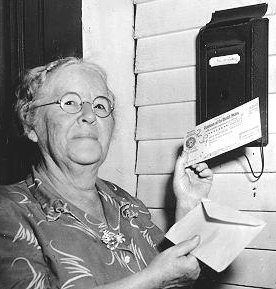
IDA MAY FULLER, RECIPIENT OF THE FIRST SOCIAL SECURITY CHECK. (THESE DAYS, YOU CAN GET DIRECT DEPOSIT.) SSA Photo


The Social Security safety net has been a blessing for every generation since the Great Depression. Medicare has been a life-saver for senior citizens in a health system run by unforgiving insurance companies. There is no good reason why Social Security and Medicare should not continue to be a blessing for today’s adults — whatever their age — and for their children and grandchildren. Where did this crazy idea of discriminating by age and generation come from? Oh, right. For the record, it came from Republicans.

(By the end of March2011, it appears clearly that Republicans intend to destroy Medicare and Medicaid first, by way of a scorched-earth budget policy. Please see my post, “Wilding in Washington: Last Stand of the White Men in Suits.”)

I’m 62, and no one I know among my contemporaries would wish upon their children and grandchildren a future without Social Security.

Only a fool would believe that children born in 2010 will be so healthy and wealthy, 65 years hence, that they will not need a safety net in old age. What is the logic, what is the fairness, in saying that America will keep faith with everyone over 55, and to hell with everybody under 55?

I wouldn’t stand for it, if I were 25 years old today, or 35, or 45. If you’re going to treat one group of people fairly, you must treat every group fairly.

Social Security is solvent right now. The propaganda claims it is not financially viable for the future. The propaganda is a lie. The most recent projections say it won’t run out of money until 2037.

All Social Security needs is minor adjustments to keep going past 2037, and going strong.  See 12 Ways To Fix Social Security.

Every machine needs routine maintenance. That is Social Security exactly. Congress made adjustments in the 1980s, and the machine has been running smoothly ever since. Right now is simply the time for the regular 100,000-mile maintenance.

To discriminate by age is not the American way. Divide American into the privileged and the have-nots at age 55? No way. Put your foot down. Open your window and scream. Just say no.

We can and must save Social Security for today’s 25-, 35-, and 45-year-olds.  With a little fine-tuning, Social Security will still be strong, for those over 55, and for all Americans. What do you think? — John Hayden

What Boomers Can Look Forward To, As We Grow Into The Third Part of Life

THE AUTUMN OF LIFE MIGHT INVOLVE SOME LOSSES AND SOME LETTING GO. DO YA THINK?


The second half of life is different from the first half. What worked in the first half might not work in the second half. So I have been told, and so I believe.

That the second half of life is “different” is, of course, obvious. But what are the differences, what are the adjustments we will have to make? These are not idle questions, for mature people trying to cope in the complex and confusing world of the 21st Century.

I’ve been thinking for some time that this Consternation blog — Consternation from the perspective of a Baby Boomer over 60 — ought to take a stab at these questions.

LIFE CAN BE A FEAST AT ANY AGE, EVEN IF IT'S HOMEMADE SOUP WITH A GLASS OF WINE.

Let’s start by clarifying the questions that I hope to examine, with your help. First, it seems more useful to look at life in thirds, and to say that the third one-third of life is different from the first one-third and the second one-third. Exactly what are the differences?

What are the conditions of life at each of the three stages? What are the problems, the challenges, the work you need to accomplish? Retirement does not necessarily mean the end of work. Particularly important, what are the changes you have to make, and the changes you have to accept, in the third part of life? Let’s stipulate that we Baby Boomers are probably going to continue to learn and grow, even this late in the game. Especially this late in the game.

Let’s acknowledge that the third part of life is going to bring some losses, some goodbyes, some letting go.  We’ll have some sadness, I expect, but hopefully also some joy and accomplishments. I hope for connectedness, rather than isolation. I imagine that a sense of connectedness and belonging will be very important.

AT MY AGE, YOU CAN TAKE A NAP WHENEVER YOU WANT. PAY NO ATTENTION TO THE GRAY HAIR. WAKE ME UP IN TIME FOR SUPPER.

The following video, which I stumbled upon at the Rowdy Kittens blog, might give us a common starting point, and some thoughts to ponder. It’s a talk by Brene Brown. She begins with the statement that, “Connection is why we’re here,” and goes on to issues of disconnection, shame, worthiness, belonging, and vulnerability.

The video is only 20 minutes long, and I hope you’ll give it a listen. Ms. Brown offers many insights on the human condition. She says that vulnerability is the core of shame, and vulnerability is also the birthplace of joy. I have no doubt that many Baby Boomers will have a sense of increasing vulnerability in the third part of life. Perhaps we will be able to embrace it as an opportunity.

Thanks to Rowdy Kittens and to the TED Web Site (“Riveting talks by remarkable people, free to the world”) for making Ms. Brown’s insights available to all.

I have no idea how many posts it’s going to take to examine the issues of the third part of life. I’m not prepared to venture any further in this post. Whether or not you listen to Ms. Brown’s talk, I hope you’ll consider offering some of your own thoughts in the comments area below. Your participation is welcome.

— John Hayden

eBooks and Indie Books Might Be the Greatest Revolution Since Printing

Johannes Gutenberg’s invention of moveable type and the printing press, in the 15th Century, was the most revolutionary development (my opinion) in the history of technology, the history of communication, the history of everything.

Using moveable type, a printer created lines of words and sentences. Wikimedia Commons photo

Mr. Gutenberg could never have imagined offset printing, the printing revolution of the 20th Century, so he definitely would not understand or believe the advent of the eBook, which could be a defining revolution of the 21st Century.

After all the technological revolutions of my lifetime (** See “A Personal Perspective,” below), I do not understand — and can hardly believe — the sudden rise of the eBook. Nonetheless, this week I purchased my first eBook.

Just another stack of books. Wikimedia Commons photo

I had associated eBooks with the development of digital book readers, starting with Amazon’s Kindle. (The price of the Kindle has dropped like a rock as competitors emerged, putting the technology within reach of even frugal folks like me.) With a Kindle or one of its imitators, you can download books, newspapers, magazines, etc., and carry them around in a small, handheld device, to be read at will. Amazon boasts that the Kindle could hold a small library of books.     Continue reading

What Prevents Surgeons And Hospitals From Providing Free Surgery To Save A Life?

Sunset at Organ Pipes

Image by Bill Gracey via Flickr

News organizations are reporting this evening that at least two patients have died in Arizona because the state has decided it can no longer afford to pay for organ transplants for low-income patients.

The organ transplants can cost from $200,000 to more than $1 million, according to NPR.  A list of 98 patients are potentially impacted in Arizona. NPR provided this explanation of the Arizona budget decision in November:

“In Arizona, 98 low-income patients approved for organ transplants have been told they are no longer getting them because of state budget cuts.

The patients receive medical coverage through the Arizona Health Care Cost Containment System (AHCCCS), the state’s version of Medicaid.” — National Public Radio

WTF?  How can a state justify refusing organ transplants to low-income patients, particularly in cases where the refusal amounts to a death sentence without a trial?

But there’s another question that’s even more compelling:

Why have no surgeons or hospitals offered to do the life-saving surgery for free?

What prevents a doctor or hospital from providing free life-saving treatment? DO THE SURGERY FOR FREE! Would that be un-American?

Am I missing something here? Would a surgeon or hospital spokesperson care to comment? Is there not a single, altruistic transplant surgeon in America? Is there not a single hospital affiliated with a religion that would be willing to provide free surgery as an act of charity, for God’s sake?

What? Would it set a bad precedent, or something?

— John Hayden

PostaDay2011 Raises A Philosophical Question: Is More Always Better?

William Shakespeare, chief figure of the Engli...

William Shakespeare, image via Wikipedia

WordPress.com, the best free blog platform in the whole World Wide Web, has thrown down a challenge to bloggers. I’m a joiner, so I’ll take up the challenge.

The goal of the WordPress challenge is to encourage bloggers to post more often. Two obvious options are to post every day during 2011 (that would put you on the path to being the Cal Ripken* of blogging), or to post once a week during 2011. I’m going for once a week.

Let me start by questioning the premise of the WordPress challenge. Most bloggers accept, as an article of faith, that we ought to post more often, ideally at least once a day. (Many people subscribe to the same theory about sex. That is, the more the merrier! And hey, doesn’t everybody do it at least once a day??)

Why? Where is it written that MORE, or MORE OFTEN, is better?

As a career journalist (both reporter and editor), I know from experience and observation that all writers have limits.

To be sure, the late, great Washington Post sports editor Shirley Povich wrote his sports column at least six days a week for years. But columnists usually write perhaps three columns a week, and no more.

William Shakespeare wrote an amazing number of plays and sonnets, back in the day. (But we don’t know very much about the life of Shakespeare. Were the works of Shakespeare all written by William Shakespeare? Or by four other playwrights using the same name?)

Cal Ripken, Shirley Povich, and William Shakespeare were uniquely gifted in their fields. But the WordPress challenge urges every blogger to post daily, if possible. Whereas Ripken, Povich, and presumably Shakespeare, devoted their lives to their professions, most bloggers are part-time amateurs. And before blogging, professional writers were backed up by editors and proofreaders. Bloggers are backed up by spellcheck, if we remember to use it.

So now we have this inferiority complex. Whatever it is we’re doing, we aren’t doing it OFTEN ENOUGH, which translates to the slogan of the assembly line: “Work faster.”

Work faster! (Is that the best you can do?) Work faster, work faster, work faster. Faster and faster!

Capitalism and the Protestant work ethic are relentless in their demand for more production, faster. We have become a society of guilt-ridden and exhausted drones. That’s in our work life. Blogging, for almost all of us, is a hobby, a leisure activity, an avocation. We want to get some satisfaction from blogging. Pushing ourselves to post every single day turns blogging into a discipline, like meditating every day, or going to the gym every day.

Discipline is good for you. But dare I say it: Blogging is supposed to be fun!

In addition to draining the fun out of blogging, the post-every-day work ethic will also drain the quality out of writing. Good writers know that writing takes some time (although miracles happen on deadline). Nearly every written page benefits from being set aside, to be reconsidered later. Nearly every page improves in the rewriting.

There, that’s almost enough. With a few more keystrokes, I’ll have 500 words. I have proven once again that any journeyman reporter can produce drivel on demand, every day if necessary.

Posting every day is not necessarily good for bloggers, or for their craft. Just my opinion.

— John Hayden

*Cal Ripken is the retired Baltimore Orioles shortstop, the “Ironman” who broke Lou Gerhig’s record of consecutive baseball games played. You could look it up.