Unknown's avatar

About Editor (Retired)

Newsman, blogger, editor, writer (and no longer young).

American Debt Crisis: A Cinder-Block Wall, Or A Screen Door?

No. 1 in a series on the Debt Crisis of 2011.

The American political deadlock over debt and taxes is an enigma. It’s a monster with too many heads. Starting today, I’m doing a series of blogging quick takes, each post only a few sentences, zeroing in on one question. No more windy dissertations.

Today’s question: Is the world as we know it about to end, if Democrats and Republicans can’t agree to raise the debt ceiling?

The sovereign debts of the U.S. and other countries are huge beyond comprehension. But what is their real import? In the 1980s, when “fiscally responsible” Republicans were digging the debt hole, they decreed that deficits no longer matter. Could that possibly be true?

Is the debt crisis being trumped-up for ideological purposes, to kill Medicare, or Social Security?

To be sure, debt exists on paper, as bonds and notes and bookkeeping entries. But what, if anything, does the paper represent? Is national debt a tangible reality, like wood; or an abstract concept, light as air?

Better check under the bed. Is anyone hiding there?

Remember Y2K? End of the world. Planes were going to fall from the sky. Approaching Y2K, it looked like a cinder-block wall, into which civilization was going to crash and burn.

Arriving at Y2K, we passed through it like air through a screen door.

— John Hayden

(Quick-take rating for this post: 215 words.)

Living Small In The Big Apple

When I think about the tiny house movement, I usually think “rural.” But I suspect a lot more folks are living large in a small space in big cities, than in the countryside. Makes sense, because in cities, you calculate rent by the square foot.

Here’s an extreme example, and just goes to show what you can do, if you’re organized (and don’t own a lot of stuff).

(Quick-take rating for this post: 69 words.)

Rightsizing Your House

This slideshow requires JavaScript.

How much living space do I need?

This week, I discovered a new community of  small, bare-bones cottages here on the Eastern Shore of Maryland, and it got me thinking about how much space is enough.

A lot of folks are intrigued by the tiny house concept. These cottages probably don’t quite meet the standard for “tiny.” Most are one-bedroom, living room, bath, and galley kitchen. Some have two bedrooms. You can look here for more pictures and floor plans.  The rooms are SMALL, but the Web site doesn’t give dimensions.

I estimate the cottages have about as much space as a small,  one-bedroom garden apartment. No doubt, many people in Manhattan live in high-rise apartments smaller than this. And tiny “alley” rowhouses were once commonplace in Baltimore.

This is no-frills living, but I prefer to think of it as a simple lifestyle. You get a front door, a few small windows, a roof. A small closet, but none of the clever, built-in storage niches you find in custom-built tiny houses. You want amenities? The community has a laundry room with  six washers.

Neighbors on both sides. Togetherness. Community! You’ve got as much space as in a modest trailer park, or less. Looking down a row of cottages, I get a flash of a Depression-era work camp. (Not that there’s anything wrong with that.)

Not exactly the splendid privacy that many small-house advocates imagine. But I’ve always wondered if the concept of a 12 X 12 cabin on a remote mountainside isn’t contradictory. Elitist even. I mean, a tiny house with your own, private, national park? It is true that when you opt for simplicity, you may also find grandeur. Monks usually take vows of poverty, but sometimes live in impressive old monasteries.

No grandeur is included with the austere cottages pictured above. Don’t be misled because they’re near a beach resort. These cottages are clearly designed for workers, not tourists.

Rent is $600 a month for the one-bedroom models, plus utilities. A modern water and sewer system is paid for by the owners. Your cable TV bill looks like a BIG EXPENSE, in this scenario, especially if you also want Internet access. I’ve been spoiled by cable TV and Internet the past few years. Wonder if I could do without? Remember, we’re talking about simplicity and frugality. TV and Internet are not necessities, like food and water. Or are they?

I could still write on my computer, just not connected to the Net. When I need the Net, I’d go to the library, and use the fast, free WiFi.

I could listen to FM music or news over FREE airwaves. (Imagine that! Free radio. TV signals used to be free, too, but free TV was too good to last forever.)

Long story short, housing is adapting, if only a little, in response to the crash. Are people choosing a simpler lifestyle? Or in the new normal, do people have no alternative? Time will tell, but I doubt that cottages as small as the ones pictured here will become commonplace in America. Other countries, maybe.

For those who want to reduce their carbon footprint, a small cottage is a big step forward. I’m nagged by one reservation: Beware the fine, thin line between simplicity and poverty. Spacious suburban manses — the ideal goal for many Americans — are clearly not a necessity. Space is a nice luxury, if you can afford it.

But I wonder if tiny houses are more a novelty than a viable alternative? Most folks feel more at ease with a bit of elbow room. Space enough for two people to slow dance, at least. An extremely tiny house could be tough on the spirit, it seems to me.

I’m in favor of living space that is, as Goldilocks put it, “Just right.” It’s an individual thing. Or a matter of negotiation, for a couple. Between huge and tiny, a modest cottage might be a reasonable compromise.

— John Hayden

For photos of my own efficiency apartment, take a look here.

You can learn about the Tiny House Movement at  “How I Met My Tiny House Hero,” by Tammy Strobel.

“It’s the dogs that count”: a tale of the New Austerity (via Baroque in Hackney)

While I’m working myself into a lather, writing my next post about THE END of Civilization in America, you have time to enjoy this spirit-lifting essay by Ms. B, a gifted British blogger. She manages to cover many of the things that really matter — dogs, austerity, friendship. Ms. B makes her points deftly and moves on. She doesn’t beat you over the head, again and again, about the same boring issues, the way I do.

"Its the dogs that count": a tale of the New Austerity Well, I promised you dogs. The sad truth is that this picture was scanned in yesterday morning and has been sitting since then, waiting for a post. It has taken that long to find a few minutes. I have a friend whose mother was a doughty woman from Bristol, who knitted and sewed and made do and mended, and who recycled absolutely everything. A good, solid, practical, no-nonsense woman, in the old  mould. She died about ten years ago, if  not maybe … Read More

via Baroque in Hackney

Eastern Shore Blogging: On Coastal Connection, 88.3 FM, Friday (via Ocean City Blog)

Here at Dispatches from Consternation, I write about issues that have no geographical boundary: political and economic change, life after 60, and simple living.

But many blogs have a distinctly local or community focus, reporting on news or life in general in a specific hometown, sometimes even a neighborhood.

I also write one of those community-focused blogs, which I started in 2007 as Maryland On My Mind, and now call simply, Ocean City Blog. I’ll be talking on Friday, April 15, with a couple of other regional bloggers about blogging on the Eastern Shore of Maryland. The interview on the local PBS show, Coastal Connection, hosted by Brian Russo, will air at noon and 8 p.m. Friday.

The discussion runs about 20 minutes, and provides a quick general introduction to the subject of community blogging. Details, including a link for Web listening, are in the post below. I hope you can listen in, and perhaps add your own comments below.

Eastern Shore Blogging: On Coastal Connection, 88.3 FM, Friday If youre interested in blogging, particularly blogging on the Eastern Shore of Maryland, youll want to catch Brian Russos Coastal Connection show on 88.3 FM, the NPR news and public affairs station in Ocean City.  The show is scheduled to air on Friday, Apr. 15, at noon and 8 p.m. Brian interviews three bloggers for a sort of round-table general introduction to the state of blogging on the Shore. I was happy to accept an invitation to particip … Read More

via Ocean City Blog

Government Shutdown Feels Like Beginning Of The End For America

Human beings have created many empires in recorded history. Every one of them, from the Roman Empire, to the Ottoman Empire, to the British Empire, on which the sun never set — every great empire has failed.

And here we have the U.S. House of Representatives and the U.S. Senate on the brink of shutting down the government of the United States of America — ON PURPOSE!  If there were any logic, any sense in the world, closing the U.S. government would be treason.

Last time politicians shut down the government, in 1995, it was able to reopen in a few days with no more serious consequence than closing a few national parks.

However, there is no guarantee for the future.  The law of unintended consequences is in effect. We live in the 21st century, the century of the “Black Swan.” Major events, or chains of events, that are unpredictable and highly improbable can happen. You can learn more about the “Black Swan” here.

Politicians who would shut the U.S. government — on purpose! — are tempting fate. Our ancestors fought a Revolutionary War to establish this government. We fought a Civil War to hold the Union together. American soldiers died in foreign wars. And now modern politicians are willing risk throwing it all away over a budgetary dispute? Whatever the unintended consequences, Republicans and Democrats will share the dishonor equally.

We live in perilous times. The U.S. is embroiled in three foreign wars. We recently survived the worst worldwide financial crisis since the Great Depression, but many countries continue to struggle with economic and debt problems of dangerous proportions. Portugal is begging for a bailout by the European Union and the International Monetary Fund. Portugal is the third European nation to require financial rescue. Japan, after two lost decades of economic stagnation, has been driven to its knees by an epic earthquake. Its nuclear power plants spew radiation, poisoning Japan’s food and water.

Enemies wish to destroy us. We’re threatened by terrorists from abroad, and by homegrown terrorists. War might be unleashed at any time, in Yemen, or the Ivory Coast, or an attack from North Korea or Iran. India and Pakistan are always on the verge of war. So are the Israelis and Palestinians.

What’s my point? Events like a government shutdown can spin out of control. One unexpected consequence cascades into others, until the entire edifice trembles. Who could have predicted that a World Trade Center building might collapse? Both towers disappeared into rubble before lunch on a single day.

On top of all the dangers in the world, U.S. politicians are going to shut down the U.S. Government? For a few days? If politicians cannot agree to keep the government open this week, will they agree to reopen it next week? What if two weeks go by? Three? The longer the crisis continues, the more difficult it will be to end. Be afraid of the “Black Swan.”

Some remnant remains after an empire fails. Rome exists as a city to this day. The British islands remain a functioning nation, with shrunken power. The Mayan civilization left ruins. Descendants of the Mayan people live today throughout Central America.

North America will remain, and millions of people will live in the historical United States. Modern civilization will continue, probably. Beyond that, there are no guarantees for the U.S. as a nation. A federal shutdown  for more than a few weeks would force the states to fend for themselves. A shutdown could lead to default on the sovereign debt, or weakening of U.S. armed forces.

Once started, a process of devolution and decay may accelerate out of control, and who has power to stop the chaos?

— John Hayden

Last Stand of the White Men in Suits

HOUSE REPUBLICAN LEADERS. AP photo, 02-09-11

Not to belabor the obvious, but does the above photo look like the last stand of Republican white men in suits?

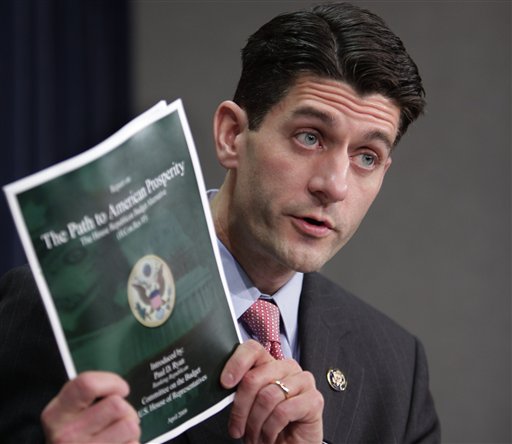
REP. PAUL RYAN. AP photo by J. Scott Applewhite

This morning, Rep. Paul Ryan, chairman of the House Budget Committee, presented the Republican budget for 2012. Joining him were a TV screen full of his Republican colleagues on the House Budget Committee. Everyone present, from what I could see on TV, was a white man. With a few exceptions, they are from the Red States, the heartland of America.

Not to put too fine a point on it, but the Republican budget would cut government spending by $6.2 trillion over a decade, and sharply cut taxes for the wealthy. The top income tax rate would be reduced from 35 percent to 25 percent. Is the U.S. really broke, or is the U.S. wealthy? You decide.

Here is a list of Republican members of the House Budget Committee. White men in suits from the heartland. Only one female name is on the list.

Many believe the Republican budget is so draconian that it's dead on arrival. I hope so, but the hard line on Medicare, especially, is ominous.

NOT TO IGNORE THE REPUBLICANS IN THE SENATE. Roger L. Wollenberg photo, 03-31-11

Umm, the photos above, of Republican leaders in the House and Senate, and the list of Republicans on the House Budget Committee . . . Is this what democracy looks like in America, in 2011? (Disclaimer: Many of my friends and relatives are white men. Come to think of it, I am a white man. Hey, I even own two winter suits AND two summer suits, so I am prepared to attend weddings, funerals, and job interviews in all seasons.)

The name of the Republican budget is “Path to Prosperity.” Rep. Ryan says these words, “Path to Prosperity,” with a straight face, without a hint of irony.

Here’s an early analysis of the Republican budget numbers, from the Huffington Post.

Here’s another analysis by Ezra Klein in the Washington Post.

The “Path to Prosperity” runs right over Medicare and Medicaid. At this moment, it appears to me that the Path to Prosperity would effectively destroy Medicare and Medicaid. Maybe that is a  good thing. Sometimes, I think, the only way to reform a program or a bureaucracy is to destroy it and start over. But I don’t think that’s what Republicans have in mind. I think Republicans intend to privatize health care for the elderly and the poor. In the name of paying off the debt. (For an earlier post on Republican strategy regarding Social Security, see “Divide and Conquer.”)

Also on the Republican chopping block: education, from Head Start to Pell Grants.

I think Republicans are focused entirely on two things: paying off the public debt, and reducing taxes. Two contradictory goals, but possibly both can be accomplished at the same time, by grinding the middle class and the poor — and the elderly — into the dirt. (Go ahead, accuse me of class warfare. Doesn’t this look like a scorched-earth policy to benefit wealthy America and corporate America?)

Rep. Paul Ryan says the Republican budget will “create jobs.”

SHOW ME THE JOBS. How exactly do you create jobs by slashing spending to the bone, on everything except the Department of Defense?

How do you create jobs when Toyota is shutting down 13 factories in the U.S., and food and gasoline inflation is vacuuming up every spare dollar of discretionary spending? AND the U.S. is fighting three wars in the Middle East.

Oh, yeah. And to show their power, or something, Republicans intend to shut down the U.S. government at the end of the week. Will that create jobs?

— John Hayden

“Whomperjawed” (via The Clueless Farmer)

Légumes

Image via Wikipedia

The “Clueless Farmhand” has now become the “Clueless Farmer.” Step one (buy a few acres with a livable house) is complete.

Sounds like the new farmer-entrepreneur, Diana, and her husband, will be focusing on the chicken business, and also growing quite a variety of vegetables. Diana, aka “Farmer Di” and “Doodi,” is methodically learning all she can about how to be a successful part of the “local-food” movement. Click on the Clueless Farmer’s report below.  Her post includes lots of links to useful farming information.

This is a serious career-change event. Diana says: “My completely awesome husband turned down a perfectly decent and lucrative office job in favor of farming for a subsistence income.”

The real farming begins this week, with “100 fluffy day-old chicks and about 500 seedlings of various vegetables.” That sounds feasible on five acres, with some room for expansion.

If it works, the small-farm movement has potential to provide a great lifestyle, along with a modest income, for thousands of workers who would otherwise be stuck in dead-end jobs, and living in suburbia.

Producing and consuming our food locally (including organic food) makes sense, and it can improve our food security in times of shortages.

We closed on our 5+ acre “farmette,” somewhat disconcertingly noted by our bank’s appraiser as being a “suburban” home (by rural standards), this morning. We’re officially terrified. All our pretty plans on how much we need to spend to get so much revenue from so many square feet of some specific vegetable or chicken species seem suddenly very ethereal when juxtaposed with our actual expenses. I have been in Madison County, VA for 4+ days now, fo … Read More

via The Clueless Farmer

War and Remembrance: Lessons of 20th Century History Lost in the Corruption and Arrogance of the 21st Century

HERMAN WOUK

Originally published 03-25-2011

I finished Herman Wouk‘s War and Remembrance,” a fictionalized but authentic novel of World War II, last night. The book left me overwhelmed and exhausted, and  wanting urgently to pin down the most important of Herman Wouk’s keen insights into human folly and war.

Quite an accomplishment, for an author to cover the entire, bloody history of World War II — the ultimate manmade catastrophe — to bring some order out of the chaos, and write down the story for an ordinary reader like me to understand.

Continue reading

ANOTHER STINKING WAR

Collage of images taken by U.S. military in Ir...

Photos from the war in Iraq. Image via Wikipedia

UPDATED MARCH 21, 2011:  After eight years of war in Iraq and 10 years in Afghanistan, the U.S. has decided that two wars in that part of the world are not enough.

On Saturday, French warplanes and U.S. and British missiles attacked Libya.

Forget a “no fly zone.” The Allies went to war. We aimed modern weapons of destruction at Libya, and pulled the trigger.

Continue reading