Unknown's avatar

About Editor (Retired)

Newsman, blogger, editor, writer (and no longer young).

Clarity on Health Insurance and the Public Option

Updated and revised, 07-31-2009.

The political and economic debate over health care in America is starting to clarify.

Congress is coming to the conclusion that the private health insurance industry is part of the problem. Tailoring American health policy to suit the private insurance industry makes no sense.

Health care policy should be designed to meet the needs of people and doctors, not insurance companies. Did you ever know a friend who liked fighting with insurance companies to get a claim approved? Do you know anyone who likes needing a referral to see a doctor? Do you know any physicians who like the paperwork that the insurance companies impose on doctors and their office staff? 

Finally, do you know any doctors who enjoy having the insurance companies tell them how to run their medical practice?  Do you know any patients who trust their insurance company more than their doctor?

President Barack Obama’s proposed public option is making more and more sense as an alternative for people who are sick of dealing with the private insurance companies.

Universal health care would also be a giant step toward simplifying life for millions of middle-class, working-class, and poor Americans. 

How nice it would be to accept a different job without having to give up your health insurance! What a relief it would be if, even when you lose your job, at least you don’t lose your health insurance! Your children could still go to their pediatrician, not the emergency room. Health care for all would be so . . . well, so equal. It would be so fair.

And for those of us in the graying generation, baby boomers who often find ourselves passed by in this fast-changing economy, what a relief if we at least had health insurance.

Medicare eliminated the specter of poor, elderly Americans unable to afford health care. What if we could do the same for all Americans? 

Health care is one of the essentials of life: Food, Shelter, Clothing, Transportation and Health Care. It would be so much easier to live a simple and frugal lifestyle, if essential health care was available for every American.

Thinking About Simplicity — Save Money On My Top Ten Nonessentials

Being downwardly mobile, I’ve got to keep pruning the low-hanging fruit, the non-essentials. In the last post, I cut the telephone land line and the monthly phone bill.  I’ve also whittled away at a long list of other non-essentials as I gradually scaled back my lifestyle from “affluent” to “working poor.” Here’s my top ten list (plus one):

  1. House (Apartment) Cleaning Service. Probably the most expensive of the non-essentials, and the first to go. For years, a cleaning service came every two weeks to do the necessary little chores I was too lazy to do. (Can you believe I paid for a cleaning service, even when I lived in a small one-bedroom apartment?)
  2. Vacations. I’ve never been bitten by the travel bug. Still, I used to get away for one weekend every season of the year, when I was affluent. And I usually took a real one-week vacation in the summer or fall. Now I haven’t had a real vacation in years. I acknowledge that forgoing vacations, year after year, is a sacrifice. But if I did vacation, I’d do it on the credit card, digging myself deeper into debt. Not a good idea.
  3. Cable TV. When I lived alone, I made do with rabbit ears. Cable, even basic cable, was a luxury I could easily live without.
  4. Home Internet Service. Same as Cable TV, above. Most of us weren’t even aware of the Internet a decade ago. Now we act like it’s a necessity. It’s not. I dropped it along with the cable TV, and used the free public Internet access at the library. However, when I share housing with another person, I usually split the cost of cable and internet. It seems like the neighborly thing to do.
  5. Newspapers. This was a tough one. All my life, I’ve read at least one daily newspaper. At the height of affluence, I subscribed to my local  paper seven days a week, plus the out-of-town New York Times. The bill for The Times was $1 a day, and well worth it. But The Times was obviously low-hanging fruit. It had to go. Later, I cancelled the local paper as well. The monthly saving was small but necessary. (I never thought the day would come that I couldn’t afford a daily newspaper.) I still buy ONE Sunday newspaper at the newsstand, when I’m feeling flush. Otherwise, I get my news from TV, or I go to the library and read the newspapers to my heart’s content, for free.
  6. Ice Cream. I switched from the premium Hagen Daz to an everyday brand. Since the doctor advised a low-fat diet, I cut way back on even the less-expensive brand, more to save my health than to save money.
  7. Pizza Delivery. I resisted this extravagance for a long time. (I might be too lazy to clean my own apartment, but I was willing to fetch my own carry-out pizza.) As the years went by, I surrendered to our cultural addiction to ease and convenience. Pizza delivery is handy when you have friends over and don’t cook. But my days of entertaining lavishly with delux pizzas (no anchovies or black olives, please) are over. I still enjoy pizza whenever I can, but I don’t have it delivered.
  8. Eating out. As a lifelong bachelor, I prided myself on preparing my own breakfast of cereal and a banana at home. But for lunch and dinner, I habitually patronized one neighborhood restaurant or another. I was a generous tipper, too, if I do say so myself. That lifestyle is a only a pleasant memory. Now, I look for price cuts at the supermarket, and eat almost every meal at home.
  9. Buying Books. One of my few extravagances was buying and reading new books, mostly paperback, but often enough, expensive hardbacks. When I read, I like to highlight important passages, and you can’t do that unless you own the book. It’s a luxury I can no longer afford. The public library lets me check out books for free, but frowns on highlighting.
  10. Church and Charitable Donations. Now frugality is getting serious. In the affluent days, I sent checks several times a year to favorite charities (soup kitchens, disaster relief, and the like). There came a day when it seemed that I needed the money as much as the charities did. Next, I reduced my weekly church contribution  to an embarrassingly small sum. Lately, I’ve been skipping church contributions entirely, and feeling guilty. I’m determined to return to my habit of small donations to church soon, but not this week.
  11. Bottled water. This is my most recent economy. For years, I carried a bottle of spring water with me everywhere. I still buy bottled water by the gallon for use at home. Our well water is OK for showers and laundry, but not for drinking or cooking. But thanks to a handy, 27-ounce stainless-steel canteen, I no longer buy those outrageously expensive small bottles of water. See, I fill the canteen free, with tap water at work, or from the gallon jugs at home. I still carry water everywhere, but I’m saving money, and with no sacrifice.

There you have it: A list of non-essentials I can live without, and save money. Please add your own suggestions for saving money on low-hanging fruit under “comments.”

Much more to come on adjusting my lifestyle from affluent to working poor. Simply cutting the low-hanging fruit was not nearly sufficient to balance my budget. Soon, we’re going to take a hard look at the essentials.

Thinking About Simplicity — The Nonessentials (My Telephone Land Line)

When I realized that I was living beyond my means, and something had to give, I didn’t start chopping away at the essentials — shelter, health care, and transportation.

Of course not. No one wants to turn their lifestyle upside down overnight. Just chopping away at the low-hanging fruit is painful enough.

By low-hanging fruit, I mean the little things that don’t cost much. You begin carefully pruning the little things.

First thing I learned I could live without came by accident. The moderately priced apartments where I lived were converted to condos. I moved to the cheapest apartment I could find in a safe neighborhood. It was a “junior one-bedroom,” barely larger than the efficiency I live in now. I got telephone service turned on in the new apartment. Basic telephone service, plus the telephone company’s voicemail, for which I paid $5 a month extra.

One little problem: the voicemail didn’t work. It sounded an annoying tone when I picked up the receiver. The tone signaled that I had voicemail waiting. Not such a big problem, right? Except that the system also wouldn’t let me access the mailbox.  So I couldn’t get my messages and turn the annoying tone off. And I didn’t know how many important messages were stuck in the mailbox. How many people were mad at me because I hadn’t called back?  Worse still, as long as the annoying tone stayed on, I couldn’t get a dial tone I couldn’t get my messages, and I couldn’t make calls.

So I call the telephone company’s customer-service department. You know how that goes. The telephone company doesn’t like to answer the phone. You get a recorded message tree: Push one if you speak English; Push two to pay your bill; Push three to add expensive options; Push four if you speak Portuguese.  And so on.

Eventually, you get through to a live customer-service agent, who listens to your problem. First time, customer service tells me they’ll fix the problem right away. Three days later, I call back, and they say they’ll fix it. I keep calling. One time they tell me there is no problem. One time they tell me I will have to pay an extra service charge to get it fixed. One time I even speak to a supervisor, who promises to call me back. She never did.

Three things you can count on when you call customer service:  One, you get an answering system;  Two, the customer service agent can’t solve your problem, but wants to sell you additional telephone services; Three, at the end of every frustrating conversation, the customer service agent asks: “Did I provide excellent service today?”

I finally realized that my existing phone service would never work again. I had an idea. I’d cancel the phone service, wait a few days, then call and order new service. What a concept!

And you know what? After weeks of not being able to use my home telephone, I had an Epiphany. I realized that I can live without a land line!  Why was I paying for both a land line and a cell phone? And the cell phone even came with free voicemail.

That is the story of how I got rid of my monthly telephone bill, and lived happily ever after. Except that I was still spending way beyond my means; I needed to prune lots more low-hanging fruit.  To be continued . . .

Thinking About Simplicity — The Essentials

Food, shelter, and clothing. In a simpler age, those three were the basic human physical needs. In this modern age, most of us would add two more basics — health care and transportation.

I’ve been giving a lot of thought to the essentials these past seven years, once it became obvious that my earnings had peaked and were sliding downhill. One clings to a familiar standard of living as long as possible, past the point of reasonable indebtedness.

I knew that I was spending more than I earned each month, resulting in slowly mounting credit card debt. I could not ignore it forever. And in my late 50s, as I bounced from one hourly wage job to another, I realized that my ability to work hard and long hours was waning.

It was clear that I needed to live more simply and reduce spending.  If I could reduce spending enough, I would be able to work less.

“What am I spending this money on?” I asked.  “And what are the absolute bare necessities?”

My three major expenses were not food, shelter, and clothing. Shelter, yes. I lived in one of the most expensive suburbs in America. The price of a decent house was outrageous. The cost of renting a decent apartment, almost equally outrageous.

The other two money pits were the car, including gas, maintenance, repairs, insurance; and health care. The health care piece came in the form of health insurance, which remained within reach as long as I had a job that offered health benefits.

Clothing has become relatively inexpensive, since most of it is manufactured by cheap labor in faraway places. I already had more clothing than I needed, so clothing expenses were negligible.

Food is nonnegotiable. Food is the last necessity you give up. You can be homeless and walk everywhere, but you still have to eat. Fortunately, food is still relatively cheap because of efficient modern agribusiness. Also fortunately, I do not consume large quantities of food. Conclusion: Not much savings likely in the essential food category.

By process of elimination, the big savings would have to come from  housing, car, and health care.

Thinking About Simplicity, to be continued . . . 

America’s Past, America’s Future

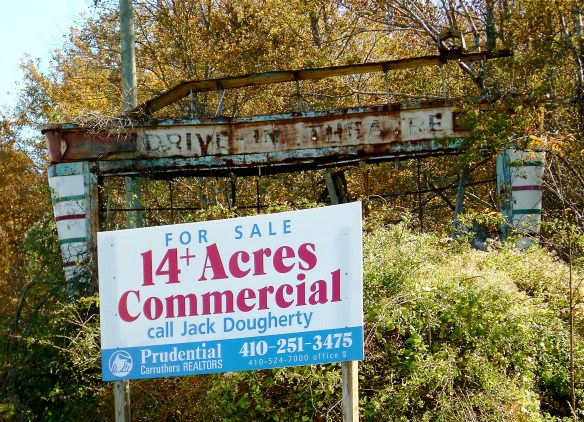
Authentic Americana:  There used to be a drive-in movie theater right here. The rusted roadside sign remains. AUTHENTIC AMERICANA:  There used to be a drive-in movie theater right here. People sat in their cars, or in lawn chairs on the back of pickup trucks, and enjoyed movies under the stars.  The rusted roadside sign is a reminder of a simpler past.

By definition, the “past” is over, and the “future” is waiting to be born. The place where we live is the present moment. We breathe, work, build, learn, change, love and forgive, right now, in this present moment.

As my years fly by, I am coming more to value the present moment. So much of my life was future-oriented, striving to get an education, a job, a mate. Waiting for the right time. Chasing success. Postponing gratification. I often missed the opportunity to live and love in the moment, to enjoy life in the moment, and those moments are gone.

Both success and failure are illusions, I suppose. These days I try to live simply and frugally in the present moment. And what of our larger society?

FUTURE ON HOLD: There's a bright new sign in front of the wreckage of the old drive-in movie sign. The 14 acres where folks once enjoyed movies outdoors on summer evenings, that real estate is still here.

FUTURE ON HOLD: There's a bright new sign in front of the wreckage of the old drive-in movie sign. And the 14 acres where folks enjoyed movies outdoors on summer evenings -- that real estate is idle.

America, and the American economy, also live in the present moment. But at present our industrial base is hollowed out by years of deindustrialization. Too many of America’s leaders put their faith in finance, not factories. Factories mean work; finance means fast money.

The fate of the old drive-in movie theater is instructive. Someone could still make a living showing outdoor movies, is what I think. But the land is  too valuable for that simple use. More money could be made by a more complicated use. In the future.

The irony is that under prevailing economic conditions, no investor can risk buying the land and building something grander.

As a result, in the present moment, the value of the 14 acres is being wasted.

WordPress, Technorati, Alphainventions, and Google

Where would blogging be today without WordPress,  Technorati — 2fv6r8p7b3 —  Alphainventions, and Google Blogsearch?  

Thanks guys.

Summer Business Likely To Be Disappointing

The relatively small community where I have taken refuge — the community that I now call “Home” — is a summer beach resort with a very seasonal economy. During the winter and spring, many locals were concerned that the economic crisis would prompt people to forgo their weekends and vacations at the beach this year. That would mean a dismal season for business and employment.

I sense that we are facing an extended period of economic hard times in America — perhaps worldwide hard times. We could be struggling for decades. Of course in any extended period, there will be signs of recovery, followed by new contractions. I’m far from an expert, but I think we have not yet seen the worst.

We have the graying of America and other advanced countries. We have the competition and sometimes turmoil of the flat-world economy (see Tom Friedman, The World Is Flat). We have complex financial problems to fix, rising unemployment, and falling real estate values. 

But I had believed  we would see some signs of temporary economic recovery by summer, and that our local, seasonal economy would be spared for this year. I thought we’d feel the pain next year, or the year after.

Business seemed relatively strong during the spring run-up to the season. The number of visitors was up, thanks to nice weather on the weekends. There were anecdotal reports that visitors were tight-fisted about spending. June went about as usual, and the resort was packed for the July 4 weekend, as always. People are going to do their best to celebrate July 4, Thanksgiving, and Christmas, come what may.

Now, the peak of the summer vacation season is here. Despite a bear-market rally in the stock markets, economic bad news continues on a daily basis. A Ponzi scheme here, a bankruptcy there. Unemployment is up to about 9.5 percent, nationwide, and set to hit 10 percent in the fall.

With unemployment so high, and house prices falling, what will people do this summer? The vast majority who still have jobs will try to enjoy the summer as usual. But how much will they spend? Over the years, even careful people have been willing to go into debt twice a year — Christmas, and vacation. Splurge a little for special family occasions, and pay the credit card bills later. That was the attitude.

Now I wonder. We all wonder. How much will people change their behavior in the face of economic recession? How afraid are people? Certainly, many will think twice about the buy-now, pay-later vacation.

We will know soon enough. In a seasonal economy, a year’s worth of preparation and work is rewarded in a few short weeks. Success or failure is in the balance for some. I’m thinking that July and August will be disappointing for many. A little disappointing? Or a lot disappointing? No one can predict the future, so we will hope for the best, and wait and see.

Escape To A New Reality

I am a refugee from reality, if you call grinding work, urban congestion, and expensive lifestyle “reality.”

I began seriously losing speed and altitude in 2002, when I accepted a small buyout from a large company, at the age of 53. It was my last stop on a career of more than 25 years. My boss said I “had guts” because I was making a change in my 50s. I said, “Change is good.”

In the intervening years, I’ve made do with a variety of survival jobs in metro areas. Twice I stayed with the same job nearly two years. By the time I hit 60 (last summer),  I felt like my job was killing me. The metro suburbs seemed more and more congested, stressful and expensive. There was no sense of community. It didn’t feel like a civilized way to live.

I thought all summer about escaping. In early September, I found an inexpensive and very small apartment in a beautiful area, at some distance from the big city. I gave two weeks notice. I spent October sorting and boxing possessions. What I didn’t need I gave away or tossed in the dumpster. Most of the large furniture went to good homes with relatives. A few boxes and chairs are stored in a relative’s basement.

What was left, was transported, with help from my brothers, in one pickup truck and three carloads, to the new apartment. I felt like a fugitive — a happy fugitive. I escaped in broad daylight.

It took most of November to get unpacked and settled in my new retreat. After 44 continuous years of paid work, from age 16 to age 60, I granted myself a winter off. Six months of leisure and freedom to partially restore body and soul. To be continued . . .

Losing Speed And Altitude

I have a picture in my mind of America as a high-flying jumbo jet with two powerful engines. One engine is American democracy, and the other is American capitalism.

Democracy and capitalism have served America well, but both engines are showing their age and in danger of burning out.

I could use the same metaphor for my own life’s trajectory, and I will. Flying at typical American cruising speed, I enjoyed moderate career success and a modest level of affluence. I lived the middle-class American lifestyle, credit cards and all. In my early 50s, I began to lose speed and altitude at an alarming rate. By the time I hit 60, I felt about burned out!

A lot of Americans in my age cohort (the baby-boomer generation) are in the same boat . . . make that the same airplane.

This “How To Make A Controlled Crash Landing” blog will attempt a serious but light-hearted commentary on the above phenomena — the faltering American political and economic systems, and the predicament of everyday Americans, particularly those of us who have reached a certain age.

It appears that mid-flight corrections are needed to save American democracy and capitalism. And many Americans are coping with unavoidable adjustments in the way we live. It’s called CHANGE. We’ll be talking about it a lot.

Personally, I’m trying to change my life in the direction of simplicity and frugality.

Posts to this blog will be frequent, short, and sweet. Period. Amen.