A good post for Fourth of July. Reminds me that life is GOOD! Sometimes I need reminding. All work and no play is a bad bargain. — John

Tiffani's avatarOverexposed + Underdeveloped

by Tiffani “Living La Vida Bathing Suit” Michele

Dear, sweet, delusional, and incorrect Erika really threw down the gauntlet yesterday when she blogged “I Hate Summer“. Haterz gonna hate, I know, but she left me no choice but to retaliate with my own post, “I Love Summer” to show her the errors of her ways. Because really, I read her words in shock and awe, shaking my head and mouthing the words “nooooooo!” while raising my fists into the air like a supplicant for correct seasonal priorities. It’s nothing personal, I suppose, and nothing that can’t be fixed over a late night of beer drinking and shots of whiskey. But still. I was offended. Hating Summer?! What?! Who could possibly?! Can you even say those words together?!

I love Summer so much I want to get drunk off vodka infused watermelon, and fondle and caress it and maybe…

View original post 556 more words

‘Responsibility’ is Key to World Economic Crisis

Is the present generation willing to accept the simple responsibility of paying its bills?

Or will we refuse to pay? That’s what it all comes down to, isn’t it?

The Roberts decision upholding the Affordable Care Act turned the spotlight on RESPONSIBILITY.  The effect of the High Court decision is to require that people of means take responsibility for buying their own health insurance. Some view that as an unreasonable request.

The decision also leaves a central question open to debate. Will society accept responsibility for the health care costs of the poor? The High Court’s position on Medicaid essentially requires each state to decide whether it will accept responsibility for its poor citizens. (A related question is: Can individuals act responsibly to preserve their own health?)

On the world economic stage, the crisis in Europe also spotlights responsibility.

Continue reading

Supreme Court Health Care Decision Divides The States

Fascinating complexity in the decision written by Chief Justice John Roberts upholding the Affordable Care Act!

English: President George W. Bush announces fr...

President George W. Bush, a Republican, announces his nomination of John Roberts to be Chief Justice of the U.S. Supreme Court (Photo credit: Wikipedia)

First of all, Justice Roberts, a conservative Republican appointee, voted with the High Court’s “liberal” justices to create the 5-4 majority upholding the law. Republicans and conservatives across the U.S. hysterically called him a “traitor.”  Wait. Isn’t a patriot’s first loyalty to the United States of America, not to any political party?

The frightening possibility is that some partisans no longer see loyalty to the U.S. as a patriot’s first loyalty. It’s possible that some of the more extreme Tea Party loyalists have already seceded from the United States in their own troubled minds.

Continue reading

John Roberts’ “Can-Do” Doctrine Scandalizes Conservatives

“I will find a way or make one.” — Admiral Robert E. Peary, American explorer

“As between two possible interpretations of a statute, by one of which it would be unconstitutional and by the other valid, our plain duty is to adopt that which will save the act.”  Justice Oliver Wendell Holmes

By all accounts, Chief Justice John Roberts believes that the Supreme Court of the U.S. should try to find a way to uphold  a law enacted by Congress, rather than declare it unconstitutional. In other words, declare a Congressional act unconstitutional only if it really is unconstitutional.

Continue reading

John Roberts Is Man Of The Hour

Official 2005 photo of Chief Justice John G. R...

Official 2005 photo of Chief Justice John G. Roberts (Photo credit: Wikipedia)

The Supreme Court decision today on the Affordable Care Act, AKA “Obamacare,” shocked my system. It was the first jolt of optimism about the future of America that I’d felt in months. And I hadn’t expected to have any reaction at all.

Chief Justice John Roberts is the man of the hour. With one stroke he won for himself a place in American history.

I can’t claim full understanding of the High Court’s ruling upholding the Affordable Care Act. My gut reaction is it changes everything. It goes far beyond the legal issues at hand. This ruling might be the turning point that saves the American system.

Continue reading

Geography of Life After Sixty: You Do Have A Choice

VANCOUVER, BEST CITY FOUR YEARS RUNNING. Wikimedia Commons photo

MELBOURNE SKYLINE. AUSTRALIA HAS FOUR OF THE WORLDS TOP CITIES. Wikimedia Commons photo

We haven’t talked about geography in a while. Have you ever thought about relocating to a better place?

Like, “If Congress is stupid enough to kill Medicare, I’m moving to Canada!”

If you’re retired and living on Social Security, you might actually have the freedom to make a considered decision about the best place for you, personally.

Her Majesty Elizabeth II, Queen of the Commonwealth, must be doing something right. Public domain photo

Turns out, Canada’s not a bad choice. In Time’s list of the 10 Happiest Countries in the World, Canada comes in third, behind only Denmark and Sweden. Australia is fourth and New Zealand is eighth. These Commonwealth countries must have a secret. Could it be their health care systems? Ireland, my favorite place to consider living, is 10th. Come to think of it, I guess all the countries in the top  10 have universal health care. The U.S. does pretty well, at 12th place, considering we have health care that’s more expensive and less effective than many countries.

In a ranking of the Most Livable Cities in the World, Australia has four(!) in the top 10 and Canada has three. Vancouver, Canada (most livable city in the world four years in a row!), and Melbourne, Australia took first and second place. If you’re gazing north across the border, Calgary and Toronto also make the top 10. Pittsburgh(!) is the top-ranked U.S. city, at 28th.

Gazing south across the border? Dunno. People used to retire to Mexico for the low cost-of-living. But I hear they’ve got an out-of-control drug war going just now.

As always, these rankings of places are subjective. You have to consider what factors were considered in the rankings. What’s important to you? Health care? Cost of living? Climate?

— John Hayden

(Quick-take rating for this post: 342 words)

Last Stand of the White Men in Suits

HOUSE REPUBLICAN LEADERS. AP photo, 02-09-11

Not to belabor the obvious, but does the above photo look like the last stand of Republican white men in suits?

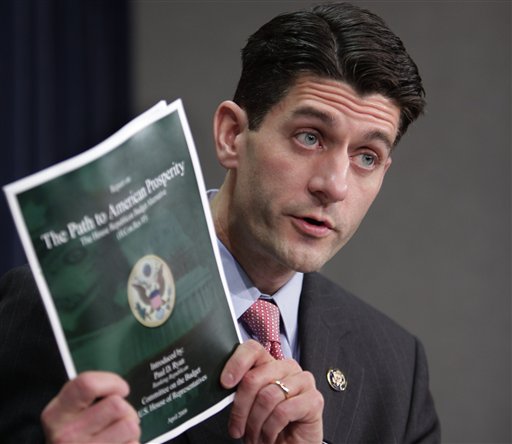
REP. PAUL RYAN. AP photo by J. Scott Applewhite

This morning, Rep. Paul Ryan, chairman of the House Budget Committee, presented the Republican budget for 2012. Joining him were a TV screen full of his Republican colleagues on the House Budget Committee. Everyone present, from what I could see on TV, was a white man. With a few exceptions, they are from the Red States, the heartland of America.

Not to put too fine a point on it, but the Republican budget would cut government spending by $6.2 trillion over a decade, and sharply cut taxes for the wealthy. The top income tax rate would be reduced from 35 percent to 25 percent. Is the U.S. really broke, or is the U.S. wealthy? You decide.

Here is a list of Republican members of the House Budget Committee. White men in suits from the heartland. Only one female name is on the list.

Many believe the Republican budget is so draconian that it's dead on arrival. I hope so, but the hard line on Medicare, especially, is ominous.

NOT TO IGNORE THE REPUBLICANS IN THE SENATE. Roger L. Wollenberg photo, 03-31-11

Umm, the photos above, of Republican leaders in the House and Senate, and the list of Republicans on the House Budget Committee . . . Is this what democracy looks like in America, in 2011? (Disclaimer: Many of my friends and relatives are white men. Come to think of it, I am a white man. Hey, I even own two winter suits AND two summer suits, so I am prepared to attend weddings, funerals, and job interviews in all seasons.)

The name of the Republican budget is “Path to Prosperity.” Rep. Ryan says these words, “Path to Prosperity,” with a straight face, without a hint of irony.

Here’s an early analysis of the Republican budget numbers, from the Huffington Post.

Here’s another analysis by Ezra Klein in the Washington Post.

The “Path to Prosperity” runs right over Medicare and Medicaid. At this moment, it appears to me that the Path to Prosperity would effectively destroy Medicare and Medicaid. Maybe that is a  good thing. Sometimes, I think, the only way to reform a program or a bureaucracy is to destroy it and start over. But I don’t think that’s what Republicans have in mind. I think Republicans intend to privatize health care for the elderly and the poor. In the name of paying off the debt. (For an earlier post on Republican strategy regarding Social Security, see “Divide and Conquer.”)

Also on the Republican chopping block: education, from Head Start to Pell Grants.

I think Republicans are focused entirely on two things: paying off the public debt, and reducing taxes. Two contradictory goals, but possibly both can be accomplished at the same time, by grinding the middle class and the poor — and the elderly — into the dirt. (Go ahead, accuse me of class warfare. Doesn’t this look like a scorched-earth policy to benefit wealthy America and corporate America?)

Rep. Paul Ryan says the Republican budget will “create jobs.”

SHOW ME THE JOBS. How exactly do you create jobs by slashing spending to the bone, on everything except the Department of Defense?

How do you create jobs when Toyota is shutting down 13 factories in the U.S., and food and gasoline inflation is vacuuming up every spare dollar of discretionary spending? AND the U.S. is fighting three wars in the Middle East.

Oh, yeah. And to show their power, or something, Republicans intend to shut down the U.S. government at the end of the week. Will that create jobs?

— John Hayden

What Prevents Surgeons And Hospitals From Providing Free Surgery To Save A Life?

Sunset at Organ Pipes

Image by Bill Gracey via Flickr

News organizations are reporting this evening that at least two patients have died in Arizona because the state has decided it can no longer afford to pay for organ transplants for low-income patients.

The organ transplants can cost from $200,000 to more than $1 million, according to NPR.  A list of 98 patients are potentially impacted in Arizona. NPR provided this explanation of the Arizona budget decision in November:

“In Arizona, 98 low-income patients approved for organ transplants have been told they are no longer getting them because of state budget cuts.

The patients receive medical coverage through the Arizona Health Care Cost Containment System (AHCCCS), the state’s version of Medicaid.” — National Public Radio

WTF?  How can a state justify refusing organ transplants to low-income patients, particularly in cases where the refusal amounts to a death sentence without a trial?

But there’s another question that’s even more compelling:

Why have no surgeons or hospitals offered to do the life-saving surgery for free?

What prevents a doctor or hospital from providing free life-saving treatment? DO THE SURGERY FOR FREE! Would that be un-American?

Am I missing something here? Would a surgeon or hospital spokesperson care to comment? Is there not a single, altruistic transplant surgeon in America? Is there not a single hospital affiliated with a religion that would be willing to provide free surgery as an act of charity, for God’s sake?

What? Would it set a bad precedent, or something?

— John Hayden

Austerity Project, Day 10

ITPB Health Club

Image via Wikipedia

It’s too soon to know whether the Austerity Project will be a success. I’m defining “success” to mean reducing my spending to match my income.

The total damage for Austerity Project, Week No. 1, was $189.13. Issues from Week No. 1: I ate pizza three times. That number has to come down. My biggest single expenditure was a fill-up at the gas station, with regular at $2.76 a gallon, for a total of $33.68. After rent, health insurance, and food, gas for the car is my next highest monthly expense. Soon I’m going to need an oil change and some regular maintenance, which is not included in the monthly budget. And looming in February is the $700 annual payment for car insurance, which is also off-budget.

The first day of Week No. 2 was my first day with no expenditures. Not a penny. Tuesday was $16.23 for miscellaneous household goods at Walmart.

Today, I signed up with a health club, aka “gym,” with a commitment of $19.95 a month for the next year! I did not make this decision lightly. There is no health club line in my monthly budget. I don’t know where the $19.95 a month is coming from. But you have to admit it’s a good price for a health club membership.

With a fancy new health club opening, there’s something of a price war going on among health clubs in my area. I found the $19.95 price at a so-called “bare bones” club. It doesn’t have a sauna or whirlpool or spa. The locker room is small. No towel service. But the place is bright and airy, and they’ve got more equipment than I’ll ever use.

I’m thinking that at age 62, with creakiness in the bones and weakness in the muscles, the health club membership comes close to qualifying as an essential.

It’s not as if I’ve been inactive in the past year. For much of that time, I worked as a security guard, which was mostly walking, walking, walking around a large building and grounds. In other words, my job was to be a moving, human scarecrow. Since August, I’ve spent a lot of time on political campaigning, which also involved lots of walking. I got a sunburn, and then a tan, on my face, but I can’t say I feel any healthier for all the walking. The campaigning resulted in two disappointing losses, first my own in the primary, and then the candidate I volunteered for in the general election.

Now, with the security guard job and the campaign over, and winter coming on, I feel like I’m facing rapid deterioration if I don’t keep these old bones moving. The health club is less than $1 a day, and it will give me another place (in addition to the library) where I can go to get out of the rain and snow.

I’m starting the health club adventure at near rock bottom (I always feel rock bottom this time of year, with the shortening daylight and the sun low in the sky). Job one is to get myself to the health club almost every day. It will be interesting to see if the exercise makes a difference. Any improvement in health of mind and/or body will be well worth the $19.95.

Stay tuned. I’ll keep you posted.

— John Hayden

Colonoscopy: Insider’s Report

Being over 60 means getting a colonoscopy. Truth to tell, I had one about 10 years ago, not long after turning 50. It’s a rite of passage at the end of the middle years. We’re entering new territory, and by now we understand the value of health.  The colonoscopy is a symbol of our new watchfulness in a dangerous world.

My second colonoscopy was today, at age 61. Any day that starts with a colonoscopy can only get better. Assuming, of course, that they don’t discover some dread disease that begins with “C.”

Everyone says the day of preparation before the procedure is the hard part.  This time, the prep day didn’t seem so bad. Two bottles of salty stuff to drink, four little pills to swallow. Just follow the instructions. They let me drink water up until five hours before the procedure.

I drive to a nice modern facility at 8:30 a.m. Lots of friendly and professional staff. They give me a hospital gown, and a robe to put over my shoulders like a cape. The volunteer says I can keep my socks on, because it’s cold in there. He leads me to a reclining chair, and puts a blanket over my lap and legs. A pre-warmed blanket! First class all the way.

There’s the usual blood pressure and temperature routine, an IV is started, people keep asking my name and date of birth, to make sure I haven’t forgotten. At least four different people ask if I’m allergic to anything. They all seem genuinely happy to be doing their jobs. I sign a few papers, talk to the anesthesiologist. The nurse says there’ll be a short wait. I relax and read my book.

After a while the doc comes and chats, and says we’ll get started in a few minutes. I walk into the next room and lie down on my side, as directed. The chief nurse announces the procedure. At least six health-care folks are in the room, and we don’t want anyone thinking this is an amputation.

The doctor asks, “Do you mind if the student nurse observes?” Of course he can observe!  He might learn something. Sell tickets, for all I care. I’m going to be knocked out. Put it on YouTube, if you want. Just make sure to get my good side.

The anesthesiologist is fiddling with his stuff, and a nurse comments on the mystery I was reading. She has the same book. It’s about a dog and a private eye, as told by the dog. We’re all laughing about the dog, or so it seemed to me, and that’s the last thing I remember.

I woke up in a fog, still lying on my side. As a nurse had warned, I felt cramps from pockets of air in my gut. They put air into the colon as part of the procedure, and try to get most of it out when they’re done. But they never get it all, so you have these pockets of air inside. You have to relax and allow the air to escape by the usual exit.

I do not remember this air cramping after the colonoscopy 10 years ago, but I honestly have to say it was the only bad part today. When I became fully awake, the air cramps felt painful. Not terrible, but definitely not pleasant.  A guy next to me was having the same problem. Minutes went by, and the air pockets were slow to disperse. I finally got the last of the air out in the privacy of a restroom. It seemed like enough air to inflate a truck tire.

Eventually I got dressed and a nurse took me to a chair, sat me down, and gave me a cup of water. They had said the procedure would begin at 9:30 a.m., and I could go home by 10:30 or 11 a.m. It seemed like a lot of time had passed, but now that I had my watch and glasses back, I could see it was only 10:50.

The doc stopped by and told me everything was fine. He had pictures! He found one polyp and zapped it. No possibility that it was the bad kind, he assured me.  Score: Doctors 1, Polyps, 0. Game over.

You may remember that I drove myself to the medical building. But you probably know that they don’t let you drive yourself home. Fortunately, my neighbor was kind enough to come and drive me home. I had something to eat and took a nap. I’ll go back and retrieve my car tomorrow.

One thing more: I decided to have the colonoscopy now, because in two months, I probably won’t have health insurance.  — John Hayden