‘Staggering Irrationality’ In American Politics

“At a time of unprecedented polarization in America, we need a more convincing explanation for the staggering irrationality of our politics. Especially since we’re now split not just over what we ought to do politically but also over what we consider to be true.

So says science writer Chris Mooney in a recent Washington Post article. He attributes the “staggering irrationality” to psychological differences in the way liberals and conservatives respond to reality. He points in particular to two differences in personality traits.   Continue reading

Walmart And The American Dream

Creative Destruction, A Photo Story

There used to be a Walmart right here. But it was too small.   Continue reading

AMERICAN VALUES — “That Used To Be Us”

From That Used To Be Us, by Thomas Friedman and Michael Mandelbaum; Chapter 13, “Devaluation:”

THOMAS FRIEDMAN, Wikimedia Commons

“. . . something else that happened with the end of the Cold War and the passing of the baton from the Greatest Generation to the baby boom generation: an erosion of important, traditional American values that long underpinned our public and commercial life. . . .

“A well-functioning political system must be rooted in something deeper than itself:   Continue reading

American and European Workers in the New Economy

It’s possible that we’re on the brink of historic collapse. Maybe not the Dark Age that Jane Jacobs suggests in her final book. Maybe the decline and fall of the Roman Empire is not an apt comparison. Maybe it will be more like the decline and fall of the British Empire. Or the breakup of the Soviet Union. Maybe only partial collapse, failure of some systems, here and there.

Is the era of labor-intensive capitalism over in the U.S. and Europe?

You can trace the demise of the factory to decisions made in the 1950s. The actual dismantling of American industry began in the 1970s. By 1982, the process was so advanced that we spoke of the industrial heartland as the “rust belt.”

The remaining labor-intensive parts of American industry were taken apart and exported during the globalization of the 1980s and 1990s. After the manufacturing base was hollowed out to a shell, the next labor-intensive sector to collapse was the construction industry.

Capitalism remains strong. But for the first time, capitalism doesn’t need many workers, at least not in America and Europe. What about the knowledge industry? Won’t that provide jobs? Google is big, but its workforce, not so much. Yes, there will be jobs for the lucky, the talented, the highly educated. But ask a recent college grad how easy it is to find a job.

We have what’s left of retailing. Count the vacant stores at your local mall. Walmart thrives. We have fast food. Many jobs, minimum wage.

The new capitalism is technology-intensive and finance-intensive. And coming soon, computers that “think,” to compete with slow, old-fashioned humans.

As manufacturing jobs slipped away, the financial sector created an illusion of growth and wealth.

The workings of the financial sector are a mystery to me. But the events of the past few years have caused me to view banking and finance with fear and loathing. Based on what little I know, the world financial system — many currencies and fluctuating values, with competing central banks and regulators — is dysfunctional and completely irrational. Finance is a crazy system, more likely to create chaos than order. It’s FUBAR (go ahead, look it up).

The institutions of finance have no soul or conscience to oppose corruption. American banks, corporations and wealthy individuals are awash in money, while average Americans, especially underwater “homeowners,” are awash in debt. For whatever reasons, the wizards of finance refuse to spend or invest.

If high-tech, high-finance, American and European capitalism can profit without much labor input, what happens to the surplus workers?

Economic, political and social systems will have to adapt rapidly, or risk collapse. The European Union looks kind of unstable. In the U.S., some states are financial basket cases. Maybe collapse is happening now.

— John Hayden

Related articles

The Big JOBS Plan: What is Possible? What is the Goal?

Cover of

Cover of End of Work

The mob is clamoring for a big, definitive “plan” to “create” JOBS.

The problem is, we are all yearning for a return to the prosperity and good jobs of the 1950s. A return to Middle-class America. That model of American prosperity lasted for a half-century, even as it was eroding away. That model lasted through the inflating 1970s, the greedy 1980s and the bubbling 1990s.

The middle-class model of America, with good-paying jobs all around — it’s over. We aren’t going back to the 1950s. It’s impossible. That’s where President Barack Obama’s JOBS plan has got to start.   Continue reading

America, Out Of Balance

We are fixated on the question: Is America headed in the right direction or the wrong direction? A sizable majority answers, the wrong direction.  But if you ask the wrong question, you get an irrelevant answer.

I think the question is not one of “direction,” but “balance.” What would be the “right direction” anyway?  East or west?

America has come unhinged, out of balance. Everything is distorted, like in a hall of mirrors. American wealth, American politics, American society, all badly out of balance.
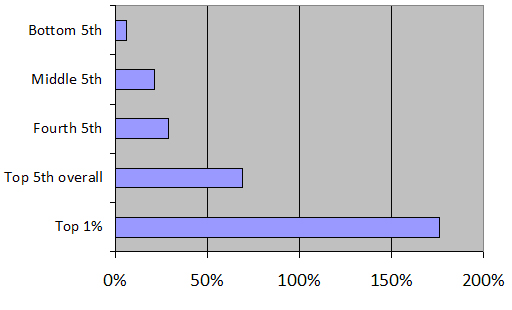
Inflation adjusted percentage increase in mean after-tax household income in the United States between 1979 and 2005. Wikimedia Commons.

Wages are too low.  CEO salaries are too high. Too much wealth goes to profits. Average Americans are “underwater,” while corporations hoard wealth.

We have too many poor people at the bottom; hardly anyone remaining in the middle.  And a relatively small cohort of the wealthy — and the associates and lackeys of the wealthy (who are nearly rich or merely affluent) — at the top.

All the money and the power is at the top, very little money and power at the bottom.

The financial sector is bloated, the industrial base is rusted and hollowed-out.

Demand is too low, and supply is too high. The supply-demand equation is a worldwide phenomenon. The whole world generally has an excess supply of nearly everything, including production capacity. Most telling, we have a worldwide surplus of labor.

Too much greed; too little love. Too much corruption and incompetence in all our institutions. A deficit of honesty and diligence.

Too many putting their faith in luck; giving up on work. Too much speculating, not enough investing.

The winners have more money than they can use; the losers are broke. We have a complete failure of compassion and justice. The winners are tired of hearing about the losers. They just want the losers to shut up. Sit down and shut up. Or better yet, lay down and die.

I wonder what would happen if all the Americans who don’t have the sense to lay down and die suddenly found their voice and their anger. Probably isn’t going to happen, because society is muddled by a surfeit of misinformation, lies, and myths.

Too much blather, not enough factual information.

Speaking of blather, it’s time for me to stop writing. It is easy enough to list the problems. I wish I could suggest some surefire solutions, but I don’t have any.

To sum up: I don’t  think America needs to change direction; rather, I believe we need to restore balance.

— John Hayden

The Great ‘Culture-War’ Election of 2012

A map of the United States of America, showing...

Image via Wikipedia

Will the next election be a “culture war?” Looks like. Please read Jon Taplin’s latest post, “Bring On The Culture War.”

“Bring on this culture war to end all culture wars. We need a real clear decision. Do we (all the people, not some of the people) want to move towards Rick Perry’s vision on the future or Barack Obama’s vision of the future. Down Perry’s road lies a world where gays stay in the closet, women are submissive, where Social Security is abandoned to the care of Wall Street (for a big fee), and where we keep trying to play the role of policeman of the world.

Pretty much the opposite would be what Obama believes. So let’s choose as a country.”  — Jon Taplin

At stake in the 2012 culture-war election, of course, is nothing less than the future of Social Security, Medicare, and Medicaid. Will America be a democracy of the people, or an aristocracy of the wealthy and powerful? Will we have a middle-class in America, or a deep divide between wealth and poverty?

Are people willing to give President Obama a fair hearing, or are they predisposed to hate the man?

— John Hayden

News Flash — Jon Taplin Is Back!

New Anarchy vs. New Fascism? — Talk About “Living in interesting times!”

Jon Taplin has returned to his blog. Please read Jon Taplin’s insights into the deepening political and economic crisis. See his posts,  “Why Now?” and  “Brave New World Redux.”  Jon Taplin is the writer who explained the ongoing disconnection and unreality in America and the Western world with his series of essays on the “Interregnum.”

Now, in his two recent essays, prompted by the riots in London, Jon Taplin suggests that a “New Anarchy” may lie ahead for the Western World.  If for every action there is a reaction, I’ll up the ante by suggesting that the New Anarchy may be an attempted revolt against a New Corporate-Fascism.

We may live to see, in the near or medium future, a great struggle between the forces of Anarchy and Fascism.  Some may believe it will be the Apocalypse.  Whether or not you believe in Apocalypse, the struggle will likely feel like an upheaval of apocalyptic proportions.

The following words are Jon Taplin’s; I took the liberty of highlighting some words in bold:

“Whatever political will the country might have had for a WPA style program —putting millions of unemployed construction workers back on the job fixing America’s third world infrastructure—now seems to have evaporated. It was perhaps our last chance to avert the Coming Anarchy. With no government infrastructure programs to put people back to work, the private sector is left  trying to create jobs for the 28 million people who are either officially unemployed, working part time but wanting full time work or “discouraged workers” who have stopped looking for a job. This of course is not going to happen—and so we are all facing the problem of a “new normal”, in which a large portion of the high school only population may never find work. Liberal pundits mourn the loss of good jobs for this cohort, but as Bernard Avishai warned in “Strategy and Business” way back in 1997, “Any job that is still simple and repetitive enough to employ a semi- or non-skilled person is going to be even more pressured by new software or by contractor-suppliers in China and Brazil.”  — from Brave New World Redux

I would have some hope for America if President Barack Obama would appoint Jon Taplin to his inner circle of advisers at the White House. Also needed at the White House, Washington Post business and economy writer Steven Pearlstein. See “Who’s to blame for this mess? Let’s start with the corporate lobby.” on page G1 of the Post, Sunday, Aug. 14, 2011.

— John Hayden

London Is Burning

This just in from a blog in London:

Tonight, in one of the greatest cities in the world, society is ripping itself apart.

If you want to know the latest in the American-European Political-Debt Crisis of 2011, I recommend you read blogs like Penny Red.

If you want a preview of what’s coming to an American city near you, California is no longer the barometer. Look at what’s going on in London, or Dublin, or Greece, Italy, Portugal, and the entire European Union. Europe is now in worse shape than America, but maybe not for long.

Here’s an excerpt from today’s report in Penny Red:

Tonight in London, social order and the rule of law have broken down entirely. The city has been brought to a standstill; it is not safe to go out onto the streets, and where I am in Holloway, the violence is coming closer. As I write, the looting and arson attacks have spread to at least fifty different areas across the UK, including dozens in London, and communities are now turning on each other, with the Guardian reporting on rival gangs forming battle lines. It has become clear to the disenfranchised young people of Britain, who feel that they have no stake in society and nothing to lose, that they can do what they like tonight, and the police are utterly unable to stop them. That is what riots are all about.

And more from Penny Red:

 This morning, as the smoke begins to clear, those of us who can sleep will wake up to a country in chaos. We will wake up to fear, and to racism, and to condemnation on left and right, none of which will stop this happening again, as the prospect of a second stock market clash teeters terrifyingly at the bottom of the news reports. Now is the time when we make our choices. Now is the time when we decide whether to descend into hate, or to put prejudice aside and work together. Now is the time when we decide what sort of country it is that we want to live in. Follow the #riotcleanup hashtag on Twitter. And take care of one another.

I also recommend Baroque in Hackney, who can provide other pertinent links in Britain.

And today, in Wisconsin, the people are voting. I wonder if what they decide, one way or another, will be able to slow down, one iota, the spread of the chaos in the Western World.

I have to go to work now.

— John Hayden

American Debt Crisis: Many Questions About the Future of American Democracy

The first battle of the American Debt Crisis is over. Perhaps the deciding battle will be fought in the 2012 elections.Everyone’s focused on the outcome of the presidential contest, but control of the House and Senate is at least as important.

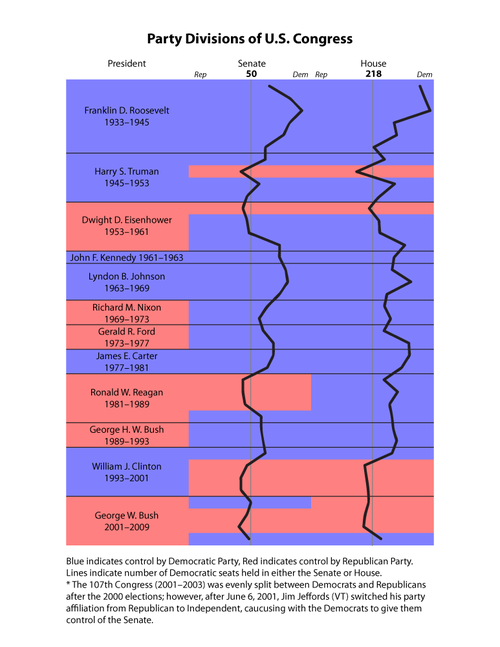
IN 2011, NEARING THE END OF THE FIRST TERM OF PRESIDENT OBAMA, CONGRESS IS SPLIT. REPUBLICANS HOLD A MAJORITY IN THE HOUSE OF REPRESENTATIVES, AND DEMOCRATS HOLD A MAJORITY IN THE SENATE. Graph by Mattbot69 via Wikimedia Commons

Questions:

  • Is America now a three-party nation? Tea Party, Democratic Party, Republican Party? Which party, if any, will dominate the 2012 Congressional elections?
  • Will another party emerge? I’m thinking it might be called the Christian-Democratic Party. I think the Tea Party is clearly out of touch with bedrock Gospel values. The Democratic Party in America, oddly enough, more nearly reflects the Gospel message, but Democrats are so focused on being secular that they can’t connect their policies with values.
  • Exactly how real is the “Debt Crisis?” Republicans and Tea Party people have repeated “spending problem” and “debt crisis” over and over until it has become the common wisdom. But clearly, in comparison to the situation in Greece, or the European Union, or Japan, or many other countries, the U.S. financial situation if solid. The debt is not sustainable in the long run. But is it really a “crisis” in the immediate future? No. I would call it a “serious problem,” not a crisis. Common-sense problem-solving is needed, by reasonable people, in a non-crisis atmosphere. Can we do that?
  • Who are the winners and losers? I just don’t know. Except this: the core American programs of Social Security, Medicare, and Medicaid are safe for now.
  • Misinformation abounds all around. Especially this: Politicians are purposely misleading the public regarding the prospects of jobs and economic recovery. People need to know that we have entered a new reality in a global economy, and the age of American Privilege is over.

Now I have to go to work. Maybe I’ll write more thoughts about a Christian-Democratic Party later. It’s probably not what you think.

— John Hayden