Dwindling Jobs, College Debt, Clueless Politicians (With Extended Discussion in Comments)

Economic and political difficulties — especially issues of justice — are on my mind, as always. Guess I’ve been reading too many scary books about economics and the jobs outlook.

What is the outlook? In developing countries, manufacturing that’s always on the move, stalking the cheapest labor. In Western countries, an abundance of jobs for machines, robots and computers; for human beings, not so much. Continue reading

Sequestration In America, Dancing On Wall Street, Pain In Maryland And Virginia

As I write this on Tuesday, the Dow-Jones Index has hit an all-time high. It’s historic! Higher than the last record, set in 2007.

Sequestration, which I call Austerity, took effect on Friday.

Devastating economic pain is predicted throughout America, although some exaggeration is baked into the “sky-is-falling” rhetoric.

Exaggeration or no exaggeration, economic growth has been sluggish. Sequestration of $85 billion in federal spending will slow the economy even more.   Continue reading

Forgiveness of Student Loans Should Be THE Democratic Issue For 2014

Protecting Social Security and Medicare — the strong and fundamental safety net for older Americans — is a core mission of the Democratic Party and Democratic voters.

Equally important — it’s a moral obligation — is making sure we don’t leave younger generations bereft of opportunity and buried in debt. We must preserve hope for everyone from today’s elementary school children to today’s forty- and fifty- somethings.

President Obama’s call for quality early childhood education for all children gets us thinking in that direction. But what about today’s working adults, from age 21 to age 62? Too many will find themselves caught in the middle between the costly (privileged?) senior generation and the expensive (and essential!) younger children.

I’ve long been troubled by the accusation that preserving Social Security for today’s elders will lead directly to the indebtedness and impoverishment of our children and grandchildren. Continue reading

Saint Dorothy Day

Day 100/365 : Choices

(Photo credit: ~jjjohn~)

“It’s a terrific idea: a home-town saint for the Occupy Wall Street era.”   — The New Yorker

Liberals, progressives, radicals: Take heart!

Dorothy Day half-length portrait, seated at de...

DOROTHY DAY (Photo credit: Wikipedia)

We knew it all along, but now Cardinal Timothy M. Dolan agrees. Dorothy Day is a candidate for sainthood!

NYC radical journalist Dorothy Day (1897-1980), co-founder of The Catholic Worker newspaper and a nationwide movement of “hospitality houses” serving the homeless, the hungry, and the poor, has been a candidate for sainthood in the Catholic Church since 2000. Now she even has the support, appropriately enough, of the archbishop of New York.

Continue reading

Vote Robin Hood

Hmmm . . . I was going to say, “No comment” . . . Seriously folks, Robin Hood’s not running this year . . . But, if the winner-take-all economy continues . . . and rich patriots continue to accumulate all the money . . . and stash their wealth in the Cayman Islands and Swiss bank accounts . . . Well, Robin Hood might begin to seem like a good idea. 

Robin Hood and Maid Marian (poster, ca. 1880)

ROBIN HOOD AND MAID MARIAN (poster, ca. 1880) (Photo credit: Wikipedia)

Robin Hood is the English folk hero who fascinates the creative imagination. His popularity never wanes. Let’s see, at least eight films, according to Wikipedia. Also, some television shows on BBC, at least one music album, and two computer games.

Robin Hood. Hold that thought. It’s something to stash away for some future election . . . if they still allow elections in the future.

— John Hayden

Maryland Election Ballot Questions: In-State Tuition, Redistricting, Same-Sex Civil Marriage, Gambling Expansion

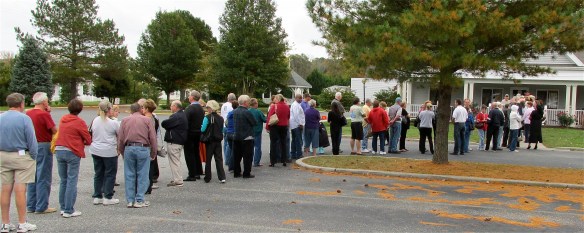
See that line? That’s the first-day of early voting at Berlin in Worcester County, Maryland.

You can expect long lines at Maryland polling places for the Presidential Election on Tuesday. The reason: Ballot questions that voters know are important, so they take the time to read all the questions in the voting booth and make their decisions. The solution: Get familiar with the ballot questions before you go to vote. Do this on Sunday or Monday. Make your decisions and mark them on your sample ballot or just jot them down on a scrap of paper. Or print out this post and take it with you. Walk into the polling booth, vote, and you’re out in three minutes. But you’ll still have to stand in line, because most people won’t take a few minutes to prepare themselves in advance.

The following comments on four of the ballot questions represent the opinions of the blogger.

QUICK GUIDE TO THE FOUR MOST IMPORTANT QUESTIONS ON THE MARYLAND BALLOT

QUESTION 4, REFERENDUM: HIGHER EDUCATION, TUITION RATES.

Quick recommendation: QUESTION 4: VOTE FOR THE QUESTION.

Question 4 is the in-state tuition referendum, AKA the Dream Act referendum. Authorizes in-state and in-county tuition rates for all true residents of Maryland, including undocumented immigrants. It’s been passed by both houses of the General Assembly after considerable debate, and signed into law by the governor.

Continue reading

Early Voting in Maryland

Status

Editor (Retired)'s avatar

A GOOD DAY TO VOTE — Nothing I write here, or say or do, is going to change the course of Sandy, whether she be a hurricane or a tropical storm.  Meanwhile,  early voting begins today in Maryland. I’m going over to Berlin (our early voting location in this corner of the state) and say hello to my friends in the parking lot. Then I’ll go inside and vote for my president, Barack Obama, my vice president, Joe Biden, and my U.S. senator, Ben Cardin. And I’ll write in the name of John LaFerla, the official Democratic candidate for Congress. By so doing I’ll also be voting for Peace, Social Security, Medicare, Medicaid, and health care for all.  — John

J.K. Rowling’s “Casual Vacancy,” Book Review, Take 1

“The Casual Vacancy”  is instantly notorious because it’s J.K. Rowling’s first novel for adults. It comes with a prominent black “X” on the cover, fair warning that between these covers you’ll find a subject that’s TABOO in America.

The subject is class warfare and classism. Ms. Rowling’s story takes place in England, and you have to remember that the British and Europeans are not as squeamish about class issues as we Americans. Until recently, we’ve been in full denial.

(If you’d like to read my preview of Casual Vacancy before you start the review, see J.K. Rowling’s “The Casual Vacancy — Prices Slashed.)

Ms. Rowling takes the micro approach to class warfare, focusing on the lives, relationships, and foibles of the individual men, women and children of one small town in England. The macro alternative would be a “God’s-eye view,” examining society from a distance. Rowling understands that you need to get up close and personal to understand classism and class warfare.

In the first 100 pages of Casual Vacancy, Rowling introduces an average of one new character every two pages.

Continue reading

Truth And Lies About Business And Jobs

Let’s expose a few lies that Americans hold dear.

“Small businesses create most of the jobs.”

TRUTH:  Small businesses are what? SMALL. By definition, small businesses have few employees.

“Small businesses fuel economic growth.”

TRUTH:  Most small businesses FAIL within the first five years. Often within the first year. When they close their doors, they create unemployment.

Continue reading

A Brief History of (Re)Distribution

(Re)distribution.

Mitt Romney is willing to go straight to the heart of issues that politicians usually avoid. Whether you agree or disagree with him, he’s helping us understand.

Economics is the study of the distribution of scarce resources. (I think that’s a valid statement.)

Isn’t it always about distribution?

Isn’t all of history about distribution? The distribution of scarce resources, of wealth, of power. Who owns what? Who has a right to what?

Aren’t most wars fought to redistribute land, wealth, and power? Land and the resources on or under the land are the fundamental scarce resources.

Continue reading