America: What I Believe In 2011

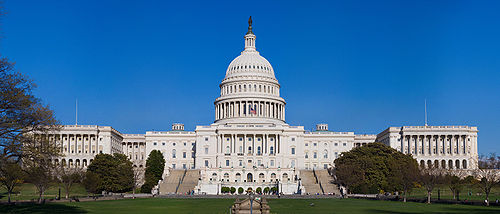
Image via Wikimedia Commons

(Please click on “comments” at the left side of the title for an interesting back-and-forth between polar opposite points of view.)

The deadlock over raising the debt limit seems almost like a clash of religious beliefs. The two sides hold different beliefs. The deadlock has helped clarify my thinking about what I believe. Maybe this debt crisis of 2011 will help us all clarify who we are, and what we believe.

Image via Wikimedia CommonsI believe that Social Security, Medicare, and Medicaid are the best part of America. I believe that without Social Security, Medicare, and Medicaid, a large part of the American population — more than half the people over 65 — would fall into hopeless poverty.

Some people believe it would be impossible to balance the American budget without deep cuts in Social Security, Medicare, and Medicaid. I believe that America is still, right now, the most prosperous society the world has ever known. I believe that America can afford Social Security, Medicare, and Medicaid.

I believe it would be fair for the most prosperous among us — those with incomes of $250,000 or more a year — to pay a little more in taxes for the good of America. These people have prospered in America. They live the good life. Aren’t they patriotic enough to want to keep America strong? I believe they ARE patriotic and willing to help. It is inconceivable that they could be otherwise.

Some politicians say they oppose any tax increase because a tax increase would “destroy jobs.”

I don’t believe it. How would a modest tax increase destroy jobs? The president is not talking about making rich people poor. He’s talking about a modest tax increase on incomes over $250,000. How exactly will that destroy jobs? Will people earning $250,000 or more even notice a small tax increase? Will a small tax increase change their way of life? I don’t think so. Some may believe otherwise.

I believe there are other ways to balance the American budget. I believe we are spending far too much on a worldwide military presence. I believe we do not have to be fighting foreign wars in Iraq, Afghanistan and Libya. I believe we could drastically reduce foreign military spending, pull American soldiers out of harm’s way and closer to the North American continent. We could reduce defense spending by perhaps a third, and still have a military that is by far strong enough to defend the North American continent.

I simply cannot understand why anyone would want to destroy Social Security, Medicare and Medicaid. I believe the vast majority of Americans support these programs. I believe that common-sense cuts in general government spending and defense spending, combined with a small increase in taxes on the most fortunate among us, would bring the American budget into balance.

What do you believe?
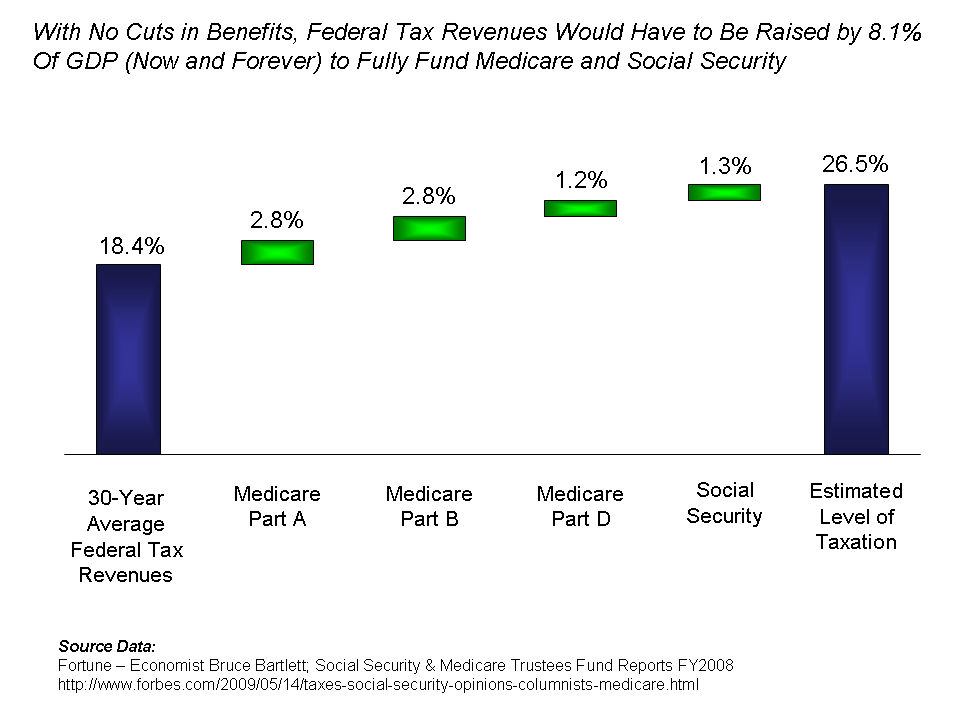
THIS CHART PUTS THE FINANCIAL CONDITION OF MEDICARE AND SOCIAL SECURITY IN PERSPECTIVE. BEGGING THE QUESTION: IF MODEST CUTS WERE MADE IN U.S. SPENDING ON GENERAL GOVERNMENT AND DEFENSE, AND SOME EFFICIENCIES ARE FOUND IN MEDICARE AND SOCIAL SECURITY, THEN HOW MUCH WOULD STILL NEED TO BE RAISED IN TAXES? Chart via Wikipedia

Keep the faith.

— John Hayden

Wildcat Debt Strike in Autumn of 2011

At rock bottom, the interlocking political and financial structures of the U.S. are based on trust. Recently, a string of financial failures has shaken the credibility of the U.S. political-financial-industrial complex, resulting in a rapidly spreading failure of trust.

PRESIDENT BARACK OBAMA, Wikimedia Commons photo

Trust is frayed to the point where, at the end of this week, Speaker John Boehner severed negotiations with President Barack Obama on raising the U.S. debt ceiling and averting financial crisis. At this point, you really couldn’t call the Tea Party a party of “loyal opposition.”

Question:  What do you think will happen when the government is forced, starting August 2, to choose which bills to pay and which bills to default on — which promises to keep and which promises to break?

Answer:  I wouldn’t be surprised if a Wildcat Debt Strike sweeps across the U.S. like a prairie fire in the fall.

Consider the events that brought us to this convergence:

SPEAKER JOHN BOEHNER, Wikimedia Commons photo

  • Strike One — The financial bubble burst, and Wall Street persuaded the pillars of the U.S. government — the Treasury Department, the President, the Congress — that the world economy would collapse without a sudden government bailout. (Presidential candidates of both parties endorsed the bailout in 2008.) Wall Street extorted billions under TARP, but continued to pay bonuses as usual to Wall Street executives.  In 2009, billions more were spent in a giant stimulus package, propping up the profits and cash reserves of corporations and the compensation packages for CEOs.
  • Strike Two — The real estate bubble burst, and banks throughout the U.S. foreclosed on mortgages, further driving down the value of houses. As people found their mortgages underwater (that is, the mortgage is worth more than the house), they considered whether or not to continue making the monthly payment. Some homeowners lost jobs and were unable to pay; some calculated that it made no sense to throw good money after a bad house. It is now widely accepted that people can and will walk away from a mortgage.  Banks are not willing to modify impossible mortgages, and debtors are not willing to pay impossible mortgages.
  • Strike ThreeThe debt bubble bursts. That comes in August, if the U.S. government decides not to pay its bills, especially its obligations to individual American citizens.

It’s all reciprocal, isn’t it? I’ll play fair with you as long as you play fair with me. As long as my house has value, I’ll continue to pay my mortgage. As long as you pay me, I’ll pay my debts.

Everything depends on our belief in the myths that George Washington will own up to cutting down the cherry tree; and that Abe Lincoln will walk six miles to return a penny.

The entire system could come undone in a cascade of individual decisions to hoard cash and ignore debts. When the government refuses to pay someone — whether it be a Social Security beneficiary, a veteran, a bureaucrat, a soldier, or a Medicare bill to a hospital — that someone will in turn refuse to pay an obligation.

The autumn of 2011 might deteriorate into a general Wildcat Debt  Strike, with individuals following the government into spontaneous default on taxes, mortgages, car payments, and most of all, credit card bills.

— John Hayden

American Debt Crisis: The Black Swan Is Circling Washington

Another update on the Debt Crisis of 2011.

An ominous Black Swan is circling Washington, D.C., like a vulture, watching and waiting as the wise men and women of Congress argue over whether to resolve the Debt Crisis of 2011. Or not.

This is the most dangerous situation in Washington since the Cuban Missile Crisis of 1962. I was in Washington on the weekend of the Cuban Missile Crisis, and I remember it well. We didn’t know how close we came to the brink, until it was all over.

This Debt Crisis is surreal. The Cuban Missile Crisis was loaded with live ammunition. The Debt Crisis is loaded with stocks and bonds and hundred-dollar bills. No one knows what will happen if we pile up a lot of stocks and bonds and bills, and set off an uncontrollable chain reaction of unpaid debt. Never been done before. But we are about to go there.

There are three major schools of thought regarding the resolution of this debt crisis. You have your big fix, valued at around $4 trillions, and your little fix, $1.5 trillions to $2 trillions, give or take. (Or is it billions? I can never remember.)

And defying all logic, there is the “no fix” option, supported by the gentlemen and gentleladies from the Tea Party. (What kind of tea are they smoking at that party? Can I get some?)

Translation: Some folks want to fix the debt crisis for the long-term, so Congress can get on to other business.  Some folks will settle for a short-term solution. And some want to commit economic suicide on Aug. 2, rather than risk the chance of possibly serious complications down the road.

Hoo-boy! You think the rich and powerful are anxious about a little economic uncertainty? How are they going to respond to total economic chaos?

Remember the Black Swan? It’s a highly improbable disaster, resulting in unpredictable consequences of a catastrophic nature.  Have a nice weekend.

— John Hayden

American Debt Crisis: Children Playing With Dynamite

The words and events of the past few days give me the gut feeling that too many of America’s current political and business leaders are not mature adults, not capable of being serious or working responsibly.

Too many members of Congress seem to think the U.S. government is all a big game, and the winners are the ones who get the most political contributions, and the ones re-elected the most times. They don’t act as if they understand that the government and the economy of the United States are matters of real importance. Instead, they act as if they’re in a reality show on a fictional island, where there are no serious consequences, and the only goal is forming alliances, talking with bravado, and gaining fame.

Too many politicians appear childish, not mature, focusing only on themselves, like a two-year-old would, and on the interest groups that pull their strings. They don’t appear to have developed the capacity to care about the needs of  others, and by others I mean the millions of real people scratching every day to earn a living, support their families, cope with illnesses.

Too many politicians seem always to put themselves and their special interests first; the needs of the larger community are of no interest to them. The needs of others be damned, the needs of the nation be damned. It’s all a game. It’s all about me and my little circle of friends.

Who Speaks For The People?

Today, Dispatches from ConsterNation publishes a guest post by Judy Davis:

Since the election of Woodrow Wilson in 1912, the Democratic Party has used our government to make laws which have improved working conditions, provided elderly support, promoted racial equality, protected the environment and addressed other social concerns. Wilson established the Federal Reserve Board, making banking safer and monitoring financial markets. The Clayton Antitrust Act allowed workers to petition for better working conditions, shortened work days and initiated child labor laws.

Franklin Delano Roosevelt’s “New Deal” programs provided relief, recovery and reform to ease the Great Depression. FDR is responsible for initiating Social Security, which provides Old Age, Survivors and Disability insurance. Through FDR’s efforts, the U.S. Bureau of Reclamation increased water development facilities in the U.S. and provided work for the unemployed.

What do these two leaders have in common? They were Democrats!

John Fitzgerald Kennedy established the Peace Corps and negotiated a ban on nuclear weapons testing with the United Kingdom and Soviet Union.

His successor, Lyndon B. Johnson, passed numerous socially significant programs, including the Civil Rights Act of 1964 and “The War on Poverty” – Medicare, Medicaid, Head Start, Work Study and food stamps.

Jimmy Carter is a human rights advocate and has worked to promote peace in the Middle East and limit the number of nuclear weapons. He encouraged energy conservation to ensure an energy-secure nation.

Bill Clinton passed the Omnibus Budget Act, which cut taxes for 15 million low-income families, made tax cuts available to 90 percent of small businesses, and raised taxes on the wealthiest 1.2 percent of taxpayers.

President Barack Obama has regulated banking and credit cards, extended health and unemployment benefits, implemented hate crime legislation, passed an economic stimulus package spurring job creation, modified bankruptcy terms, reinforced Iran sanctions, and reformed health care. No small feat for less than 2.5 years!

“Each time a man stands up for an ideal, or acts to improve the lot of others, or strikes out against injustice, he sends forth a tiny ripple of hope.” — ROBERT F. KENNEDY,  from www.democrats.org/issues.

Democrats speak for the people! We are responsible for each other and should provide the safety nets needed to ensure basic rights for all.

— Judy Davis

America’s Can’t-Do Attitude

Here’s a glimpse of government in America, as reported in my hometown newspaper.

The City Council is concerned about the large crowds waiting at bus stops, often watching three or four buses pass without stopping because the buses are already jam-packed standing-room-only.

The transportation administrator (we’ll call him H.A.) assured the City Council that his department is “doing the best they can.” He explained:

“The problem is just like the  _____ Steakhouse, you can’t build it big enough, you can’t staff it enough to meet the people, you can’t do it and you can’t afford to do it.”

Four can’t-do-its in one miserable sentence by a high-ranking public bureaucrat! And he’s the boss! Can you imagine how demoralized his employees must feel? It’s enough to make you cry. But wait. H.A. is only getting started. As the newspaper reported:

H.A. added that it is also difficult to fill bus shifts because driving a bus in   _______ City isn’t a fit for everybody. He said currently the department does not have full staffing and there are 32 vacant eight-hour shifts.

“As of today, we are not fully staffed . . . you can’t walk in the door and get in the seat of that bus,” H.A. said.

H.A. explained that if a driver does not have a CDL license (commercial driver’s  license) it would take an additional 30 days to train and acquire a passenger license.

Let me see if I understand this. Unemployment is over 9 percent in America — and higher in our local area — and yet the administrator is unable to hire sufficient bus drivers? The required 30 days training is too high an obstacle to overcome?

A City Council member assured H.A., “There are no problems in us giving you the money you need to have to do the job.” H.A. proudly acknowledged that money is NOT the problem. Money is not going to change his can’t-do attitude.

“If you hand me a bazillion dollars, it doesn’t mean I have all the drivers and all the vehicles,” H.A. said. “It’s an octopus with a lot of tentacles, you make it work.”

(H.A. also affirmed that the supply of buses is not the problem. He has 14 brand new buses waiting to go into service.)

If anyone remained unconvinced that HA can’t do the job, he went on to confirm his determined futility with the following:

“I don’t want anybody in this room to think we will be in a position to deploy a sufficient number of buses every time you’re waiting at the bus stop during a peak hour, on a peak night, on a beautiful hot, sunny evening in June, July and August and that we will be able to pick you up every 10 minutes.” H.A. said. “It’s utopia and it just can’t be done.”

Case closed. Ladies and gentlemen, when any bureaucrat, government agency, corporation, or business becomes so thoroughly demoralized and convinced that it can’t do its job, don’t you think it’s past time for a change?

American workers, businesses, and government used to proudly flaunt a CAN-DO attitude. No More. H.A.’s defeatist can’t-do attitude has become the new standard in America. Can’t-do permeates American government, politics, and business.

America seems immobilized by a deadly epidemic of passive-aggressive sickness. We can’t do it. Even if we could do it, we won’t do it, and nobody can make us do it. You can’t complain about it, because we won’t even answer the phone.

  • “Hello. We value your business.
  • Please press One for Lies.
  • Press Two for Dysfunction.
  • Press Three for Disrespect.
  • Press Four for Excuses.
  • Press Five to be Disconnected.
  • Have a nice day.”

Add up all the can’t-do attitudes like H.A.’s from every corner of this once-great nation, and you get the following:

American workers can’t compete with other workers around the world.

American businesses can’t stop moving factories and jobs overseas.

America can’t maintain its bridges and highways and water and sewer systems.

America can’t afford Medicare and Social Security. (Although every other advanced Western nation can.)

American business is sitting on billions in idle capital, but American business can’t put the money to work because of uncertainty. (Life is uncertain. Starting a business or investing capital is always fraught with uncertainty, by definition. Uncertainty is the nature of capitalism. Profits and stock prices routinely climb a wall of fear.)

The U.S. Senate can’t pass a budget because it can’t get 60 votes. On anything. You name it, the U.S. Senate can’t do it.

Congress can’t follow and the President can’t lead. Democrats and Republicans can’t work together. What did you expect?

We, the voters, can’t be serious. We’re surrounded by momentous problems, begging to be solved; but we can’t pay attention to anything, except sex scandals.

Ladies and gentlemen, our can’t-do attitude is killing whatever is left of the American Dream.

— John Hayden

Government Shutdown Feels Like Beginning Of The End For America

Human beings have created many empires in recorded history. Every one of them, from the Roman Empire, to the Ottoman Empire, to the British Empire, on which the sun never set — every great empire has failed.

And here we have the U.S. House of Representatives and the U.S. Senate on the brink of shutting down the government of the United States of America — ON PURPOSE!  If there were any logic, any sense in the world, closing the U.S. government would be treason.

Last time politicians shut down the government, in 1995, it was able to reopen in a few days with no more serious consequence than closing a few national parks.

However, there is no guarantee for the future.  The law of unintended consequences is in effect. We live in the 21st century, the century of the “Black Swan.” Major events, or chains of events, that are unpredictable and highly improbable can happen. You can learn more about the “Black Swan” here.

Politicians who would shut the U.S. government — on purpose! — are tempting fate. Our ancestors fought a Revolutionary War to establish this government. We fought a Civil War to hold the Union together. American soldiers died in foreign wars. And now modern politicians are willing risk throwing it all away over a budgetary dispute? Whatever the unintended consequences, Republicans and Democrats will share the dishonor equally.

We live in perilous times. The U.S. is embroiled in three foreign wars. We recently survived the worst worldwide financial crisis since the Great Depression, but many countries continue to struggle with economic and debt problems of dangerous proportions. Portugal is begging for a bailout by the European Union and the International Monetary Fund. Portugal is the third European nation to require financial rescue. Japan, after two lost decades of economic stagnation, has been driven to its knees by an epic earthquake. Its nuclear power plants spew radiation, poisoning Japan’s food and water.

Enemies wish to destroy us. We’re threatened by terrorists from abroad, and by homegrown terrorists. War might be unleashed at any time, in Yemen, or the Ivory Coast, or an attack from North Korea or Iran. India and Pakistan are always on the verge of war. So are the Israelis and Palestinians.

What’s my point? Events like a government shutdown can spin out of control. One unexpected consequence cascades into others, until the entire edifice trembles. Who could have predicted that a World Trade Center building might collapse? Both towers disappeared into rubble before lunch on a single day.

On top of all the dangers in the world, U.S. politicians are going to shut down the U.S. Government? For a few days? If politicians cannot agree to keep the government open this week, will they agree to reopen it next week? What if two weeks go by? Three? The longer the crisis continues, the more difficult it will be to end. Be afraid of the “Black Swan.”

Some remnant remains after an empire fails. Rome exists as a city to this day. The British islands remain a functioning nation, with shrunken power. The Mayan civilization left ruins. Descendants of the Mayan people live today throughout Central America.

North America will remain, and millions of people will live in the historical United States. Modern civilization will continue, probably. Beyond that, there are no guarantees for the U.S. as a nation. A federal shutdown  for more than a few weeks would force the states to fend for themselves. A shutdown could lead to default on the sovereign debt, or weakening of U.S. armed forces.

Once started, a process of devolution and decay may accelerate out of control, and who has power to stop the chaos?

— John Hayden

Last Stand of the White Men in Suits

HOUSE REPUBLICAN LEADERS. AP photo, 02-09-11

Not to belabor the obvious, but does the above photo look like the last stand of Republican white men in suits?

REP. PAUL RYAN. AP photo by J. Scott Applewhite

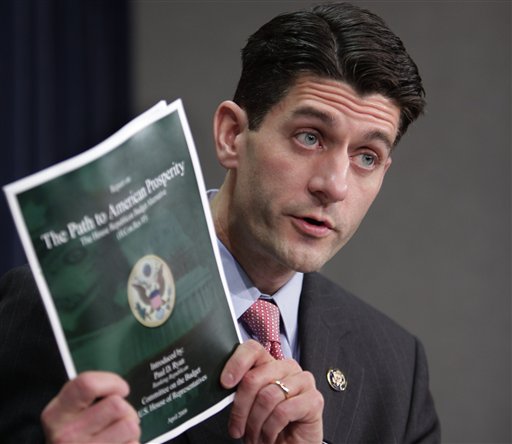
This morning, Rep. Paul Ryan, chairman of the House Budget Committee, presented the Republican budget for 2012. Joining him were a TV screen full of his Republican colleagues on the House Budget Committee. Everyone present, from what I could see on TV, was a white man. With a few exceptions, they are from the Red States, the heartland of America.

Not to put too fine a point on it, but the Republican budget would cut government spending by $6.2 trillion over a decade, and sharply cut taxes for the wealthy. The top income tax rate would be reduced from 35 percent to 25 percent. Is the U.S. really broke, or is the U.S. wealthy? You decide.

Here is a list of Republican members of the House Budget Committee. White men in suits from the heartland. Only one female name is on the list.

Many believe the Republican budget is so draconian that it's dead on arrival. I hope so, but the hard line on Medicare, especially, is ominous.

NOT TO IGNORE THE REPUBLICANS IN THE SENATE. Roger L. Wollenberg photo, 03-31-11

Umm, the photos above, of Republican leaders in the House and Senate, and the list of Republicans on the House Budget Committee . . . Is this what democracy looks like in America, in 2011? (Disclaimer: Many of my friends and relatives are white men. Come to think of it, I am a white man. Hey, I even own two winter suits AND two summer suits, so I am prepared to attend weddings, funerals, and job interviews in all seasons.)

The name of the Republican budget is “Path to Prosperity.” Rep. Ryan says these words, “Path to Prosperity,” with a straight face, without a hint of irony.

Here’s an early analysis of the Republican budget numbers, from the Huffington Post.

Here’s another analysis by Ezra Klein in the Washington Post.

The “Path to Prosperity” runs right over Medicare and Medicaid. At this moment, it appears to me that the Path to Prosperity would effectively destroy Medicare and Medicaid. Maybe that is a  good thing. Sometimes, I think, the only way to reform a program or a bureaucracy is to destroy it and start over. But I don’t think that’s what Republicans have in mind. I think Republicans intend to privatize health care for the elderly and the poor. In the name of paying off the debt. (For an earlier post on Republican strategy regarding Social Security, see “Divide and Conquer.”)

Also on the Republican chopping block: education, from Head Start to Pell Grants.

I think Republicans are focused entirely on two things: paying off the public debt, and reducing taxes. Two contradictory goals, but possibly both can be accomplished at the same time, by grinding the middle class and the poor — and the elderly — into the dirt. (Go ahead, accuse me of class warfare. Doesn’t this look like a scorched-earth policy to benefit wealthy America and corporate America?)

Rep. Paul Ryan says the Republican budget will “create jobs.”

SHOW ME THE JOBS. How exactly do you create jobs by slashing spending to the bone, on everything except the Department of Defense?

How do you create jobs when Toyota is shutting down 13 factories in the U.S., and food and gasoline inflation is vacuuming up every spare dollar of discretionary spending? AND the U.S. is fighting three wars in the Middle East.

Oh, yeah. And to show their power, or something, Republicans intend to shut down the U.S. government at the end of the week. Will that create jobs?

— John Hayden

‘Democratic Revolution’ in Ireland

Irish General Election - Enda Kenny's Victory ...

Enda Kenny claims victory for Fine Gael at Burlington Hotel. By infomatique via Flickr

Countries with elected parliaments operate under a strict-constructionist interpretation of the “consent of the governed” clause.

Irish voters lashed out in economic pain this week, withdrawing their consent in no uncertain terms, and dismissing Ireland’s longtime ruling party, Fianna Fail. It may be a historic change election.

Enda Kenny, leader of the victorious Fine Gael party, called it a “democratic revolution.” See the Christian Science Monitor story.

Irish voters are incensed over the banking meltdown and the collapse of housing values — which left their country nearly bankrupt — and angry about bailouts by the European Union and International Monetary Fund.

Fine Gael is projected to win 75 seats in the Irish parliament, 8 seats short of a majority, according to the Christian Science Monitor. Relying on the revised consent of the governed, Mr. Kenny is expected to forge a coalition government with the Labour Party, projected to win 37 seats.

75 seats + 37 seats = consent of the governed

The consent of the governed is just so tenuously conferred, and is valid so long as the new coalition can dodge a vote of no-confidence.

For the long-powerful Fianna Fail party, consent was replaced by contempt. Fianna Fail was reduced from 77 seats to a woeful minority of 20. And the Green Party was wiped out, losing all 6 of its seats.

Exactly what the new ruling coalition will do differently is far from clear, but the voters are not pleased that their recent proud prosperity has been reduced to indebted austerity.  They believe that ordinary Irish citizens are not responsible for the economic collapse, but are  bearing the resulting hardship.

Mr. Kenny has indicated that he will attempt to renegotiate interest payments on the unpopular bailout.

Spectacular street protests against dictators in Egypt, Bahrain, and Libya have attracted far more news coverage in the U.S.  However, this Irish election is more relevant to the political mood and financial power struggles in the Western democracies. (It’s interesting that the Irish vote comes as Republican governors fight to inflict a strong dose of austerity in the U.S.)

I can’t wait to learn more about the transfer of consent in Ireland. What course will the Fine Gael-Labour coalition chart?

Whether Democrats and Republicans can discern anything of value regarding consent of the governed in the U.S. remains to be seen.

— John Hayden

Economic Crisis, Political Turmoil, Consent of the Governed


All governments depend on the consent of the governed. That’s what we learned in high school, so it must be true.


We’ll see how that works in the real world of the 21st Century. Does the consent of the governed matter, in the global economy? Or in a world with imaginary national boundaries, do governments depend more on the consent of multinational corporations?


The political and social consequences of the Great Recession are beginning to manifest, but the results are unpredictable. For background, see World Economic Crisis Phase II, Political and Social Upheaval.


In North Africa and the Middle East, massive street protests oppose long-established regimes. It looks to me like mob rule. The mobs appear to have power to topple dictators, but mobs cannot control the establishment of a new order. As the dictators fall, power can be seized by opportunists, regardless of character, ability, or ideology.


In the U.S., Wisconsin and other states are attempting to impose budget austerity and blunt the power of the public-worker unions. It looks like rule by legislative majority. But legislating is a messy business in the U.S. Power in a state is divided between the governor and the legislature, which is itself fractured into two houses.


In the example of Wisconsin, Republicans have control of state government following the 2010 election. The rowdy opposition by Democrats and unions will almost surely prove ineffective. The legislative majority will have its way. But under democracy as it has evolved in the U.S., does the legislative majority represent the people, or do the legislators represent corporations and special interests that bankroll their election campaigns? In a modern democracy, power can be purchased by opportunists.


Today’s national election in Ireland may provide a first reliable reading on the consent of the governed in the 21st Century.  You can listen to and read a PBS report here.


Ireland, you may recall, was one of the first European economies to be staggered by the bursting of world financial and housing bubbles. The Irish voters will probably pass judgment on the austerity measures taken in Ireland, and on the bailout efforts by the European Union and the International Monetary Fund.


Irish turnout is reported at 70 percent. The ruling party is expected to be ousted, but it will take about two days to count the votes.


There are so many other economic shoes waiting to drop. The debt problems of Europe, England, America, and Japan remain awesome and unresolved. We still have the possibility of default, or a chain of defaults in Europe, and among states in the U.S.


You want far-out scenarios regarding the consent of the governed? Consider the breakup of one or more major political structures.


If the USSR could break up, it could happen in the European Union, or even in the U.S.  The stability of Pakistan is not guaranteed. And speaking of stability, what about Saudi Arabia?


I could muddle on, wondering about the price of gold, or airline tickets, or $5 gas. But I just confuse myself more with every line I write. I must be watching too much Cable TV News.

See also,  You Say You Want a Revolution?

— John Hayden