Minimum Wage Increase Passes In Maryland, O’Malley Will Sign It

Tuesday morning, Gov. Martin O’Malley sent out an email recap of the 2014 General Assembly, highlighting bills that he will enthusiastically sign into law. He didn’t mention the bill to decriminalize possession of small amounts of marijuana, but I believe he will most likely sign that one too.  — John

middle class

Below is the text of O’Malley’s email message. I’ve put some of the key words in bold text:

Yesterday afternoon, the State House voted to raise Maryland’s minimum wage to $10.10 an hour.

This effort — which has now passed both chambers — is the culmination of a lot of hard hard work to forge consensus and bring people together to give hundreds of thousands of our friends, neighbors, and family members a well-deserved raise.

I will sign it enthusiastically — because no one who works full time should have to raise their family in poverty.

Yesterday also marked the conclusion of Maryland’s 2014 legislative session. Strengthening and growing our middle class was the North Star of our work — both in this session and for the past seven and a half years — and I’m pleased to report that we took meaningful action this year to move our State forward:

– We passed a bill to expand Pre-Kindergarten for 1,600 children in low-income families because investments in early childhood education make a huge difference throughout a person’s life.

– I’ll sign a comprehensive package to strengthen protections for victims of domestic violence, furthering our work to keep families safe. Since 2007, we’ve driven down the rate of female and juvenile homicide in Maryland, and this year’s effort builds on that work.

– Maryland’s Wildlands are critical to preserving and protecting the last untouched landscapes and waterways of our great State. As Marylanders, we have a duty to ensure that these open spaces can be enjoyed by future generations and that is why we passed this measure to expand our State’s Wildlands by 50%.

– We passed a responsible budget that invests in job creation and innovation, expands opportunity, strengthens our State’s middle class and puts us on a path to eliminate our inherited structural deficit by 2017. And we did it without raising any taxes or fees.

These accomplishments did not happen by chance — they happened by choice.

Hope drives belief. Belief drives action. And action achieves results. We achieved together this legislative session, and I thank you for your help moving Maryland forward.

All the best,

Martin O’Malley
Governor, Maryland

A quick graphic look at the Maryland budget dollar.

A quick graphic look at the Maryland budget dollar.

Marijuana Decriminalization Passes In Maryland, Awaits O’Malley’s Decision

Maryland State flag

John Hayden photo

I’m surprised but pleased that even in an election year, the Maryland General Assembly was able to take action on significant issues in the session that ends Monday.

An important but controversial marijuana decriminalization bill finally passed the House of Delegates on Saturday, 78-55. Now, gubernatorial candidate Heather Mizeur and others are pressing Gov. Martin O’Malley to sign the bill into law. O’Malley has not yet committed himself one way or the other.

“Today’s passage of marijuana decriminalization in the House is a huge first step towards slowing down and ultimately ending our state’s failed war on drugs,” Mizeur said Saturday.

“We snatched victory from the jaws of defeat because we understood the urgency behind the need to act this year. Our marijuana prohibition laws have been a failure and are ruining people’s lives. I urge Governor O’Malley to follow the will of the people and sign this legislation into law,” she said.

The other two Democratic candidates for governor, Lt. Gov. Andrew Brown and Attorney Gen. Doug Gansler, have also indicated support for decriminalization. But Del. Mizeur has been one of the leading proponents for marijuana reform in the House of Delegates. Over the past several days Mizeur’s campaign sent out requests by social media and email, urging supporters to call their delegates to urge passage of marijuana decriminalization.

Decriminalization is a sort of half-way step, following up on acceptance of medical marijuana by removing the criminal stigma for possession of small amounts of pot. A civil fine would be imposed, rather than a criminal conviction. Differences in the amounts of fines remain to be ironed out between the House and State Senate.

Maryland delegates and senators clearly are not yet ready to take the big step of legalizing recreational use of marijuana, as Colorado and Washington State have. However, the Maryland bill would result in a more uniform regional approach, since the D.C. government has already decriminalized possession of up to one ounce of pot.

I believe the General Assembly’s measured deliberation over the past few sessions demonstrates an appropriately serious approach to a major and controversial change in marijuana law. Maryland is not rushing headlong to be at the front of the line of states legalizing recreational use of marijuana, but neither are we stubbornly refusing to make step-by-step reforms in the law. Decriminalization in Maryland, if signed by O’Malley, would protect many young people from an unnecessary criminal record, which often limits opportunities for jobs, housing, even marriage. What exactly is the advantage to society of labeling people as criminals for minor offenses?

Some political sidelights on passage of the marijuana decriminalization bill:  Mizeur is a rising star in the Maryland Democratic Party, along with Del. Keiffer Mitchell, also a leading sponsor of the bill.

“We’re sending the message that we’re not going to allow small amounts of marijuana possession to ruin the lives of our young people,” said Mitchell, according to The Washington Post.

It’s a message that will likely resonate in Mitchell’s Baltimore district, where he faces opposition in the Democratic primary. Mitchell already has the advantage of a historic and respected last name in Baltimore politics, as well as experience on the City Council. A strong win in the 2014 election could propel him to a State Senate seat or even a congressional seat at some point in the future. Mayor, governor or U.S. senator? The Baltimore region has other ambitious and promising leaders, but I suspect Mitchell is a prospect who could run well statewide.

On the other hand, I think passage of the bill indicates Del. Joseph Vallario’s star is setting. Vallario has over-stayed his welcome as chairman of the House Judiciary Committee (my opinion only). He opposed the marijuana bill and tried to block it. But a critical mass of delegates pried the measure lose, forcing Vallario to get out of the way.

— John Hayden

Real Estate Development Always At Issue in Montgomery County Elections

UPDATE: For more on economic development and growth in Montgomery County, past and future, please see my post, “Contemplating Life Inside An Economic Engine,” at the TheSeventhState political blog,  http://www.theseventhstate.com

_______________________

Most Americans outside the beltway* are justified in thinking that the Washington, D.C., metropolitan area is a one-company town, and that company is the U.S. government with its myriad contractors.

But here in Montgomery County, MD, the industry with political clout, decade after decade, is real estate development. It’s always a lucrative proposition. Start with some relatively inexpensive farmland, rough-in a few roads and water and sewer, build housing, and sell the added value for a tidy profit. Styles change — ticky-tacky ranchers, split-levels, townhouses, McMansions, luxury apartments or condos — but the concept remains the same.

An example of the modern residential construction style, the four-story rectangle with pitched roof. It allows somewhat denser development than the three-story garden apartments of the 20th  century.

An example of the modern residential construction style, the four-story rectangle with pitched roof. It allows somewhat denser development than the three-story garden apartments of the 20th century. This one is in Germantown.

Development has been a political issue in every local election for as long as I can remember. The slogans are short and sweet: No Growth, Slow Growth, Managed Growth, Smart Growth.

Sometimes the focus appears to be on related construction, such as adequate schools, highways, pubic transit, even parks and open space.**  The undercurrent is always development. Some recent twists have been fill-in development and redevelopment.

Election 2014 will be more of the same. If anything, the focus on development has been reinvigorated by the recent debate regarding Ten Mile Creek and Clarksburg. Bill Turque of The Washington Post has a concise story today highlighting the influence of developers on Montgomery County local politics. It’s a little bit “inside baseball,” but it might be a good introduction for voters new to the area.

The proximate subject is the Democratic primary contest for the District 1 County Council seat between Roger Berliner and Dutchy Trachtenberg.  The tantalizing story is a political fund-raiser associated with the development community calling the Sierra Club “the most vicious anti-development, anti-growth organization in the country.” For the record, the Sierra Club endorsed Berliner over Trachtenberg.

The “most vicious anti-development” trash talk is only a passing tempest in a long campaign season. But for any new MoCo voter, the story pulls back the curtain on the role of political contributions by real estate development interests. Montgomery county is home to a million people. Candidates for County Executive and the nine County Council seats face about a million pounds of pressure from all sorts of interests, with developers supplying much of the tonnage. Developer interests, as might be expected, are usually at odds with environmental concerns.

A secondary insight from the story is the role of candidate endorsements by influential interest groups such as the Sierra Club. Every imaginable interest group throughout the state is pestering candidates with questionnaires, with endorsements often forthcoming for the right answers. However, endorsements are sometimes often made in arbitrary fashion behind closed doors. In many cases, endorsements go almost automatically to incumbents, rather than challengers.

— John Hayden

* Maybe it’s time to retire “inside the beltway” and replace it with “inside the InterCounty Connector.”

** In the early days of suburbia, country club golf courses were often cited as “open space.”

Any thoughts on the wild world of nearly unlimited campaign money?

Rumors Of War And Economic War, Russia And Ukraine

After the most horrible, bloody century of war in history — 1914 to 2014 — wouldn’t you hope that humankind has learned something about war and peace?

After all these years, we are still attracted to war like mindless, flying insects to a lightbulb on a dark night. In recent decades, we’ve certainly not hesitated to invade, shoot and bomb, using ever more-effective killing and maiming technology. But we’ve also perfected the art of economic war. Politely known as “Economic Sanctions.” At this very moment, the U.S. and Great Britain are threatening to unleash the equivalent of unlimited economic war on Russia.

The economic sanctions are intended to defend the “sovereignty” of Ukraine and Crimea, whatever “sovereignty” means in that part of the world, with it’s emotional history and artificial national boundaries. In the course of such defense, economic sanctions and/or military intervention might just as well destroy Ukraine and Crimea. Sort of like the U.S. destroyed Vietnamese villages to save them, and invaded Iraq to save it, instead ransacking and wrecking Iraq for ten years before abandoning it.

Embed from Getty Images

As the Ukraine reached the boiling  point in recent days, I’ve engaged in discussion with Clarissa, a blogger who knows much more about Russia and Ukraine than I do. She’s posting daily about the developing situation. You can scroll through her many posts and interesting discussion threads at her blog.

I’ve been learning a lot, but also arguing a lot. I used to think I understood this kind of stuff. But as old age sets in, I find I no longer understand anything about the human obsession with war, both military and economic.
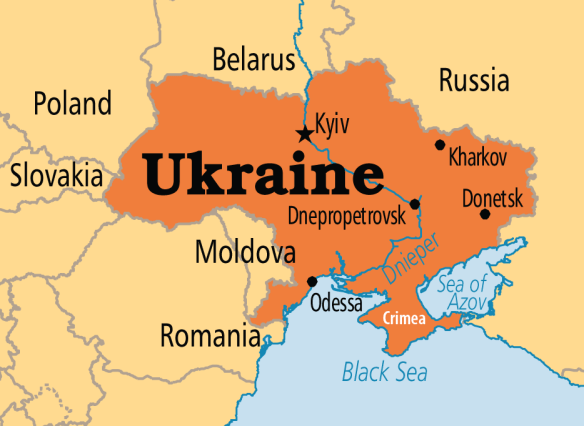
Ukraine-map

Below I express my puzzlement in comments I’ve written for Clarissa’s blog.

I guess I’m being blindsided. I read every story about Ukraine and Crimea in this morning’s Washington Post, including an analysis of the emotions and history involved by a former colleague of mine at the Baltimore Sun. I don’t give any credence to cable news speculation.

Forgive me, but I have read no credible evidence that this is anything but a civil war of WORDS involving Russia, Ukraine and Crimea. In fact, if it is a civil war, I’d put the emphasis on the word “civil.” There’s much hand-wringing about a Russian “invasion” of Crimea. Really? Has a single shot been fired? The Russian and Ukraine soldiers in fact seem quite chummy.

The main issues seem to be emotional grievances regarding the official language in Ukraine (reminds me of Quebec’s grievances against English-speaking Canada), “sovereignty,” and which paper money to use. I suspect the “crisis” might blow over if the U.S. would butt out and Ukraine simply decided to recognize both Russian and Ukrainian as official languages.

I do not understand what makes the U.S. and European countries so self-righteous that they must declare economic war on Russia. Yes, I see one blog report that one person has been tortured and killed. There are anecdotes about “volatile protests,” outside agitators and thugs beating up people. As a journalist, know the difficulty of confirming such anecdotes.

In the U.S. most of this would be called street crime, police brutality, or “the right to gather in public and express grievances,” protected under the Bill or Rights. How many confirmed casualties in Ukraine or Crimea? I’m serious. There are 500 murders a year in Chicago. Multiple murders every weekend in Washington and Baltimore. Is it more dangerous right this moment to be in Kiev or in Chicago?

The U.S. government “said the vote was rigged and discounted it as illegal.” (The Washington Post)  I ask: How does the U.S. know that?

I’ve studied politics my whole life, and I have no trouble at all believing that a large majority of people in Crimea would vote allegiance to Russia, and did so on Sunday. Where is the evidence to the contrary? (Yes, 97% seems an obvious exaggeration. So what?) I cannot even verify the election results in my own state, Maryland, where we use a computerized voting system with no way to audit the results. If the computers have not already been hacked, they will be some day soon.

It seems to me that the U.S. and Great Britain foment wars and economic hardship by meddling in internal affairs of other countries.

Sorry, I know I sound naive, and maybe I am. I have a healthy skepticism about what is true or false or propaganda or posturing. — John

____________________________________________________________

Clarissa responds to my comment:

“The main issues seem to be emotional grievances regarding the official language in Ukraine (reminds me of Quebec’s grievances against English-speaking Canada), “sovereignty,” and which paper money to use.”

– These are definitely not the central issues for anybody in Ukraine or Russia. Honestly, this is the first time I hear about paper money in this context at all. I get my news from Russian and Ukrainian media and people I know who live in these countries.

“In the U.S. most of this would be called street crime, police brutality, or “the right to gather in public and express grievances,” protected under the Bill or Rights.”

– If the Russian troops crossed the US border, would this still be called street crime and police brutality?

“I suspect the “crisis” might blow over if the U.S. would butt out and Ukraine simply decided to recognize both Russian and Ukrainian as official languages.”

– In 1994, Ukraine, Russia and the US signed the Budapest accords in which the US promised not to butt out in case Russia violates the territorial wholeness of Ukraine in its 1994 borders. Out of these 3 countries, Ukraine is the only one that fulfilled its part of the agreement by handing over its entire nuclear arsenal to Russia, the country that has invaded right now. If the US didn’t want to have anything to do with what is happening in that area, it shouldn’t have signed the agreements. Wouldn’t you agree that you can’t enter into a contract, get everything you wanted from the other party, and then refuse to fulfill your part of the obligations you freely undertook?

” Is it more dangerous right this moment to be in Kiev or in Chicago?”

– If you look at the map, you will see that Kiev lies pretty far from the Russian border, there are no Russian troops there. Yet. The invasion is taking place in the Lugansk, Kharkov, Mariupol’, Kherson and the Crimea areas. Tragically, these are, indeed, highly criminalized areas. 😦 However, now on top of the street crime and the mafia, there are foreign troops there.

“It seems to me that the U.S. and Great Britain foment wars and economic hardship by meddling in internal affairs of other countries.”

– Russia has been invading Ukraine long before the US even existed. This is not about the US and definitely not about the UK, which has been selling itself to the bandits from Russia for years.

“Sorry, I know I sound naive, and maybe I am.”

– I’m very grateful to you for trying to understand.

end of Clarissa’s reply

____________________________________________________________

My further response:

“- If the Russian troops crossed the US border, would this still be called street crime and police brutality?”

AND

“- Russia has been invading Ukraine long before the US even existed. This is not about the U.S. and definitely not about the UK.”

Both good points! And you can see the absurdity when you place the above two statements side-by-side in historical and geopolitical context. I’m not an expert on any of this, so I hesitate to make the following analogy, and I welcome more knowledgeable observers to correct me:

Doesn’t it seem that Russia, Ukraine, and Crimea have a long history of  marriage of convenience and breakups? Tumultuous relationships, to be sure, trial separations and divorce, friendly or otherwise. But they are geographically intertwined; they HAVE to live near each other over the long run, and so they do. As you point out, this love-hate affair has been going on since LONG BEFORE the U.S. existed. I agree, it’s NOT about the U.S. or the UK, so what gives the U.S. and UK the right to declare economic world war?

Regarding the 1994 Budapest Memorandum, in which the U.S., Britain, and Russia reaffirmed their commitment to Ukraine’s territorial sovereignty, and Ukraine agreed to return its nuclear weapons to Russia. Well.

The salient point here is the nuclear weapons. You could keep an international courtroom full of lawyers busy for a century, arguing what the wording of the Budapest Memorandum (contract?) means.

Would the world be a better place if Ukraine had those nuclear weapons at this moment?

A few Ukrainian NATIONALISTS would say “Yes,” but they would be crazy. Everyone else, especially Russia, Crimea, U.S. and UK, understands, in retrospect, the wisdom of the nuclear weapons accord made at Budapest. After the past century of European and Russian history, can’t we all agree that emotional NATIONALISM is not sufficient reason to start a shooting war?

And thank God the U.S. and UK commitment to the territorial “sovereignty” of Ukraine is definitely not a “mutual defense treaty” requiring the U.S. and UK to defend militarily the sanctity of the region’s artificial boundary lines.

What exactly does the word “sovereignty” imply in this case? Can anyone untangle the history and mythology behind these lines on a map? Let Russian, Ukraine, and Crimea work this out in divorce court.  — John

___________________________________________________________

Let me repeat that I respect Clarissa and her knowledge of Russia and Ukraine. I appreciate her willingness to engage in informative discussions with me and others on her blog. I recommend her blog for anyone following developments in the Ukraine.

Conclusion:

Is there any conclusion? Is history ever over? When will we ever learn?

— John Hayden

Link

I recommend this post about Michelle and her service dog, Ruthie Mae. http://dogkisses.wordpress.com/2014/03/18/a-campaign-for-the-sweetest-dog-in-the-world/comment-page-1/#comment-3317

Please click on the title “Ruthie Mae,” to see a clickable link. Thanks.  . . . .

— John


St. Patrick’s Day Parades Launch 2014 Election Season In Maryland

Democrats have a good chance to gain seats on the Eastern Shore 

Question: Why do Democrats dominate Maryland elections?

Answer: Democrats have superior candidates.

Democrat Judy Davis (second from right) and supporters at St. Patrick's Day Parade in Ocean City. (John Hayden photo)

Democrat Judy Davis (second from right) and supporters at St. Patrick’s Day Parade in Ocean City. (John Hayden photo)

St. Patrick’s Day parades mark the start of election year in Maryland — more so than ever this year — because primaries have been moved up to June. Three months from St. Pat’s Day to Election Day. Nearly every Maryland city and town had a parade this weekend, and nearly every serious candidate — both Democrats and Republicans — was marching (or sometimes riding in a convertible.) Let the record show that Saturday was a perfect, sunny day for a parade in Ocean City.

Democrats hold a solid majority in Maryland’s General Assembly. Republicans, as always, hope to improve their minority position. They might pick up a seat or two, but that’s about the limit. Democrats have better candidates nearly everywhere in Maryland.

A case in point is District 38, located in the far southeastern corner of the state, the Lower Eastern Shore (Worcester County, Somerset County, and part of Wicomico County). District 38 will likely have some of the closest and most hard-fought elections in Maryland this year. Let me explain.

Many people presume that the Lower Eastern Shore leans Republican, either slightly or severely. History and election results indicate otherwise.

Four years ago, Democrats gained a Senate seat on the Lower Shore when Jim Mathias, former mayor of Ocean City, defeated a Republican businessman. In 2014, Democrats have every reason to expect to hold the Senate seat AND pick up one or even two seats in the House of Delegates. But it’s hardly a foregone conclusion.

Neither party will have competitive legislative primaries in District 38. All the action — and it could be hot– will be in the November General Election. Both sides are already hard at work.

Democrat Judy Davis meeting the crowd at St. Patrick's Day Parade in Ocean City. (John Hayden photo)

Democrat Judy Davis meeting the crowd at St. Patrick’s Day Parade in Ocean City. (John Hayden photo)

Did we mention superior Democratic candidates?

Sen. Jim Mathias has never lost an election. He’s been elected once to the House of Delegates and once to the State Senate. Before that, he was elected councilman and mayor repeatedly in Ocean City. Mathias faces a serious challenge from one-term Republican Del. Mike McDermott. It will be a hard-fought contest, but McDermott simply doesn’t match up well against Mathias in terms of experience, gravitas, or fund-raising ability. Mathias won a squeaker by 640 votes in 2010, and only after a recount. The 2014 results will likely be close, but not that close. I see Mathias winning by 3,000 to 5,000 votes. www.jimmathias.com

Superior candidates for Delegate

After the 2010 Census, District 38 was divided into three single-member districts for House of Delegates. Republicans have two of the three delegates now, but they might be in trouble. In reverse order:

Judy Davis chatting with voters before the parade.

Judy Davis chatting with voters before the parade.

District 38CDemocrat Judy Davis (her brand:  Teacher, Mother, Volunteer) should cruise to victory against Democrat Mike Hindi in the June primary. Davis will probably be outspent in the General Election by her Republican opponent, Mary Beth Carozza, who has not lived on the Eastern Shore since she graduated from high school. District 38C includes northern Worcester County (Ocean City, Ocean Pines, West Ocean City, Bishopville), and the rural northeastern part of Wicomico County. www.judydavisforshore.com

Ms. Carozza returned to the Shore last year specifically to run for the open delegate seat. Republican operatives from Washington, D.C. where Carozza had a career in Republican politics, are funding her campaign big time. But it will be hard to buy an election in this small-town, one-delegate district, where people know each other. Judy Davis has lived and taught school here for decades. Davis is a graduate of the Democratic Emerge Program, which prepares promising community leaders like Judy to run for public office. I think Democrats, seeing the opportunity to pick up a seat, will give her strong support.

District 38BDel. Norm Conway, chairman of the House Appropriations Committee, has no primary opposition and is nearly a lock for re-election in November against a Republican named Carl Anderton Jr.  Del. Conway is the only delegate from the entire Eastern Shore with any clout in Annapolis. His support in his Salisbury district is nearly unshakable. (See what we mean by superior Democratic candidates?)

District 38A — May lean by a hair to the Democrats. 38A includes all of Somerset County and the southern half of Worcester County, including Pocomoke City, Snow Hill and Berlin. In 2012, President Barack Obama won Somerset County by a handful of votes. The Democratic candidate, Percy J. Purnell Jr. is a definite threat to unseat one-term Republican Del. Charles James Otto. Otto is quite popular in the Somerset County part of District 38A. I give Otto a slight advantage in a close race in Somerset. But the election will be won or lost in the Worcester County part of the district. The outcome will depend on which party can turn out its voters in this sprawling rural subdistrict.

To recap: District 38 is currently represented by two Democrats and two Republicans. The two Democrats, Sen. Jim Mathias and Del. Norm Conway are likely winners in 2014. The other two delegate seats will be close races. I give the edge to Democrat Judy Davis in 38C and Republican Charles Otto in 38A, with Democrat Percy J. Purnell Jr. making a strong challenge and possibly edging Otto. A Democratic sweep in this district would be a painful loss for the minority Republicans.

— John Hayden

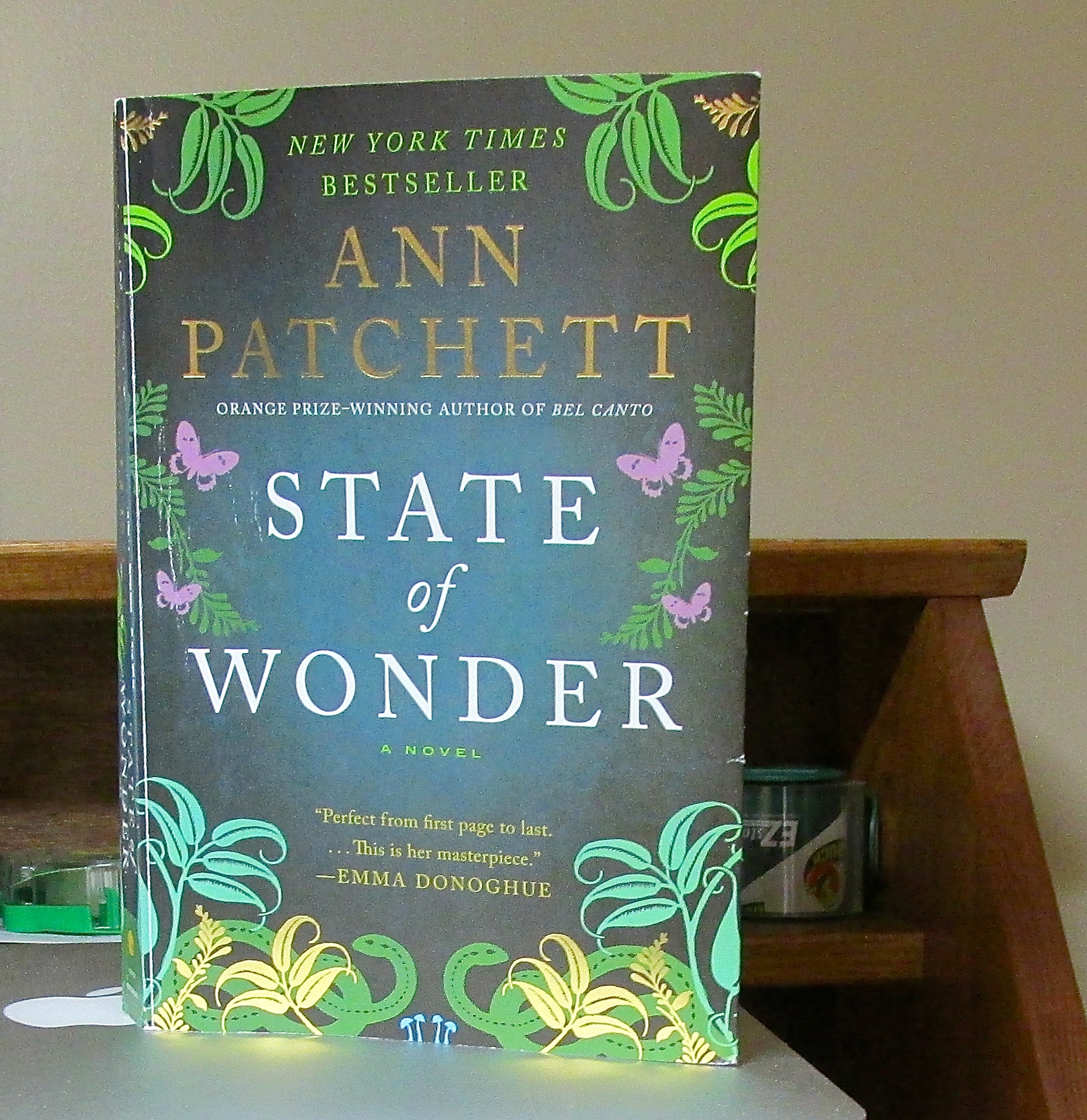
Ann Patchett’s State of Wonder, a book review

“STATE OF WONDER,” is a 21st century fairy tale. The Ann Patchett novel explores, among many things, the potential for human excellence, the power and consequence of romantic love, the implications of paternal presence and absence. Perhaps most importantly, the story reveals our willingness to deceive, disappoint, and betray one another. But also our ability to persevere and survive.

Read State of Wonder twice. It’s that good. I missed most of the message on first reading. I’m planning to give it a third go, a few years hence. I can’t wait to see how the story stands the test of time. After two readings, I think it has “classic” stamped all over it.

State of WonderOne reader called State of Wonder “A life-changing experience.” For anyone paying attention, it is a life-informing experience, at least.

As a story, State of Wonder is a tale of grand adventure, bordering on science fiction, in a faraway and dangerous place.

The journey takes us from frozen Minnesota to steaming Amazon jungle. It’s the archetypical plot of ancient and modern literature. To wit: The hero leaves home; the hero returns home.

First the hero, Dr. Anders Eckman, departs on a great quest, which includes birdwatching and searching for a disappeared mad scientist. Dr. Eckman contracts a tropical fever and perishes.

Now comes the heroine, Dr. Marina Singh, an unwilling volunteer on a mission. The heroine departs partly because she’s guilt-tripped into it, and partly because she’s in love with the anti-hero, a CEO named Mr. Fox. He stays home, at least for now. What a man! Mr. Fox must remain behind to keep the ship from sinking. In this case, the ship is a corporation. But never mind.

Is the brilliant (mad?) scientist, Dr. Annick Swenson, seemingly lost in the jungle without even a telephone, the true heroine? Or is she the villain? Whatever, Dr. Swenson understands the hard truth, when it finally slaps her in the face.

“I don’t know another story to match this,” says she.

Correct. There is no story to match this, at least not since Homer. Or maybe Adam and Eve. Forgive my hyperbole.

The icy Dr. Swenson inspires unwavering loyalty, admiration, and fear. She’s a central character here, but not THE central character.

The central character is our overeducated and slightly naive heroine, Dr. Singh.  All the leading characters seem to be doctors, if you don’t count the endearing little boy, named Easter, who happens to be deaf.

Marina Singh is a humble but daring protagonist. She wanders alone in a sweltering, alien city, braving deadly insects and malaria day and night. She travels by small boat down unknown tropical rivers, deep into the dense Amazon jungle.

Our heroine is fearful, but overcomes all fears. She battles a fire-breathing dragon. And slays it with a machete.

(Time out for truth in book reviewing: OK, it’s NOT a fire-breathing dragon. It’s ONLY a poison-spitting boa constrictor, powerful enough to squeeze the life out of a child, and possibly also devour a grown man. This snake is a creature of mythic proportions, a perfectly good stand-in for the archetypical dragon.)

Dr. Marina Singh performs life-and-death surgeries under primitive conditions. She ingests the bark of the tree of eternal fertility, but eschews the hallucinogenic blue mushrooms.

Most importantly, Marina discovers a great truth (I’m not giving it away!) and uncovers a great deception (read the book!).

After all these labors, Marina finds and rescues our original lost hero (Dr. Birdwatcher) and returns him home at last to his family in Minnesota, where it is now springtime.

Ann Patchett has written five other novels and a couple of non-fiction memoirs. She’s only of a certain age, so probably she will write many more books. State of Wonder is, I believe, her masterwork. My review of Ann Patchett’s novel “Run” is here.

I’m tempted to nominate State of Wonder to be a Great American Novel, except that most of the story takes place in the Amazon jungle.

Tell me, have you read State of Wonder? Or Run? What did you think of Ann Patchett’s work?

— John Hayden

Meanwhile…

I stumbled upon this post, “Meanwhile” serendipitously via Michelle at “The Green Study.”    Thanks to Michelle and also to Wyrd Smythe for putting into words the thoughts I’ve been repressing. Maybe bloggers of a certain maturity are all channeling the same frustrations.

It feels like cheating, but since I can’t force myself to write a worthwhile post of my own this week, at least I can repost a really good post by someone else.

(Regarding our shared perception of few readers and still fewer commenters, the WordPress blogger “Time Thief” has some insight — over at “One Cool Site”  — on the possibility that people are seeing our stuff on the WordPress Reader, so they no longer have to visit our actual blogs.) Thanks to Michelle and Wyrd Smythe for helping me understand the “loose ends.”
— John

Wyrd Smythe's avatarLogos con carne

tangled I find myself feeling “at loose ends.” If you search on that phrase, you find a big part of the definition involves the idea of “not knowing what to do,” although sources differ a bit on whether that’s due to having nothing to do or due to not being able to decide what to do. More to the point, most identify the main feeling: being restless and unsettled.

A key reason my ends are loose is obvious given my last post, but this river has other tributaries (I never met a metaphor I couldn’t mix). Certainly in my case, the problem isn’t having nothing to do; I have plenty of projects. The problem is the utter lack of fulfillment in doing most of them.

And, sadly, this blog is turning out to be high on that list.

View original post 985 more words

Montgomery County Council Candidates List (With Websites And Map)

Council office bldgCounty Council Candidates, 2014

Candidates are listed in alphabetical order by last name and party. They’re color-coded, blue for Democrats, red for Republicans, and green for Green Party.

All nine County Council seats are up for election for four-year terms in 2014. In Montgomery County we have 20 Democratic candidates, four Republicans, and one Green Party candidate.

The 2014 Primary Election is June 24. Democrats will have a choice of Democratic candidates for County Council in the at-large race and in four of the five districts. Not enough Republican candidates filed to give Republicans  a contested primary in the at-large race or any of the district races.

At-Large Candidates, Democrats (Vote for four)

At-Large Candidates, Republican (Vote for four)

  • ROBERT DYER — www.robertdyer.net — Republican 
  • SHELLY SKOLNICK — no website listed — Republican

At-large Candidates, Green (Vote for four)

Montgomery County Council districts map.

Montgomery County Council districts map.

Council District 1 (Vote for one)

Council District 2 (Vote for one)

Council District 3 (Vote for one)

Council District 4 (Vote for one)

Council District 5 (Vote for one)

Notes:

Information source: Maryland State Board of Elections. Some candidate websites may not be operational. Some candidates may have websites that are not listed with the Board of Elections.

Registered voters in Montgomery County can vote for four at-large council candidates, and one candidate to represent the district you live in.

Please report any omissions, misspellings or other errors to BJohnHayden@icloud.com.

(A few Republican candidates were nominated AFTER the candidate filing deadline by the Republican Central Committee, to avoid the embarrassment of having no Republican candidate at all for some seats. I’ll update the list eventually to include the Republican candidates who had to be pushed forward by the Central Committee, in order to provide an updated list of both Democratic and Republican nominees for the General Election.) 

Which County Council district are you in?

Easy to find out, even if you’re not a registered voter. Go to this page and enter your street address and zip code. You’ll get the location of your polling place, and your County Council district number, State Legislative district number, and Congressional district number.

For a more detailed look at the County Council district maps, click here.

Want to register to vote?

It’s easy. Click here to go to the Maryland online registration site.  Deadline for voter registration before the Maryland Primary Election is June 3. Registered Democrats can vote in the Democratic primary and registered Republicans can vote in the Republican primary. It’s that simple and obvious.

Other registered voters, such as independents and members of the Green Party or Libertarian Party, are not eligible to vote in the Democratic or Republican primaries. (Membership has its privileges and responsibilities. If you want the privilege of voting in a primary, you have the responsibility to register with that party.)  All registered voters can vote in the general election in November.

— Information Compiled by John Hayden

The Winter of ’14 And The Promise Of Spring

I talked with my uncle in Rhode Island this afternoon. It was snowing there, of course. Maybe it’s the same snow we had in Maryland yesterday. It shows signs of letting up. Today’s snow in RI., that is. Not the winter of 2014.

My uncle assures me that this is the coldest winter in his 85 years. And it ain’t over yet. When the snow stops, he’s planning to go out and shovel his steps.

He can’t drive just now. There’s good news and bad news from the retina specialist. The fluid in one eye has gone away, after five shots over nearly a year’s time. The shots cost $1,500 a pop. Thank goodness for his health insurance plan, which pays all but a $40 copay.

Meanwhile, vision in the other eye is not so good. It’s three years since he’s had new glasses. So the specialist sends him back to the regular eye doc. Maybe new lenses will improve his vision enough  to make him legal to drive. Fortunately, a cousin lives just across the state line in Massachusetts and takes my uncle to the grocery store every week and the laundromat every two weeks.

The coming attraction is winter storm Titan. Look for it Sunday or Monday. Possible heavy snow,  not to mention ice.  How can we have reached the letter “T” in storms? What happens when we run out of letters? What if winter never ends? Let’s hope we never reach “T” during hurricane season.

Let’s wrap this report up neatly on a positive note. Only two days remaining in February. March arrives Saturday. I can hardly believe it, but my calendar claims that daylight saving time begins March 9. More amazing still, Spring is scheduled for March 20, a few days after St. Patrick’s Day.

Nothing can stop Spring. Not freezing temperatures, not snow. In case of a blizzard, school might be closed that week, but Spring can never be canceled.

I look forward to driving north to see my uncle, but not until the last snowflake falls.

— John Hayden