Thanksgiving Simplicity in America

The cozy comfort of family tradition took precedence, at the last minute, over the plan to simplify Thanksgiving.

Turkey-vegetable soup was replaced on the menu by a grand old turkey with all the trimmings. We were all so mellow after the dinner and wine that we didn’t get around to the pie at all on Thursday.  No problem, man. Apple pie warmed in the microwave, with a generous topping of whipped cream, makes the perfect Black Friday breakfast. Apple pie for breakfast is American simplicity, as long as the pie has been pre-baked.

Now Black Friday, THAT we have simplified, for years. We all slept late, sat around and read the newspaper (they still get the Washington Post here!), and tossed the tennis ball for the dog. How about that reality-show glamor couple that crashed President Obama’s first state dinner? Of course, Barack and Michelle Obama are America’s first family of glamor.

In a little while, we’ll have a larger family gathering at an undisclosed location in Montgomery County, with a pie theme. Pizza and left-over apple and pumpkin. Continue to relax and enjoy!

Thanksgiving Simplicity in America

[picapp align=”center” wrap=”false” link=”term=thanksgiving&iid=7129735″ src=”4/a/b/8/Las_Vegas_Performers_6b13.jpg?adImageId=7834475&imageId=7129735″ width=”380″ height=”539″ /] [picapp align=”center” wrap=”false” link=”term=thanksgiving&iid=7129234″ src=”2/0/8/4/Bay_Area_Food_0325.jpg?adImageId=7834773&imageId=7129234″ width=”380″ height=”257″ /] [picapp align=”center” wrap=”false” link=”term=thanksgiving&iid=7129230″ src=”c/d/5/d/Bay_Area_Food_ebe2.jpg?adImageId=7834666&imageId=7129230″ width=”380″ height=”261″ /] [picapp align=”center” wrap=”false” link=”term=thanksgiving&iid=7129788″ src=”f/4/5/5/Las_Vegas_Performers_2eb8.jpg?adImageId=7833951&imageId=7129788″ width=”380″ height=”286″ /] [picapp align=”center” wrap=”false” link=”term=thanksgiving&iid=7129744″ src=”a/4/2/5/Las_Vegas_Performers_44c6.jpg?adImageId=7834155&imageId=7129744″ width=”380″ height=”270″ /] [picapp align=”center” wrap=”false” link=”term=thanksgiving&iid=7129239″ src=”3/a/3/f/Bay_Area_Food_93cc.jpg?adImageId=7834269&imageId=7129239″ width=”380″ height=”258″ /] [picapp align=”center” wrap=”false” link=”term=thanksgiving&iid=7112612″ src=”7/8/c/0/Thanksgiving_Meals_Delivered_9f36.jpg?adImageId=7835021&imageId=7112612″ width=”380″ height=”260″ /] [picapp align=”center” wrap=”false” link=”term=Thanksgiving&iid=7112610″ src=”5/8/b/6/Thanksgiving_Meals_Delivered_f77a.jpg?adImageId=7835139&imageId=7112610″ width=”380″ height=”253″ /]

I’m enjoying Thanksgiving with family in Montgomery County, in the neighborhood where we grew up. Lilley, Poe, Bubbles, et. al.  They have an entire guest basement for me, with full bath.

Thanksgiving in America

This year we’re simplifying Thanksgiving.  Instead of a whole turkey with all the trimmings, the menu will include hot turkey-vegetable soup, cheese, wine, bread, pumpkin and apple pie, whipped cream. What more could we possibly need? I can hardly wait. Lots of talk. Scrabble. Maybe good movies on TV.

We have much to be thankful for, and we know it!  Thankful to the Creator, and thankful for each other. (And thanks to PicApp for making this selection of Thanksgiving photos available.)

Happy Thanksgiving to one and all! God Bless America! And God Bless The Whole Wide World, No exceptions!

[picapp align=”center” wrap=”false” link=”term=thanksgiving&iid=7112611″ src=”5/c/6/c/Thanksgiving_Meals_Delivered_6406.jpg?adImageId=7835277&imageId=7112611″ width=”380″ height=”253″ /] [picapp align=”center” wrap=”false” link=”term=Thanksgiving&iid=218836″ src=”0215/d1621a26-ecc3-4508-ab5f-04b0d1bb9bd7.jpg?adImageId=7833240&imageId=218836″ width=”380″ height=”318″ /]

Stupid Bachelor Tricks: Potatoes

51LAFD7YepL._SY344_PJlook-inside-v2,TopRight,1,0_SH20_BO1,204,203,200_Why have I wasted my life eating French fries at restaurants? Why have I limited my home cooking to nuking frozen food?

I should have known better. I read “Potatoes Not Prozac!  by Kathleen DesMaisons PhD.  I read the book 15 years ago!

I told my sister, Rosemary, about the book. She read “Potatoes Not Prozac.”  I ignored it, and she took its message to heart.

A few days ago, Rosemary told me how she boils Yukon Gold potatoes. She said it was OK to put butter on them! That was the magic word. “Butter.” Or maybe, “Boil.”  

“Boil a potato, that doesn’t sound too difficult. I can do that!”

Tonight, motivated by the desire for a more frugal lifestyle, I boiled a potato. I knew to use water, but I wasn’t sure how long to boil the potato. I washed it first, left the skin on, and cut it in quarters like Rosemary said. I used the “stick a fork in it” method to decide when it was done.

I smashed the quartered potato a little and added a liberal amount of butter. I topped it off with a sprinkle of that brand-name “seasoned salt” (no MSG). The potato was great! Why didn’t I think of this before?

I don’t know if Kathleen DesMaisons Ph.D. would approve of the butter and the seasoned salt. She’s the one who wrote “Potatoes Not Prozac!” Ms. DesMaisons also has a nifty Web site, “Radiant Recovery,” where her disciples gather to meditate on the virtues of a life without sugar.

Wait a minute! No sugar? I don’t think I’m ready for that. Stick a fork in me, I’m done.

— John Hayden

How Many Blogs Is Too Many?

Blogging can take over your life, if you’re not careful. I know I’ve been ignoring Life After 60, Simplified, lately, but I haven’t forgotten it. I’ve simply been focusing my blogging energy on my main blog, Maryland On My Mind.

Some bloggers are so proficient! They can juggle multiple blogs. And then there’s me. I feel like I’m not doing all I could be doing with MOMM, but I don’t want to abandon Life after 60, either.

Obviously, it would simplify my life to have only one blog. But I’m already trying to cover Maryland politics and life in Ocean City, plus frequent side trips into national politics and economic change, in MOMM. They  say a blog is best if focused like a laser on one subject. So I want draw some boundaries for MOMM. Two of my major interests (life after 60, and simplicity) simply don’t fit there. What to do?

I’m pondering three courses of action. You can help me decide. Please vote.

Voluntary Simplicity — Really?

A friend says she is a member of the involuntary simplicity movement.  That sounds about right.

Many people, perhaps, have chosen voluntary simplicity. The Desert Fathers come to mind.

In my lifetime, the hippies. And some idealistic people who lived in communes. For a time.

Adventurers, frontiersmen, explorers, the American Indian?  Scholars, artists and writers (but only if they are in a position to work without distraction).

Some who devote their lives to service: doctors, nurses, teachers, clergy. Mother Theresa. St. Francis of Assisi.

Monks and nuns. Lighthouse keepers.

Farmers. But I think farming is simple mostly in the minds of people who have never farmed.

The homeless? Homelessness is the opposite of simplicity. It is an everyday struggle for survival.

The wealthy? Ah. The wealthy may be in a position to choose voluntary simplicity, if they wish.

The workaholic, perhaps.

I am still thinking.

Simplify Or Perish


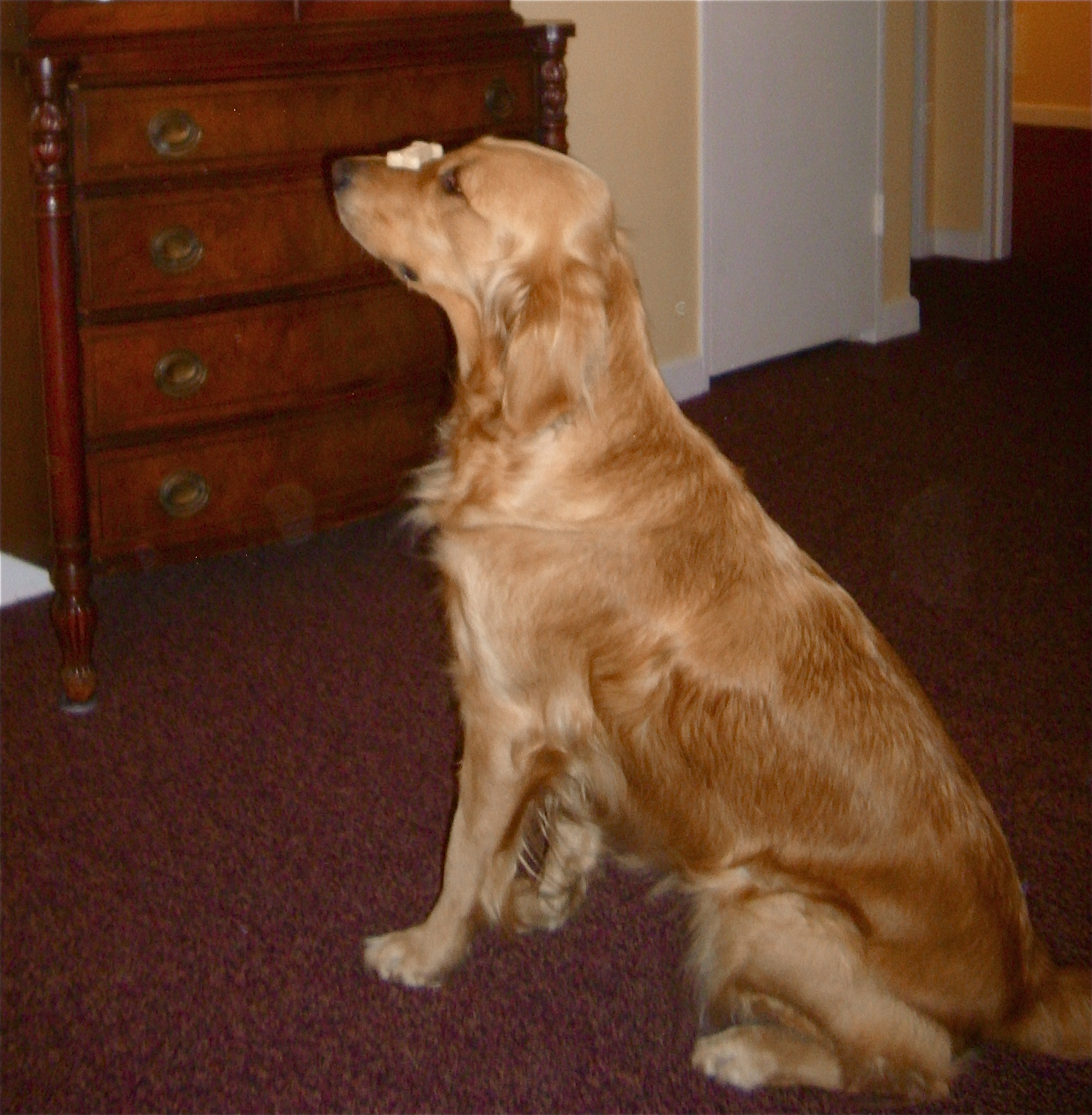
Golden Retriever with dog biscuit on nose

LILY WITH A DOG BISQUIT ON HER NOSE. NOT A PROBLEM. LILY KNOWS HOW TO SIMPLIFY THIS SITUATION.

My first encounter with simplicity came in a chess game, when I was a boy.

Sometimes I found myself on the defensive. My opponent had the momentum, I was constantly reacting to his moves. I needed a “game-changer.” When I could see no better option, I resorted to simplification.

In chess, I learned two quick ways to simplify. A player can “castle,” which is the only gambit in chess that allows you to move two pieces at once. Your king switches places with one of your rooks. This allows your king to escape immediate pressure, and possibly creates a whole new dynamic on the chess board.

The other way to simplify in chess is a last resort. You “exchange” pieces of equal value. For instance, you take your opponent’s knight, knowing that one of your own knights will be captured. You sacrifice your knight for your opponent’s, and both knights are removed from the board. The result is a “simplified” game, perhaps working to your advantage.

If the exchange involves the most powerful chess pieces, sacrificing a queen for a queen, the result can be dramatic simplification. Without the queens, the players may be reduced to a frustrating game of attrition, possibly leading to stalemate rather than checkmate.

lilly

In real life, as in chess, you often have to give up something in return for simplification.

I can choose a new major in college; fire my boss (i.e., quit my job); end a friendship or relationship. I can give up a hobby or recreation that takes time away from responsibilities; change a harmful habit or behavior, improve my diet, quit smoking.

As in chess, I may have to give up something, sacrifice something.  Changes usually require thought and decision-making, even discernment. Not every change leads to simplicity. Sometimes we need to make a change to challenge ourselves more, not less; to grow; to be more productive. Small changes may have greater consequences than we imagined.

Some changes can be turning points.  A career change, a marriage or divorce, a geographic relocation — all these have the power to change the course of your life.

A desire for ease or simplicity is not sufficient reason to walk away from a responsibility. Many times, life requires us to take up new responsibilities. Necessary change may make life more complicated, not more simple.

But even shouldering heavy responsibilities can sometimes simplify life. The responsibility may be greater, but the way forward may be clearer. By giving up what is unnecessary or distracting, we may be able to focus on what is important.

As the author Marsha Sinetar says, attention is power. Giving full attention to what is important is a kind of simplicity.

Simplicity is not for every person or every situation. When I study, I like to study in silence. But many people prefer to study while listening to music. People are very different in their abilities, talents, and needs. My doctor once pointed out that intelligence is like computing power. Some computers have more processing power than others. Some people can tolerate more complexity than others. Some people thrive on complexity.

I’ve often found myself working with people who have faster brains than mine. I’ve often compensated by working longer hours to keep up. This can lead to fatigue or even burnout. So I often seek simplicity, either through focused concentration, or simple lifestyle. Not many responsibilities, only one or two. Not many interests and recreations, one or two is enough.

I’ve always been attracted to simplicity. As a boy, I though Dunkin’ Donuts had an excellent business concept, and later, McDonald’s. They concentrated on a limited menu. Donuts and coffee; or hamburgers, French fries, and milkshakes. They focused on consistent quality and service.

Simplicity is not for everyone. I don’t agree with self-help gurus who say, “Everyone should do this,” or “Everyone must do that.”  You hear that everyone should meditate; the world would be better if we were all vegetarians; everyone should exercise four times a week; everyone should give up sugar and salt; everyone should use mass transportation, or ride a bicycle to work. All good suggestions, but not for everybody. People are different, and one size does not fit all.

Many people thrive on complexity.  I need to simplify in order to survive.

— John Hayden

Four Nonessentials I Hate To Quit

I’ve already written about my telephone land line and 11 other nonessentials that I’ve given up, in order to save money and live within my means.

None of them was as hard to give up as cigarettes, which I quit a long, long time ago. Of those nonessentials, I’ve relapsed on only two, which come as a package: cable  TV and internet service. I presently have cable and internet access thanks to a housemate, and it seems only fair for me to pay my share.

A few other nonessentials, I must admit, I have refused to give up so far, although I’ve cut way back on some of them. Here are four nonessentials that are particularly hard to quit:

  • Dry cleaning, I’ve always washed my own underwear and stuff, but for most of my adult life I’ve made regular use of the dry cleaning industry. Dress pants and suit coats, blazers and sweaters, even ties, I have routinely taken to the dry cleaner. This is expensive. Hence the expression, “Taken to the cleaners.” If the label says “dry clean” or “professional cleaning only,” I still must obey. But my simplified life doesn’t require me to wear fancy duds every day, so I’ve been able to cut way back on the dry cleaning.
  • Having dress shirts professionally laundered, starched and pressed.  This I used to consider  an “essential.” It was my one concession to dressing appropriately for work. A wrinkled shirt simply does not project a professional image, in my opinion. No more! In the spring of 2009, I went cold turkey on pro shirt laundering. I taught myself to iron, and even tried spray starch, with varying degrees of success. For the future, I intend to buy dress pants and dress shirts that are drip-dry, and preferably require no ironing.
  • Haircuts. I refuse to give up haircuts completely. However, I get haircuts much less frequently, and go to an old-fashioned “barber,” not a more expensive “stylist.” I let the barbers cut my hair as short as they want; it makes it that much longer before I have to come back and pay for another haircut. Also, I’ve taught myself to trim the hair around my ears with a razor.
  • Coca-Cola. Not a necessity! I know this, intellectually. But as a practical matter, I’m as hooked on caffein now as I used to be on nicotine. I have failed miserably to give up Coke, or even cut down on my consumption. To me, Coca-Cola seems like an essential. The combination of all that caffein and sugar gives me a real kick. I know it’s not good for me, but I need it to get through the day. That’s my story, and I’m sticking to it. I’m sure other people have the same problem with coffee.

I surely have overlooked other expendable nonessentials. Please let me have your nominations in the comments section. Thanks.

Simplicity 101, The Blog

Remind me again: Why do we need ANOTHER blog about “simplicity?”

Everything you need to know about simplicity. NOT. The DVD cover for "The Simple Life" DVD, with Paris Hilton and Nicole Richie.

Everything you need to know about simplicity. NOT. Here's the cover for "The Simple Life" DVD, with Paris Hilton and Nicole Richie.

Is there anything left to say about simplicity — or frugality, for that matter — that hasn’t already been covered? We even had a popular TV “reality” show, “The Simple Life.” If it’s been on TV, who needs a blog?

I have a whole shelf of books about simplicity, and there must be thousands of blogs and Web sites on the subject.

I intend to add a separate page to this blog, listing and reviewing books about simplicity (when I get around to it.) In the meantime, to give you a sense of where I’m coming from, here are three of the best on my bookshelf:

  • The Greening of America, by Charles A. Reich, first published by Random House in 1970. The book was a phenomenon in its day. My friends and I passed it around, adding notes on any empty pages.
  • Small is Beautiful, Economics as if People Mattered, by E.F. Schumacher, first published by Blond & Briggs in London, in 1973. The concept that small might be better than big was innovative, almost revolutionary, at the time.
  • Graceful Simplicity: The Philosophy and Politics of the Alternative American Dream, by Jerome M. Segal, published by University of California Press in 1999. 

The Greening of America and Small Is Beautiful were groundbreaking, pop-culture hits. Nearly three decades later, Graceful Simplicity had a more subdued impact. 

As for blogs and Web sites, I intend to provide links to many that I like the best. Already, the short list in my sidebar has links from AARP to Zen.

So who needs another blog about simplicity — specifically the blog you’re reading right now, “Life After 60, Simplified?”  I really can’t justify it, except to say that it’s a matter of perspective. Once, I had an office with a window on the ninth floor. Across the street was a church and a high school. I memorized the air-handling equipment and watched the repairs on the flat roof of the church. I could read the greetings of bygone graduating classes, spray-painted on the pitched roof of the high school. I could even see the athletic field on the other side of the school. I knew that summer was nearly done when I saw the football team begin morning drills in the August heat. 

The tops of the roofs of the church and the school were hidden in plain sight. I could see them clear as day, every day, because of my perspective from the ninth floor. But pedestrians on the street had not a clue about the roofs of the buildings, or the practice field beyond.  That information was not visible or knowable from street level.

What I mean to say is that this blog will offer a different perspective than most of the other books and blogs about simplicity. I’ll write about simplicity from my perspective, the perspective of a 61-year-old baby boomer.

One more thing. Many of the best books and blogs about simplicity are written by people more knowledgeable than I am. I’ll be writing about simplicity and frugality from a personal point of view. You should know that I’ll be learning about simplicity (or making it up) as I go along. Much of what I write will probably seem basic (over-simplified?) to people who have lived simply and thought about simplicity for a long time.

So you might even call this blog “Simplicity for Beginners” or “Simplicity 101.”  Other bloggers will understand this next sentence: Whether or not anyone really needs to read this blog, I need to write it.

Welcome to Life After 60, Simplified. Your contributions and comments will be appreciated.

Clarity on Health Insurance and the Public Option

Updated and revised, 07-31-2009.

The political and economic debate over health care in America is starting to clarify.

Congress is coming to the conclusion that the private health insurance industry is part of the problem. Tailoring American health policy to suit the private insurance industry makes no sense.

Health care policy should be designed to meet the needs of people and doctors, not insurance companies. Did you ever know a friend who liked fighting with insurance companies to get a claim approved? Do you know anyone who likes needing a referral to see a doctor? Do you know any physicians who like the paperwork that the insurance companies impose on doctors and their office staff? 

Finally, do you know any doctors who enjoy having the insurance companies tell them how to run their medical practice?  Do you know any patients who trust their insurance company more than their doctor?

President Barack Obama’s proposed public option is making more and more sense as an alternative for people who are sick of dealing with the private insurance companies.

Universal health care would also be a giant step toward simplifying life for millions of middle-class, working-class, and poor Americans. 

How nice it would be to accept a different job without having to give up your health insurance! What a relief it would be if, even when you lose your job, at least you don’t lose your health insurance! Your children could still go to their pediatrician, not the emergency room. Health care for all would be so . . . well, so equal. It would be so fair.

And for those of us in the graying generation, baby boomers who often find ourselves passed by in this fast-changing economy, what a relief if we at least had health insurance.

Medicare eliminated the specter of poor, elderly Americans unable to afford health care. What if we could do the same for all Americans? 

Health care is one of the essentials of life: Food, Shelter, Clothing, Transportation and Health Care. It would be so much easier to live a simple and frugal lifestyle, if essential health care was available for every American.

Thinking About Simplicity — Save Money On My Top Ten Nonessentials

Being downwardly mobile, I’ve got to keep pruning the low-hanging fruit, the non-essentials. In the last post, I cut the telephone land line and the monthly phone bill.  I’ve also whittled away at a long list of other non-essentials as I gradually scaled back my lifestyle from “affluent” to “working poor.” Here’s my top ten list (plus one):

  1. House (Apartment) Cleaning Service. Probably the most expensive of the non-essentials, and the first to go. For years, a cleaning service came every two weeks to do the necessary little chores I was too lazy to do. (Can you believe I paid for a cleaning service, even when I lived in a small one-bedroom apartment?)
  2. Vacations. I’ve never been bitten by the travel bug. Still, I used to get away for one weekend every season of the year, when I was affluent. And I usually took a real one-week vacation in the summer or fall. Now I haven’t had a real vacation in years. I acknowledge that forgoing vacations, year after year, is a sacrifice. But if I did vacation, I’d do it on the credit card, digging myself deeper into debt. Not a good idea.
  3. Cable TV. When I lived alone, I made do with rabbit ears. Cable, even basic cable, was a luxury I could easily live without.
  4. Home Internet Service. Same as Cable TV, above. Most of us weren’t even aware of the Internet a decade ago. Now we act like it’s a necessity. It’s not. I dropped it along with the cable TV, and used the free public Internet access at the library. However, when I share housing with another person, I usually split the cost of cable and internet. It seems like the neighborly thing to do.
  5. Newspapers. This was a tough one. All my life, I’ve read at least one daily newspaper. At the height of affluence, I subscribed to my local  paper seven days a week, plus the out-of-town New York Times. The bill for The Times was $1 a day, and well worth it. But The Times was obviously low-hanging fruit. It had to go. Later, I cancelled the local paper as well. The monthly saving was small but necessary. (I never thought the day would come that I couldn’t afford a daily newspaper.) I still buy ONE Sunday newspaper at the newsstand, when I’m feeling flush. Otherwise, I get my news from TV, or I go to the library and read the newspapers to my heart’s content, for free.
  6. Ice Cream. I switched from the premium Hagen Daz to an everyday brand. Since the doctor advised a low-fat diet, I cut way back on even the less-expensive brand, more to save my health than to save money.
  7. Pizza Delivery. I resisted this extravagance for a long time. (I might be too lazy to clean my own apartment, but I was willing to fetch my own carry-out pizza.) As the years went by, I surrendered to our cultural addiction to ease and convenience. Pizza delivery is handy when you have friends over and don’t cook. But my days of entertaining lavishly with delux pizzas (no anchovies or black olives, please) are over. I still enjoy pizza whenever I can, but I don’t have it delivered.
  8. Eating out. As a lifelong bachelor, I prided myself on preparing my own breakfast of cereal and a banana at home. But for lunch and dinner, I habitually patronized one neighborhood restaurant or another. I was a generous tipper, too, if I do say so myself. That lifestyle is a only a pleasant memory. Now, I look for price cuts at the supermarket, and eat almost every meal at home.
  9. Buying Books. One of my few extravagances was buying and reading new books, mostly paperback, but often enough, expensive hardbacks. When I read, I like to highlight important passages, and you can’t do that unless you own the book. It’s a luxury I can no longer afford. The public library lets me check out books for free, but frowns on highlighting.
  10. Church and Charitable Donations. Now frugality is getting serious. In the affluent days, I sent checks several times a year to favorite charities (soup kitchens, disaster relief, and the like). There came a day when it seemed that I needed the money as much as the charities did. Next, I reduced my weekly church contribution  to an embarrassingly small sum. Lately, I’ve been skipping church contributions entirely, and feeling guilty. I’m determined to return to my habit of small donations to church soon, but not this week.
  11. Bottled water. This is my most recent economy. For years, I carried a bottle of spring water with me everywhere. I still buy bottled water by the gallon for use at home. Our well water is OK for showers and laundry, but not for drinking or cooking. But thanks to a handy, 27-ounce stainless-steel canteen, I no longer buy those outrageously expensive small bottles of water. See, I fill the canteen free, with tap water at work, or from the gallon jugs at home. I still carry water everywhere, but I’m saving money, and with no sacrifice.

There you have it: A list of non-essentials I can live without, and save money. Please add your own suggestions for saving money on low-hanging fruit under “comments.”

Much more to come on adjusting my lifestyle from affluent to working poor. Simply cutting the low-hanging fruit was not nearly sufficient to balance my budget. Soon, we’re going to take a hard look at the essentials.