Unknown's avatar

About Editor (Retired)

Newsman, blogger, editor, writer (and no longer young).

American Debt Crisis: Many Questions About the Future of American Democracy

The first battle of the American Debt Crisis is over. Perhaps the deciding battle will be fought in the 2012 elections.Everyone’s focused on the outcome of the presidential contest, but control of the House and Senate is at least as important.
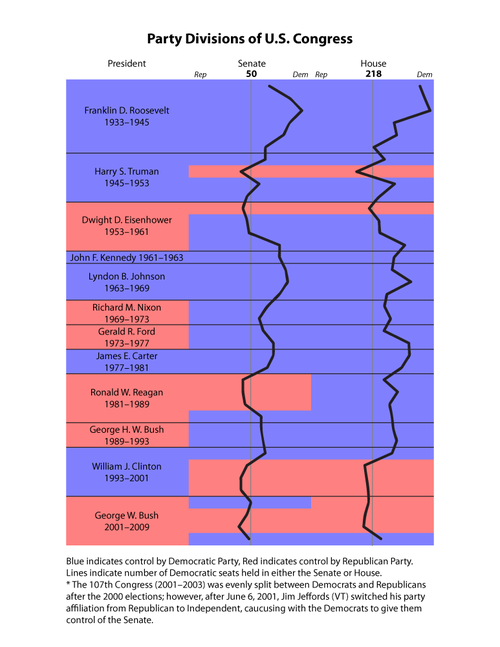
IN 2011, NEARING THE END OF THE FIRST TERM OF PRESIDENT OBAMA, CONGRESS IS SPLIT. REPUBLICANS HOLD A MAJORITY IN THE HOUSE OF REPRESENTATIVES, AND DEMOCRATS HOLD A MAJORITY IN THE SENATE. Graph by Mattbot69 via Wikimedia Commons

Questions:

  • Is America now a three-party nation? Tea Party, Democratic Party, Republican Party? Which party, if any, will dominate the 2012 Congressional elections?
  • Will another party emerge? I’m thinking it might be called the Christian-Democratic Party. I think the Tea Party is clearly out of touch with bedrock Gospel values. The Democratic Party in America, oddly enough, more nearly reflects the Gospel message, but Democrats are so focused on being secular that they can’t connect their policies with values.
  • Exactly how real is the “Debt Crisis?” Republicans and Tea Party people have repeated “spending problem” and “debt crisis” over and over until it has become the common wisdom. But clearly, in comparison to the situation in Greece, or the European Union, or Japan, or many other countries, the U.S. financial situation if solid. The debt is not sustainable in the long run. But is it really a “crisis” in the immediate future? No. I would call it a “serious problem,” not a crisis. Common-sense problem-solving is needed, by reasonable people, in a non-crisis atmosphere. Can we do that?
  • Who are the winners and losers? I just don’t know. Except this: the core American programs of Social Security, Medicare, and Medicaid are safe for now.
  • Misinformation abounds all around. Especially this: Politicians are purposely misleading the public regarding the prospects of jobs and economic recovery. People need to know that we have entered a new reality in a global economy, and the age of American Privilege is over.

Now I have to go to work. Maybe I’ll write more thoughts about a Christian-Democratic Party later. It’s probably not what you think.

— John Hayden

Connect The Chaos: Acedia, American Debt Crisis, Failure of Democracy

America is not in the grip of mass hysteria. It’s more like mass acedia.

Americans are jamming the Congressional switchboards with telephone calls, as political and economic chaos draws near, but what’s the message? We have no consensus for constructive action. And surprisingly, we lack even a widely shared impulse to avoid self-destructive behavior. What we see and hear is more like a combination of teen-aged indifference and childish impatience: “Do something. Do Anything. Just stop bothering me.”

Democratic processes are failing, and we have no King Solomon, no leader with the sure wisdom to know the right thing to do in the present circumstance.   Continue reading

Home is…where? (via I Heart Mondegreens)

Wow! This post makes me realize how limited my experience is, since I’ve never been anyplace but the U.S. and Canada.

Sounds like Italy, in particular, would be a wonderful place to live life, especially for people of a certain age. But how would I ever adjust to being fashion-aware?

Home is...where? This year marks the longest I’ve been away from home. More so, this Spanish summer has been a time chock-full of changes – after D-Man finished his osteopathy studies and I began working on my thesis, we had a wonderful stroke of luck and got new jobs in the city, moved into a cozy apartment by the mountains, and sneaked a trip in to Portugal for our one-year anniversary – all within the span of a month. And though I’m relieved and ecstatic that … Read More

via I Heart Mondegreens

Debt Madness Was Always About Killing Social Security (via roger hollander)

Below is a commentary worth reading. Conservative ideologues have hated Social Security from the beginning, in 1934.

Social Security is not the cause of the U.S. public debt, and neither is Medicare. To blame Social Security and Medicare is to lie! The methodic run-up of defense spending, starting in 1971, and the extension of U.S. military influence to every corner of the globe over the past four decades — those are the primary causes of the U.S. public debt, in my opinion. — John

Debt Madness Was Always About Killing Social Security Published on Wednesday, July 27, 2011 by TruthDig.com   by  Robert Scheer This phony debt crisis has now passed through the looking glass into the realm where madness reigns. What should have been an uneventful moment in which lawmakers make good on the nation’s contractual obligations has instead been seized upon by Republican hypocrites as a moment to settle ideological scores that have nothing to do with the debt. Hypocrites, because their rad … Read More

via roger hollander

America: What I Believe In 2011

Image via Wikimedia Commons

(Please click on “comments” at the left side of the title for an interesting back-and-forth between polar opposite points of view.)

The deadlock over raising the debt limit seems almost like a clash of religious beliefs. The two sides hold different beliefs. The deadlock has helped clarify my thinking about what I believe. Maybe this debt crisis of 2011 will help us all clarify who we are, and what we believe.

Image via Wikimedia CommonsI believe that Social Security, Medicare, and Medicaid are the best part of America. I believe that without Social Security, Medicare, and Medicaid, a large part of the American population — more than half the people over 65 — would fall into hopeless poverty.

Some people believe it would be impossible to balance the American budget without deep cuts in Social Security, Medicare, and Medicaid. I believe that America is still, right now, the most prosperous society the world has ever known. I believe that America can afford Social Security, Medicare, and Medicaid.

I believe it would be fair for the most prosperous among us — those with incomes of $250,000 or more a year — to pay a little more in taxes for the good of America. These people have prospered in America. They live the good life. Aren’t they patriotic enough to want to keep America strong? I believe they ARE patriotic and willing to help. It is inconceivable that they could be otherwise.

Some politicians say they oppose any tax increase because a tax increase would “destroy jobs.”

I don’t believe it. How would a modest tax increase destroy jobs? The president is not talking about making rich people poor. He’s talking about a modest tax increase on incomes over $250,000. How exactly will that destroy jobs? Will people earning $250,000 or more even notice a small tax increase? Will a small tax increase change their way of life? I don’t think so. Some may believe otherwise.

I believe there are other ways to balance the American budget. I believe we are spending far too much on a worldwide military presence. I believe we do not have to be fighting foreign wars in Iraq, Afghanistan and Libya. I believe we could drastically reduce foreign military spending, pull American soldiers out of harm’s way and closer to the North American continent. We could reduce defense spending by perhaps a third, and still have a military that is by far strong enough to defend the North American continent.

I simply cannot understand why anyone would want to destroy Social Security, Medicare and Medicaid. I believe the vast majority of Americans support these programs. I believe that common-sense cuts in general government spending and defense spending, combined with a small increase in taxes on the most fortunate among us, would bring the American budget into balance.

What do you believe?

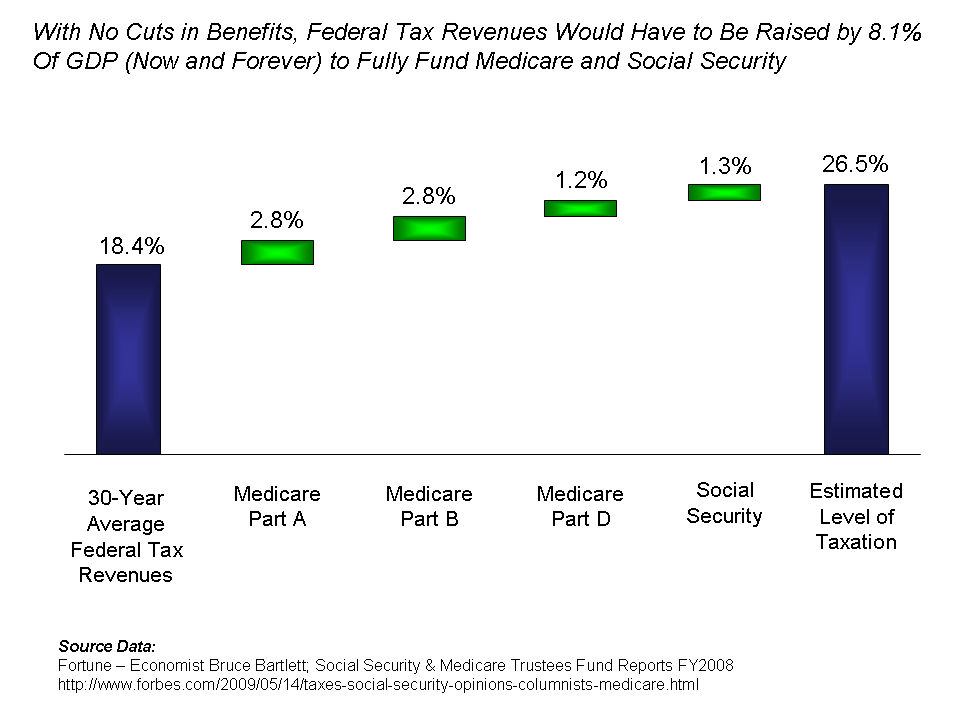
THIS CHART PUTS THE FINANCIAL CONDITION OF MEDICARE AND SOCIAL SECURITY IN PERSPECTIVE. BEGGING THE QUESTION: IF MODEST CUTS WERE MADE IN U.S. SPENDING ON GENERAL GOVERNMENT AND DEFENSE, AND SOME EFFICIENCIES ARE FOUND IN MEDICARE AND SOCIAL SECURITY, THEN HOW MUCH WOULD STILL NEED TO BE RAISED IN TAXES? Chart via Wikipedia

Keep the faith.

— John Hayden

Wildcat Debt Strike in Autumn of 2011

At rock bottom, the interlocking political and financial structures of the U.S. are based on trust. Recently, a string of financial failures has shaken the credibility of the U.S. political-financial-industrial complex, resulting in a rapidly spreading failure of trust.

PRESIDENT BARACK OBAMA, Wikimedia Commons photo

Trust is frayed to the point where, at the end of this week, Speaker John Boehner severed negotiations with President Barack Obama on raising the U.S. debt ceiling and averting financial crisis. At this point, you really couldn’t call the Tea Party a party of “loyal opposition.”

Question:  What do you think will happen when the government is forced, starting August 2, to choose which bills to pay and which bills to default on — which promises to keep and which promises to break?

Answer:  I wouldn’t be surprised if a Wildcat Debt Strike sweeps across the U.S. like a prairie fire in the fall.

Consider the events that brought us to this convergence:

SPEAKER JOHN BOEHNER, Wikimedia Commons photo

  • Strike One — The financial bubble burst, and Wall Street persuaded the pillars of the U.S. government — the Treasury Department, the President, the Congress — that the world economy would collapse without a sudden government bailout. (Presidential candidates of both parties endorsed the bailout in 2008.) Wall Street extorted billions under TARP, but continued to pay bonuses as usual to Wall Street executives.  In 2009, billions more were spent in a giant stimulus package, propping up the profits and cash reserves of corporations and the compensation packages for CEOs.
  • Strike Two — The real estate bubble burst, and banks throughout the U.S. foreclosed on mortgages, further driving down the value of houses. As people found their mortgages underwater (that is, the mortgage is worth more than the house), they considered whether or not to continue making the monthly payment. Some homeowners lost jobs and were unable to pay; some calculated that it made no sense to throw good money after a bad house. It is now widely accepted that people can and will walk away from a mortgage.  Banks are not willing to modify impossible mortgages, and debtors are not willing to pay impossible mortgages.
  • Strike ThreeThe debt bubble bursts. That comes in August, if the U.S. government decides not to pay its bills, especially its obligations to individual American citizens.

It’s all reciprocal, isn’t it? I’ll play fair with you as long as you play fair with me. As long as my house has value, I’ll continue to pay my mortgage. As long as you pay me, I’ll pay my debts.

Everything depends on our belief in the myths that George Washington will own up to cutting down the cherry tree; and that Abe Lincoln will walk six miles to return a penny.

The entire system could come undone in a cascade of individual decisions to hoard cash and ignore debts. When the government refuses to pay someone — whether it be a Social Security beneficiary, a veteran, a bureaucrat, a soldier, or a Medicare bill to a hospital — that someone will in turn refuse to pay an obligation.

The autumn of 2011 might deteriorate into a general Wildcat Debt  Strike, with individuals following the government into spontaneous default on taxes, mortgages, car payments, and most of all, credit card bills.

— John Hayden

American Debt Crisis: The Black Swan Is Circling Washington

Another update on the Debt Crisis of 2011.

An ominous Black Swan is circling Washington, D.C., like a vulture, watching and waiting as the wise men and women of Congress argue over whether to resolve the Debt Crisis of 2011. Or not.

This is the most dangerous situation in Washington since the Cuban Missile Crisis of 1962. I was in Washington on the weekend of the Cuban Missile Crisis, and I remember it well. We didn’t know how close we came to the brink, until it was all over.

This Debt Crisis is surreal. The Cuban Missile Crisis was loaded with live ammunition. The Debt Crisis is loaded with stocks and bonds and hundred-dollar bills. No one knows what will happen if we pile up a lot of stocks and bonds and bills, and set off an uncontrollable chain reaction of unpaid debt. Never been done before. But we are about to go there.

There are three major schools of thought regarding the resolution of this debt crisis. You have your big fix, valued at around $4 trillions, and your little fix, $1.5 trillions to $2 trillions, give or take. (Or is it billions? I can never remember.)

And defying all logic, there is the “no fix” option, supported by the gentlemen and gentleladies from the Tea Party. (What kind of tea are they smoking at that party? Can I get some?)

Translation: Some folks want to fix the debt crisis for the long-term, so Congress can get on to other business.  Some folks will settle for a short-term solution. And some want to commit economic suicide on Aug. 2, rather than risk the chance of possibly serious complications down the road.

Hoo-boy! You think the rich and powerful are anxious about a little economic uncertainty? How are they going to respond to total economic chaos?

Remember the Black Swan? It’s a highly improbable disaster, resulting in unpredictable consequences of a catastrophic nature.  Have a nice weekend.

— John Hayden

American Debt Crisis: Children Playing With Dynamite

The words and events of the past few days give me the gut feeling that too many of America’s current political and business leaders are not mature adults, not capable of being serious or working responsibly.

Too many members of Congress seem to think the U.S. government is all a big game, and the winners are the ones who get the most political contributions, and the ones re-elected the most times. They don’t act as if they understand that the government and the economy of the United States are matters of real importance. Instead, they act as if they’re in a reality show on a fictional island, where there are no serious consequences, and the only goal is forming alliances, talking with bravado, and gaining fame.

Too many politicians appear childish, not mature, focusing only on themselves, like a two-year-old would, and on the interest groups that pull their strings. They don’t appear to have developed the capacity to care about the needs of  others, and by others I mean the millions of real people scratching every day to earn a living, support their families, cope with illnesses.

Too many politicians seem always to put themselves and their special interests first; the needs of the larger community are of no interest to them. The needs of others be damned, the needs of the nation be damned. It’s all a game. It’s all about me and my little circle of friends.

Who Speaks For The People?

Today, Dispatches from ConsterNation publishes a guest post by Judy Davis:

Since the election of Woodrow Wilson in 1912, the Democratic Party has used our government to make laws which have improved working conditions, provided elderly support, promoted racial equality, protected the environment and addressed other social concerns. Wilson established the Federal Reserve Board, making banking safer and monitoring financial markets. The Clayton Antitrust Act allowed workers to petition for better working conditions, shortened work days and initiated child labor laws.

Franklin Delano Roosevelt’s “New Deal” programs provided relief, recovery and reform to ease the Great Depression. FDR is responsible for initiating Social Security, which provides Old Age, Survivors and Disability insurance. Through FDR’s efforts, the U.S. Bureau of Reclamation increased water development facilities in the U.S. and provided work for the unemployed.

What do these two leaders have in common? They were Democrats!

John Fitzgerald Kennedy established the Peace Corps and negotiated a ban on nuclear weapons testing with the United Kingdom and Soviet Union.

His successor, Lyndon B. Johnson, passed numerous socially significant programs, including the Civil Rights Act of 1964 and “The War on Poverty” – Medicare, Medicaid, Head Start, Work Study and food stamps.

Jimmy Carter is a human rights advocate and has worked to promote peace in the Middle East and limit the number of nuclear weapons. He encouraged energy conservation to ensure an energy-secure nation.

Bill Clinton passed the Omnibus Budget Act, which cut taxes for 15 million low-income families, made tax cuts available to 90 percent of small businesses, and raised taxes on the wealthiest 1.2 percent of taxpayers.

President Barack Obama has regulated banking and credit cards, extended health and unemployment benefits, implemented hate crime legislation, passed an economic stimulus package spurring job creation, modified bankruptcy terms, reinforced Iran sanctions, and reformed health care. No small feat for less than 2.5 years!

“Each time a man stands up for an ideal, or acts to improve the lot of others, or strikes out against injustice, he sends forth a tiny ripple of hope.” — ROBERT F. KENNEDY,  from www.democrats.org/issues.

Democrats speak for the people! We are responsible for each other and should provide the safety nets needed to ensure basic rights for all.

— Judy Davis

Shock and Awe Kindness (Inspired by Kermit the Frog) (via yearofkindness)

Two reposts in a row! But you have to admit, I repost good stuff.

Here I am, feeling a bit frustrated because I don’t have time to write as much as I think I should. And instead, I’m reposting a second great post in a row from another blogger. But honestly, these two posts are more meaningful and more real than anything I’m likely to write about politics or simplicity. I write like a reporter, from my own personal knowledge and observations; they write about the good ideas they got serious about and turned into real actions. The world needs reporters, I guess, but what this “can’t-do” world needs most is doers.

To paraphrase the Bible, as best I can from my faulty memory, “You will know them by the fruitfulness of their actions.” — John

Shock and Awe Kindness (Inspired by Kermit the Frog) Dear Kindness Recruits, In preparation for Wednesday’s 100 Days of Kindness mission, I must tell you something. Sometimes being kind is a bit like being green – it’s not always easy and people often give you very strange looks. But this only proves even more just how much the Kindness Revolution is a cause worth fighting for. We live in a crazy, mixed-up world and it’s up to kindness crusaders like us to remind people that it’s not all gloom and … Read More

via yearofkindness